

Never give up (control)! Never (cognitive) surrender!
Podcast: Play in new window | Download
Subscribe: Apple Podcasts | Spotify | Amazon Music | Email | TuneIn | RSS
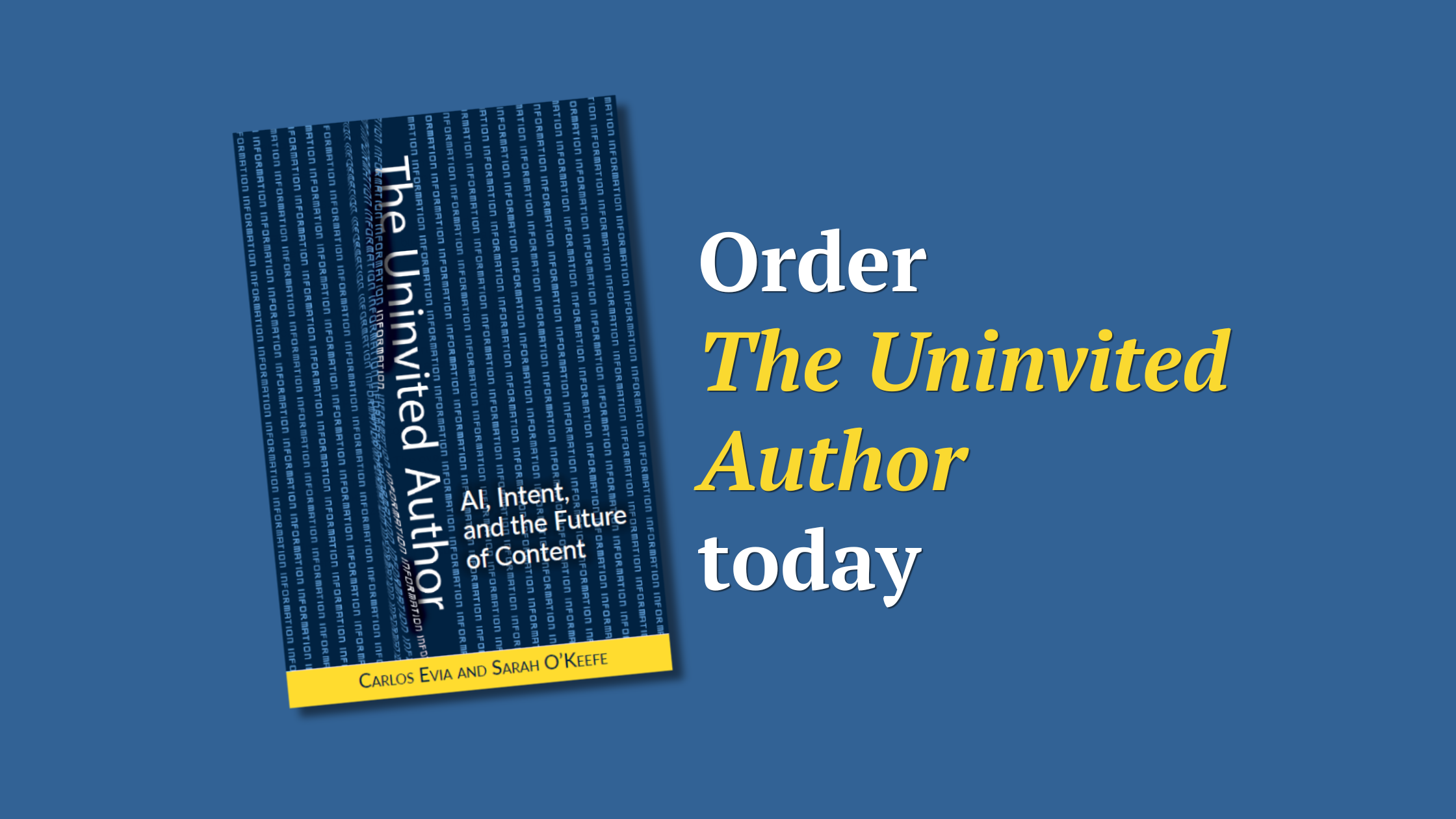
In this episode of The Uninvited Author podcast series, authors Sarah O’Keefe and Carlos Evia discuss their use of AI in creating the book. Key insights are that AI was never permitted to lead, only follow. Carlos also touches on the idea of cognitive surrender—he is opposed to it.
Related links:
- Check out other episodes in The Uninvited Author podcast series
- Buy The Uninvited Author in the Scriptorium store
- Read about our AI process (PDF link)
LinkedIn:
Transcript:
Disclaimer: This is a machine-generated transcript with edits.
Introduction with ambient background music
Christine Cuellar: From Scriptorium, this is Content Operations, a show that delivers industry-leading insights for global organizations.
Bill Swallow: In the end, you have a unified experience so that people aren’t relearning how to engage with your content in every context you produce it.
Sarah O’Keefe: Change is perceived as being risky; you have to convince me that making the change is less risky than not making the change.
Alan Pringle: And at some point, you are going to have tools, technology, and processes that no longer support your needs, so if you think about that ahead of time, you’re going to be much better off.
End of introduction
SO: Hey everyone, I’m back again with Carlos Evia. Hey Carlos. I am good. And we are in our ongoing series about The Uninvited Author and content in that book. Today what we wanted to do was talk about our process and specifically the tool stack that we used to put this book together and our AI usage or lack thereof, because it turned out that lots of people wanted to know how you got this thing out awfully fast. So did you just, you know, did you just
Carlos Evia: Hello, how are ya?
SO: generate it with AI? Did Chat GPT really write this book? You know, what’s going on here? So Carlos, let’s start with the tool stack. What was the what was the formatting process and what was the production process that we used?
CE: Mm.
CE: Well, as you can imagine coming from us, and I know that the three listeners who know us know that the one thing that we have in common, there are some other things that we have in common. with gen Xers from the same era of 1970-71. But we
SO: We’re within six months of each other’s age and we’ve had some arguments about who’s older due to our inability to do math.
CE: Which we have already decided, yes. I think the thing that creates a common platform for us is that we both have been working for decades on the Darwin Information Typing Architecture standard with Dita. And that that’s how we started to chat. And we started chatting about DITA, and you came here, I invited you to talk to my students.
Probably I don’t even know how many years, eighteen years ago, something like that. And you came, you were very generous. Well, maybe you were you were a baby, you came with your kindergarten class. And we have been involved with the development and implementation and adoption, particularly you with learning data and the work that I do in my courses here at Virginia Tech, but also the work that I did for the DITA Technical Committee on the
SO: Not possible. I’m only twenty one. Yep.
CE: How the sausage is made when it comes to the standard. So it was a no-brainer that the book was going to be written according to the Darwin Information Typing Architecture standard. So we started writing in a Google document, and we were putting some ideas and making a bit of an outline. And then we decided we need to move this party to DITA. And the editor that we decided to use, which we have been using both of us for many, many years. And we have very good friends in Romania who are in the Synchrosoft company. We use Oxygen editor. And we were writing our topics in Oxygen. And UK assembled a repository as a Git repository. And we started committing things to it. And before we knew it, we had a a DITA map that started compiling those topics. And the monster started growing and we completely abandoned our Google document at one point. We had an and and it was a Chat GPT or Gemini. I don’t know who you prompt who. I say who for the little Ms. What’s wrong with me? I don’t know what you prompted. I think it was Gemini, right?
SO: yeah, we we had a plan. It was very pretty.
SO: I actually I think so, but I don’t remember. But we made this outline and it was really great, but it got overtaken by events because it was far, far, far more efficient to redo the outline as the DITA map because that gives you essentially a view of your table of contents. So we could just move things around there. there were repeated you know, it’s interesting because DITA usually people go into DITA for reuse.
We did not have reuse. We we, it’s a book. It goes from A to B to C to D, as books do. And so we didn’t actually have reusable objects of any sort. But what DITA bought us was really two to from my point of view was really two main things. One is that one is Git, the ability to put the files under source control and manage them. So we could have done this in a sort of manuscript workflow with something like Word or Google Docs and shared files, but it was actually much, much more efficient to have everything stashed there and broken up into topics, which implied that if I was working on the first topic in chapter one, Carlos could be working on the second topic in chapter one. And we only occasionally had collisions, merge conflicts.
CE: Mm-hmm.
CE: Mm-hmm.
SO: ask me anything about how to clean up merge conflicts for text. I have done many, but but it worked really, really well. And it gave us the ability to keep track of what we were doing, easily see what the other person had done, right? Numerous times I would pull down updates that Carlos had made and would actually look at them and I could see what was added and subtracted. You know, it’s all color coded, it’s all there in
I was using source tree. I don’t know about you. Yeah.
CE: I was using SourceTree 3 as my as my client. And I want to acknowledge that indeed one of the most awesome things that you do, you did a lot of awesome things for the book, was fixing whenever we had a merge conflict. I will send you a panicky message Friday at six PM and you were at a hockey game or wherever you were and I was like, Help and you will go and fix the merge conflict so we could continue working on our
SO: Ha.
SO: But it was fine. a lot of the merge conflicts were just they they weren’t actual conflicts. It just got confused. And so that that worked out really well. But so fundamentally there were two things that DITA up bought us and merge conflicts was one. Git and source control. Version control was one of them. I think there was only one instance where I, in resolving a conflict, did you know, deleted like a sentence that had crept in there because we had essentially modified the same paragraph at the same time in very close to the same way, which was helpful. But the second thing was that it bought us formatting automation. I had several people recently asking me, well, how long did it take to produce the book? Right? From and so there was this idea of we wrote it in Word, except we didn’t, but we wrote it in Word, and then there was the step of getting it print ready. Well, we didn’t have it print ready from day one, but we did have a draft print output, a PDF output from day one. It looked like a book, it was paginated, it looked respectable. And then over time, as we no, not we, as the Scriptorium people, particularly Melissa [Kershes]. was making updates and changes and fixes to the formatting, but that was on a separate, also source controlled work stream. So I would get updates there and would just rerun the book. So the conversion from DITA to PDF took in the vicinity of like four seconds to run. You know, because it was on a command line and all I had to do was up arrow and hit return and it would go. and I did that I mean
SO: It must have been every 20 minutes on occasion, just as as updates were flowing in and we were making changes and things were moving around. And so when we got to the point of this needs to go to print, we need to deliver it to the the print vendors, which is all print on demand. So they wanted a PDF in a particular format, essentially, with particular settings. It took not very long at all. I mean it was just a matter of rerun the transform and get your final print output. Now, the one hiccup was that I was running on an open source stack using FOP, which is a PDF rendering engine, and we have licenses internally for Antenna House, which is a commercial PDF rendering engine, but I don’t have one of those. So I was running on FOP and when we got to the point where we wanted the really good PDF output, I had to hand it over to Melissa.
SO: But same issue. She pulled down all the files, the source files, and she had the transform and she ran it. And so now it takes then it took like ten minutes because of the issue that I had to tell her I needed an output and she had to post it back to us instead of me just running it here.
CE: But you know, one of the things that I want to emphasize is that those FOP transformations that happened literally in four seconds and you were building those in your computer as we were having our frequent online meetings allowed us to have a constant and continuous process of peer review. something that from day one we decided is that the book was not going to be just Sarah and Carlos talk about the world and solve all the problems without anybody else making comments about it. So we assemble a team of friends and collaborators in industry and academia to review what we were writing. And as we were creating sections, as we were assembling specific parts or chapters of the book, you will make that decently looking PDF, which was by no means the final version.
And we will share that with our reviewers and then we use Google Drive to compile those versions. And we will just go and address the comments as soon as we received. And that created what I think was a very effective cycle of we write something, it’s ready to be shared with the peer reviewers, we send it out, we wait for the feedback, but at the same time we continue to work in new sections and new chapters, and we incorporate the questions, feedback, and address any issues that need to be addressed. If it needs that I run to the Virginia Tech Library to get another book, to put another citation or change a paragraph, we used we were doing that and pretty much our whole summer was running like that. You would build something, share it, we continue working, we get feedback, we address the feedback, we incorporate the changes and then we move on to the next one until we got to that point in which I think we’re done.
SO: I think suddenly we were done.
CE: And that’s when that’s when the actual building of the final version of the book.
SO: So we we collectively, I think mostly Carlos, but we collectively hatched this idea at Convex in April, late April, I think. By May we had worked out what we were going to do and a title and, you know, contracts and that kind of thing. And we released this thing on, I think, September first. So maybe it was October first. But anyway, it was about four months, which is a ludicrously short time period for anything, but especially a book, and especially a book that is not AI generated. So let’s talk about that. we for those of you that have the book or are planning to buy it, there’s there’s actually an AI disclosure in the back of the book, which I will attach that excerpt to the show notes so that you can see it. but let’s talk about what we did and did not do with AI in the process of writing this content. Things we did not do.
CE: Well, the there’s a term that I kinda like and I have been embracing in the work that I do here at the university that actually came from a report from the Massachusetts Institute of Technology and said that people get too excited to adopt AI and that they go at a fast pace. And the problem is that in some cases human beings are engaging in cognitive surrender to the AI overlords. And I was like, I don’t want to think, I don’t want to process AI chatbot, AI agent, do the thinking for me. From day one, we knew that that was not the book that we wanted to write. Because we kind of have some tiny baby reputations out there with some friends and the three people who thank you very much have purchased the book. And that was not something that we wanted to do. But although the title of the book is The Uninvited Author, also, early in the process, we acknowledged that we were writing a book about AI and content in 2026. So it was unavoidable and to a degree desirable that we were going to use AI as an assistant when it made sense. So, as I mentioned, early in the process, you prompted Gemini to create this fancy table with an editorial calendar that we used for like three days and then we abandoned and we just started typing things as we were going. It was pretty but it was really not functional. For people who know me, people who were around when I was a grad student at Texas Tech many years ago, and people who have been to my basement in my house and have seen my bookshelves with my collection of Umberto Echo books, they probably know, and again this is not even three people, they know that I have been working on this idea of a framework of intentions to expand the three intentions that Umberto Eco wrote in the limits of interpretation. At one point, I thought that was going to be my dissertation when I was a PhD student at Texas Tech, but for reasons that we can address later, I changed my topic. But I still wanted to explore that for many years.
And this is before AI. I was working with DITA and I was like, what are the intentions that a DITA map and the transformation of DITA with ditavals inject into the building process that in traditional channels we have one reader that receives material from one author? And I shelved that idea for many years. And then when we started outlining the process that for this book back in April, I realized that that was what we were going to talk about. I was like, this is what we need to be at this what needs to be at the center of our conversation here. How is AI injecting new intentions into the cycle of creating content? So there was zero cognitive surrender on that. That came from ideas that I had.
And if you take a look at the work that Sarah has been doing for many years, you will see that the life cycle of content, and particularly a life cycle of content with AI, has already been included in some blog posts from Scriptorium So there was no cognitive surrender from her part either. We were working with concepts that we had been incubating like chickens or hens. That was a horrible thing to say, but I’m okay with that. We did engage.
SO: It took me a long time to wrap my brain around this intention model. And it makes me feel better to know that you’ve been working on it since grad school, since that was a while ago. And because that I think that was really is and was really key. and and it was hard. I mean, it was hard and painful and annoying, which is how it should be to write content, right? Because if you’re gonna say something interesting or new, you have to do the work. And so we we did the work with pain and suffering. I will say that, you know, to your point, we did have a fair amount of existing content, blog posts, webinars, conference presentations, all those kinds of things. And certainly we mined those, our our existing work for drafts like I have this conference presentation over here. Let me get the transcript and turn that into an outline for a chapter. What was very interesting to me was I I tried that a couple of times. And I mean, you get a you get an outline, but fundamentally a presentation is so the the slides themselves are are effectively useless because they are just topic headings.
SO: With maybe some bullets if you get lucky. There’s not enough text in there to do anything. And fundamentally, a chapter is longer than a 45-minute presentation. It goes more in depth, it has more information in it. So even though I was able to say, take a transcript of this presentation and make an outline, that was it. Like at that point, I had to go back and look at the headings and then rewrite everything that went under them because what I got was not actually usable text. It was more like, okay, well I made these three points in this section and now I have to turn it into something that sounds like writing rather than like somebody giving a semi-entertaining presentation.
I was able to use a lot of the images, but I had to rework them because most of my presentations were delivered on dark backgrounds. So all the all the the images were white on dark, and that doesn’t work so well for a book and page output. so I had to rework that. but I thought it was interesting that we did what I think we tell people to do, which is use AI to synthesize and summarize and not extrapolate.
CE: I did have conversations, if you can call them that, or chats with mainly Claude when I had an idea that I wanted to expand and I was like propose sources. I got mad at Claude several times because again, this work that we do in our little corner of what the world knows as content is very niche to a specific population of people who work with technical or enabling content. So my friend Claude will recommend things that were from content marketing or even from entertainment content and wanted me to start looking at Netflix clicks and stuff. And I’m like, that’s not what we are writing. I don’t wanna say that I rejected everything that Claude proposed because some of those ideas I again had to go read the sources and had to go expand the material, but I did use some of the recommendations. And likewise, because as we mentioned, we wrote the book using the DITA standard. We have many components of the book that include lists and list items. And in order to keep consistency across list items, I will ask Claude or Chat GPT, can you format this properly in Dita? And here’s a snapshot of my topic, and it will do that for me. It will change the structure of some of my bullet items for parallelism and also to have the tags that we needed to make them fly. But other than that, the content is ours. And I think that the most interesting processes that happen were the sarahfication of my content and the carlosification of Sarah’s content, which goes like this. I will write something and first she will look for curly quotes and transform them into straight quotes [SO: for the record, it was the other way] because obsession, obsession, obsession. And then she will add images, which I really appreciate because I have no talent for images. And then she will tell me this doesn’t make sense. And I will go and rewrite something. And the carlosification of Sarah’s content is I’m gonna find a source to put that
SO: Well, more often it was I don’t understand this.
CE: to support the claim and put some evidence and do the APA citation of your sources and go find a book or download an article that we can find. And I was very happy that at one point Sarah was finding her own articles and saying, I found these articles that we can cite. So there you go. So I think that the real partnership came with the human beings in charge of the creation of the content and the authoring of the book.
SO: I am teachable, you know.
CE: But without a doubt, I will not I don’t want to be a hypocrite and I don’t want to be an anti-AI person and put a team full hat. I wanna say yes. We prompted AI to help us with some formatting issues and we prompted AI to have some questions on how to transform things that we already had and expand them into chapters. We accepted some of those things, but there were also things that we rejected because let’s be honest, even the smartest of AI chat button agents do not understand the complicated reticulate network of things that we call content.
SO: Yeah, it it’s I think one of the most interesting things to me, other than my rediscovery of citations and my discovery that I really, really hate APA style. and mercifully I had a contributor who was like, I’ll I’ll fix them. You just put in a URL and I’ll make it happen. And that was fantastic. Also, it was not the AI, FYI. the thing that was most interesting to me is, I mean, this is not, for either of us, our first rodeo with writing books or long form content. And we got a lot faster because of AI, but not in the way that you think. So AI helped in a couple of different ways, but in a lot of cases it got in the way. Like, you know, we tried to use it to make a schedule and it was just a hot mess. Didn’t work at all. it was very helpful actually in building graphics because Canva.
SO: Inside Canva, which I use to make the graphics, there is an AI that you can use and you can say things like change the colors of this image, and it will. So it’s an AI assistant running inside Canva that lets you use that instead of using the user interface, the buttons. and that was that was actually quite helpful because I had some issues with Canva. If you’re coming from Illustrator, Canva is a very, very different model for how you do illustration and also I’m not that good at illustrating. So but the reason that AI speeded us up was actually because it allowed us to use a voice and tone that would not have been permissible 10 years ago. So if we were writing this book or a book, not this book, because the AI wasn’t there. If we were writing a book 10 years ago, a lot of the content that made it into the book would have been labeled, you need to clean this up. It sounds unprofessional. This is too over the top. This is too snarky. This is too whatever.
SO: And because we were we are now in the world of AI, if your tone is too professional, people look at it and say, the AI wrote that. So basically, we got to be snarky because it proves that we’re not, it’s not the AI writing the content. I hope you all like snark. If you don’t, I’m really sorry. but this is like our true voice coming out, I’m afraid. And what you’ve seen from us previously with that like veneer of professionalism, that was editors forcing us to, you know, not show our true selves. And so here we are. but it, yeah.
SO: It it a lot of stuff got left in because it was like, Well, this is sufficiently demented that the AI would never come up with it. I think we should leave it in.
CE: And I think that a the combination of of traditions where we are coming from. You are your previous books obviously are very practitioner-oriented. I I have here a copy of Technical Writing 101 that I always have on my desk. And and you speak and you write in a language that is very concrete and applicable. And I have rejected
SO: And unsubstantiated.
CE: Well now you have how many pages of citations I don’t even know. in even in my previous books, books that have been for academic press, I don’t think I write in a very complicated ivory tower approach. And that’s my work. I do things that try to bridge, I say try, I cannot claim that it’s successful, academia and practice. So
SO: About ten.
CE: And in our previous books, even before LLMs, we use [em] dashes. So you cannot blame us for using dashes just because the chatbot was writing the content, which it was not. So I think that I did not people know me and know that, you know, I don’t take things always super seriously. That one of the things that I do in my in my daily job here is that when I had to deliver bad news, I deliver bad news with the gravitas that it requires. But if it’s not bad news and if I really want to propose something that is change management, I tend to inject humor into my delivery. And my students sometimes appreciate that, sometimes don’t like it. Some of my colleagues don’t like it. But I’ve been doing this for so many years that you ain’t gonna change me. And we decided that to to present a human voice in the book, we’re going to have some silly I won’t even call them jokes, but some silly
SO: Easter eggs. I am still waiting. Hey, those three listeners that are out there, have you found the Easter eggs yet? Because send us a note. We want to know if you’ve found them.
CE: Things. Easter eggs. Yes.
CE: And we we entertain ourselves. Sarah will text me and be like, I didn’t know you spoke Tagalog, and I’m like, I don’t, but you know, we have our characters with interesting names and we found
SO: I look forward to our our one listener who actually is from the Philippines or has that background finding the inside joke that was just for them and them only.
CE: Yeah, and somebody and some we we just saw by the way, we we just came back from the Lavacon conference in Charlotte, North Carolina, and somebody came to me and said, I love Sprockey. And if you don’t know who Sprockey or what Sprockey is, well then you you have to read the book. But Sprockey is another quote unquote character that apparently has at least one fan out there in the world.
SO: Somebody picked up the book, opened it up, took one look at it, and found the section where we were talking about a particular company that was in the spirits, in the business of making spirits, and they took one look at like literally they had not read a thing. The book fell open. They looked at it and they said, Really? Gin AI?
SO: And I just looked at them and blinked a couple of times. So i I mean, fundamentally, if you don’t, in order to learn, I mean, this is more on your side of the fence than mine, but in order to learn, you have to be interested. And in order to be interested, you have to be engaged. And in order to be engaged, we wrote some really silly stuff. That’s that’s the throughline, right? It’s not that we were silly for the sake of being silly, although, well, I mean, there was some of that.
But our defense, our ex post facto justification is that it makes it more likely that people will actually read because they’re not bored. Now somebody told me, I’m not reading this, you know, can I have a summary? And I said, Well, the point of this book is to get you to think about AI. So I don’t really see how a summary is gonna help you. The summary is gonna say you should think about AI.
CE: The fancy ball.
CE: Yeah. And we also interviewed serious people. Not everything in the book I want to emphasize came from us or came from informal and non-serious conversations. We decided that if we were going to and that’s the main component that I want to emphasize. I have seen so many books in our discipline of technical content and technical communication from industry and from academia that are just like an author or authors just dumping their ideas and brains on paper without any logic and rhythm. We didn’t want to do that. So from very early on we decided that we needed to build this on the shoulders of people who have already done work on the specific fields that we were addressing or topics that we were writing about. So we invited some of our colleagues for interviews and we have a section of acknowledgments in the book that talks about all the people that we invited to talk to us and give us their insight. And we assemble a collection of quotes that made it into the book. And even if we don’t have direct quotes from some of the people that we interviewed, their ideas, their opinions, their input are injected into the book and we really really appreciate how we were able to be in a Zoom room or a Google Meet Room with some big thinkers in this domain and extract some ideas from them that then we then expanded to become sections and chapters in the book.
SO: Yeah. So fundamentally the throughline is we tried to model usage of AI in a way that we think is appropriate for the type of content that we work on. You know, when you’re working on enabling content, learning content. What does it look like to use AI in a productive way that helps you improve what you’re delivering and does not destroy your or our voice and our ideas for that matter? I mean, I don’t know how fundamentally important this book will be going forward, but we tried very, very hard to establish a couple of throughlines and a couple of high-level concepts that we believe will help carry people through this AI era. That that was our goal. And I really would like to get some feedback from the people that are reading it on whether we have actually accomplished that goal.
CE: Mm-hmm.
Absolutely. And I wanna point out that at LavaCon when I saw a stack of books that you had at the Scriptorium table, was the first time that I noticed that the spine of the book in very pretentious ways announces that this is The Uninvited Author first edition. So I just leave that open.
SO: That was I I’m gonna blame our wonderful graphic designer for that one, Jeff Crawford, who did the cover design. but yeah, I saw it and I thought, okay, you know, that sure, why not? I am hoping that we will not spend the next four months working on that, but that’ll have a lifespan of more than, you know, a week or two. All right. I’m gonna leave it there. I know we have more to say, but it’ll have to wait for another episode. So thank you, Carlos. Bye. Thanks, everybody.
CE: Bye bye, thank you.
About the author