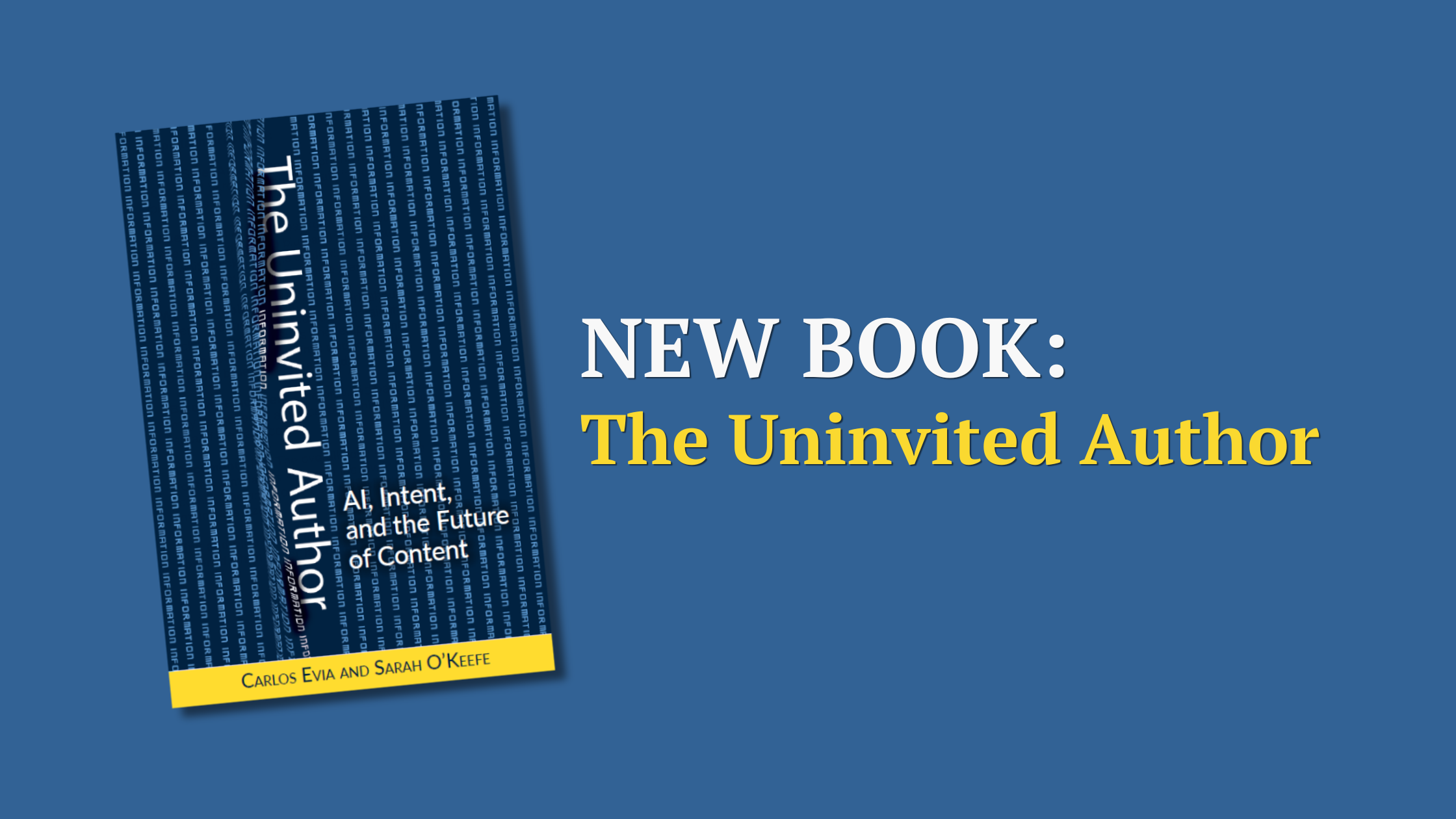
NEW BOOK: The Uninvited Author
Ready to make AI work for your content, instead of the other way around? The Uninvited Author is the guide you need.

Ready to make AI work for your content, instead of the other way around? The Uninvited Author is the guide you need.

In this podcast, Sarah O’Keefe and Carlos Evia discuss their upcoming book: The Uninvited Author: AI, Intent, and the Future of Content.
Carlos Evia: One of the things that we really want to invite people who end up reading this book to do is engage critically with AI tools across the text cycle. It’s not magic. It’s a collection of ugly computers in water-chugging data centers that work primarily on predictability approaches. And I truly think that we need to be critical in our engagement with AI as authors and as readers of content.
Our team is headed to Charlotte, NC, October 25—28 for the LavaCon Content Strategy Conference. Will we see you there?
What are the limits of automation and AI in content systems? In this episode, Sarah O’Keefe and Bill Swallow dive into traditional formatting, workflow challenges, and what happens when AI is introduced.
The limit of automation here is not really the automation. It’s the people who say, “I don’t like the way this looks, and I’m gonna find a way to fix it. I know all sorts of ways of bending this stuff to my will.” If you’re generating content at scale, you can’t afford to do any of this stuff.
Sarah O’Keefe: The working definition that I’m using is that digital sovereignty is control over your own digital assets, digital destiny. That could be you personally, it could be you as an organization, or it could be you as a country or as a group of nations. And when I say group of nations, probably 98% of the time I’m talking about the EU, which has some laws in this regard. Digital sovereignty is your ability to control, own, and manage your digital assets and how they are used, reused, processed, resold, repurposed, and all the rest of it.

In a plot twist that will surprise no one, Sarah O’Keefe and Carlos Evia are writing a book. It’s about AI. Please contain your astonishment.
In June of 2023, Sarah O’Keefe authored this white paper on AI in the content lifecycle. Three years later, here’s what’s changed and what’s still true about AI in the content lifecycle.

Get industry-leading insights from Scriptorium at these upcoming events!
With AI, users are taking control over content delivery through summarization, personalization, translation, and more. But what are the risks? In this webinar, Sarah O’Keefe, CEO of Scriptorium, and Fabrice Lacroix, CEO of Fluid Topics, explore strategies and share examples of UI for AI that empower users while protecting them—and your organization—from misinterpretation, incomplete information, and compliance breaches.
As somebody who works in structured content with metadata, taxonomy, and all those other fun things, we’re telling people, you have to do the work. You have to do the work upfront because once that ingestion step happens and the AI is ingesting not structured, not consistent, not governed, not accurate, not up-to-date content, then what chance does the AI have? The AI is not going to make your content magically more accurate. It’s not magic. I mean, it can do some magic looking things, but it is not magic. Your entropy always wins. Your content will always sort of degenerate, right? So you start for your best possible, and it goes down from there. So what’s the best possible thing that you can get into your database?
— Sarah O’Keefe
Your website may look great to humans, but can machines understand it? In this episode, Sarah O’Keefe (Scriptorium) and Tom Cranstoun (Digital Domain Technologies) explore the emerging discipline of machine experience (MX). Sarah and Tom discuss what AI agents actually encounter when they visit your web pages, why microdata and metadata are critical, and what content creators must do to ensure content is consumable for both human and machine audiences.
Tom Cranstoun: Humans are looking for pictures, they’re looking for text, and they can infer. You may think, “Well, we’ve already added information on the page,” but by putting it in as microdata, it doesn’t appear on the page for the humans. It appears on the page for the machine. I think that that’s a critical distinction. We are trying to design for both. We don’t want to overload a human with information, but we do want to give the machine as much information as it can take.
What does the content future actually look like? At ConVEx 2026, our team shared glimpses of the future and practical insights on how to prepare.
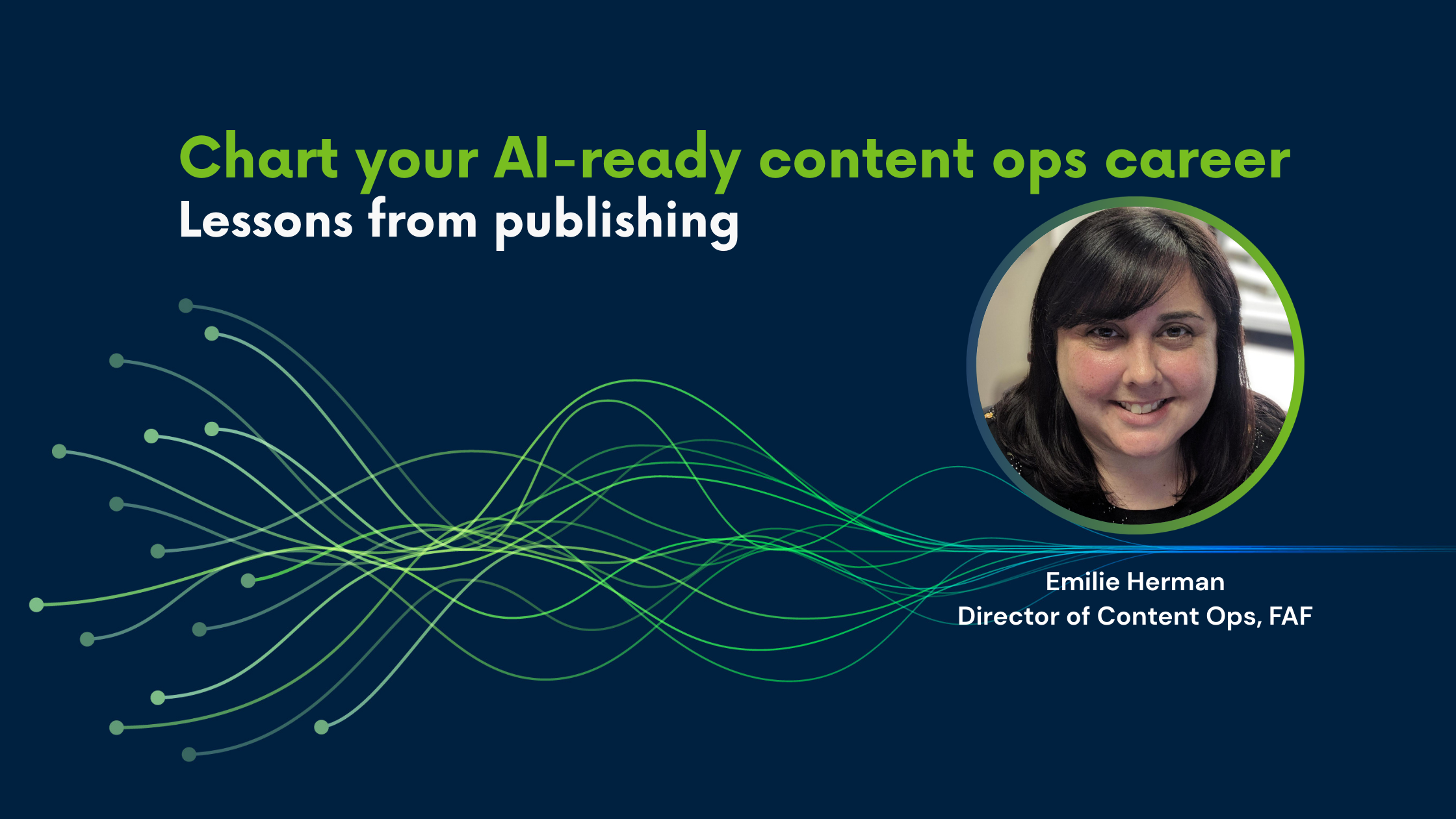
In this webinar, Emilie Herman, Director of Content Operations at the Financial Accounting Foundation (FAF), shares lessons from her career journey. Through the lens of publishing services and large-scale content workflows, Emilie shows how the shift from manual processes to automation mirrors what’s happening with AI, and how these adaptation techniques apply to your content ops career.
It’s isolating when you feel like it’s all on you to figure out how to reinvent your career. Reach out and talk to people. It’s nice to make a human connection, which is very important to get past AI, but also to look at what other people are doing. Collaborate, talk things through, and acknowledge that everybody’s trying to figure things out. People want to experiment! There’s strength in numbers. If you have a manager, mentor, or someone who can help put you in the room to be part of the discussion, you feel empowered to take control of your destiny.
— Emilie Herman

Content experience matters. We don’t often get a chance to talk openly about our clients and content experience. This time, the good experience came to us AS THE CLIENT, and it was so good that we have to share.

Ready to futureproof your content operations? These upcoming events have the insights you’re looking for!
As AI adoption accelerates, accountability and transparency issues are accumulating quickly. What should organizations be looking for, and what tools keep AI transparent? In this episode, Sarah O’Keefe sits down with Nathan Gilmour, the Chief Technical Officer of Writemore AI, to discuss a new approach to AI and accountability.
Sarah O’Keefe: Okay. I’m not going to ask you why this is the only AI tool I’ve heard about that has this type of audit trail, because it seems like a fairly important thing to do.
Nathan Gilmour: It is very important because there are information security policies. AI is this brand-new, shiny, incredibly powerful tool. But in the grand scheme of things, these large language models, the OpenAIs, the Claudes, the Geminis, they’re largely black boxes. We want to bring clarity to these black boxes and make them transparent, because organizations do want to implement AI tools to offer efficiencies or optimizations within their organizations. However, information security policies may not allow it.

Generative AI + lip service to guard rails = instant free content.
The brutal reality is that content is a commodity.
We’re ready to bring you more industry-leading content ops insights in 2026! Check out these upcoming events.
Like every conference in the past few years, AI was a major emphasis at tcworld in mid-November. With around 4,000 attendees and a huge trade show, tcworld is bigger than any of the North American technical documentation events. The program includes sessions in both English and German, and attendees come from all over the world.
At LavaCon 2025, we investigated the impossible dream of customer content, uncovered the potential of structured learning content, and shared solutions to make sure your content doesn’t sleep with the fishes—or the whale sharks.

We have several industry-leading sessions lined up for the rest of 2025. Learn about our upcoming events in this blog post.

For a few months, I’ve been hearing rumors that Zoomin would be discontinued after its purchase by Salesforce.
We have several great events lined up for the summer of 2025. Here’s where you can see Scriptorium in action.

Reeling from a one-two punch of scattered and inaccessible content? Ready to transform chaotic content into a seamless user experience? I trained a scattered group of content using a combo of robust metadata and content filtering to publish player-specific rules guides. Get in the ring and find out how you can apply these lessons to your own content processes.