Check out our digital twin for Lavacon!
We know not everyone can attend LavaCon 2026 in person. If you’re attending virtually, here’s how you can get the full conference experience.

We know not everyone can attend LavaCon 2026 in person. If you’re attending virtually, here’s how you can get the full conference experience.
Is AI the catalyst that will finally bring content design and content ops together? In this episode, Sarah O’Keefe speaks with Kate Agena, Vice President of Content Design at SAP, about why fluency is cheap while meaning remains expensive in an AI-driven world.
Kate Agena: But users don’t care if content is coming from marketing, product, or whatever: they want whatever it is that they need at the time they need it. If everything is just kind of in one pile of information, that’s not going to come out correctly. So I think ops is just so incredibly important now, and content ops in particular are going to be far more important than they were.
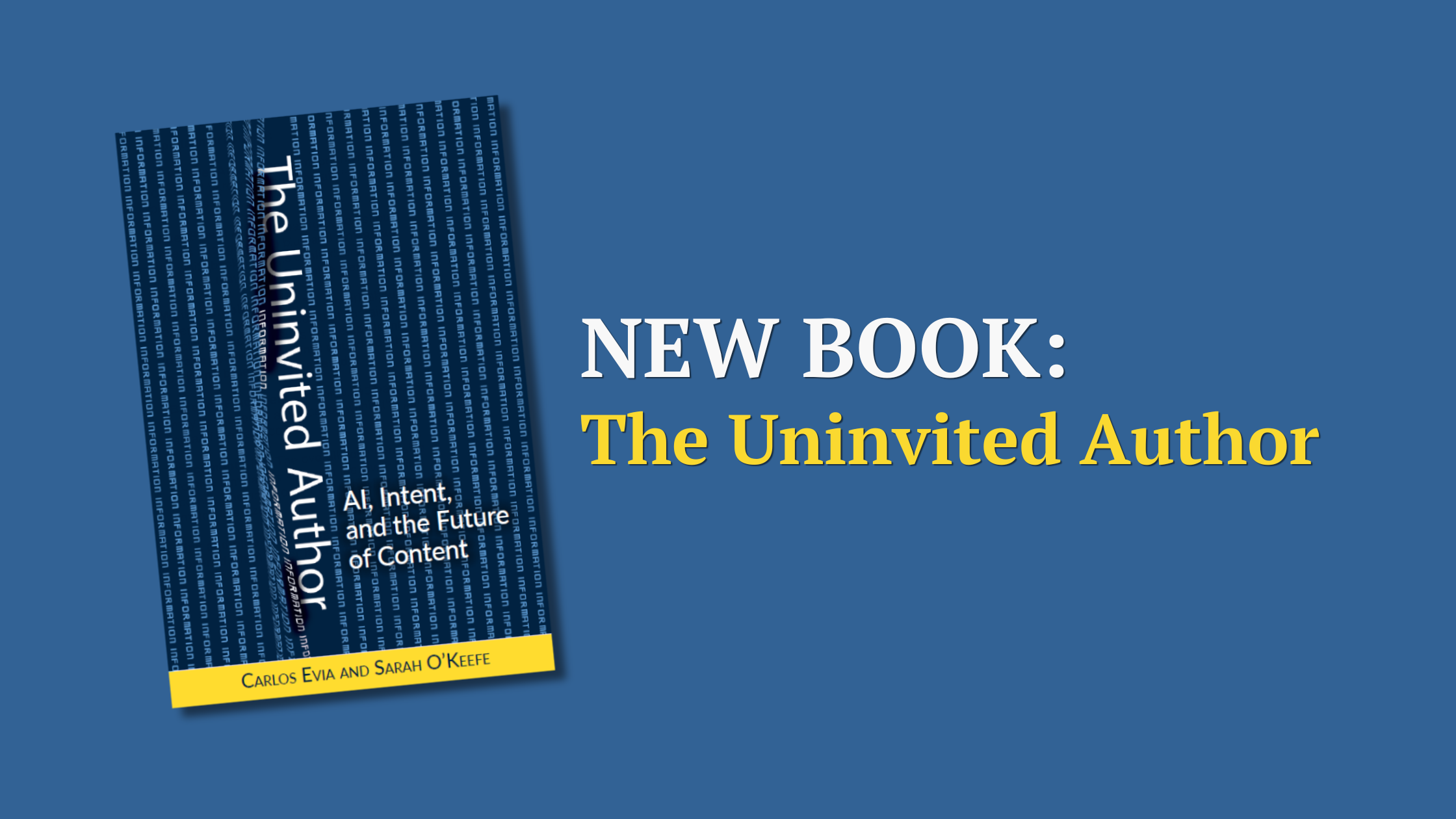
Ready to make AI work for your content, instead of the other way around? The Uninvited Author is the guide you need.
In this podcast, Sarah O’Keefe and Carlos Evia discuss their upcoming book: The Uninvited Author: AI, Intent, and the Future of Content.
Carlos Evia: One of the things that we really want to invite people who end up reading this book to do is engage critically with AI tools across the text cycle. It’s not magic. It’s a collection of ugly computers in water-chugging data centers that work primarily on predictability approaches. And I truly think that we need to be critical in our engagement with AI as authors and as readers of content.

Our team is headed to Charlotte, NC, October 25—28 for the LavaCon Content Strategy Conference. Will we see you there?
What are the limits of automation and AI in content systems? In this episode, Sarah O’Keefe and Bill Swallow dive into traditional formatting, workflow challenges, and what happens when AI is introduced.
The limit of automation here is not really the automation. It’s the people who say, “I don’t like the way this looks, and I’m gonna find a way to fix it. I know all sorts of ways of bending this stuff to my will.” If you’re generating content at scale, you can’t afford to do any of this stuff.
Sarah O’Keefe: The working definition that I’m using is that digital sovereignty is control over your own digital assets, digital destiny. That could be you personally, it could be you as an organization, or it could be you as a country or as a group of nations. And when I say group of nations, probably 98% of the time I’m talking about the EU, which has some laws in this regard. Digital sovereignty is your ability to control, own, and manage your digital assets and how they are used, reused, processed, resold, repurposed, and all the rest of it.

In a plot twist that will surprise no one, Sarah O’Keefe and Carlos Evia are writing a book. It’s about AI. Please contain your astonishment.
In June of 2023, Sarah O’Keefe authored this white paper on AI in the content lifecycle. Three years later, here’s what’s changed and what’s still true about AI in the content lifecycle.
What happens when you feed years of messy content into AI? In this episode, Bill Swallow and Alan Pringle dig into the content debt crisis, including increased system costs, neglected localization, and the fallout of “just use AI” mandates. They share practical insights to help organizations get back on track.
Alan Pringle: Is your content updated? Does it reflect the latest information? Is it created for all the different locales that your company serves? Is it in different languages? That is another pile of debt that when you start looking at AI, all the problems will be very brutally magnified, and you’re going to have to address them to really have a large language model that works at all.
Get industry-leading insights from Scriptorium at these upcoming events!
There are five levels of maturity for AI-driven content operations. Which level are you in? In this episode, Sarah O’Keefe and Bill Swallow walk through the AI content ops maturity model, from ad hoc experimentation to fully autonomous workflows.
Sarah O’Keefe: We want this automation, right? We want the ability to go in and extract release notes and do something with them. We have to have a certain level of maturity on the software development process so that we can grab the appropriate information. The same thing is true on the content side. You have to have a certain level of maturity in your content development processes, in your content management, so that you can identify the right things to process and the right things to access.
To a lot of people, the word “taxonomy” sounds intimidating. But what I want content professionals to know is that metadata doesn’t have to be painful. You don’t need to start with a blank page, and you don’t need to reinvent the wheel. The framework already exists, and it’s Dublin Core.
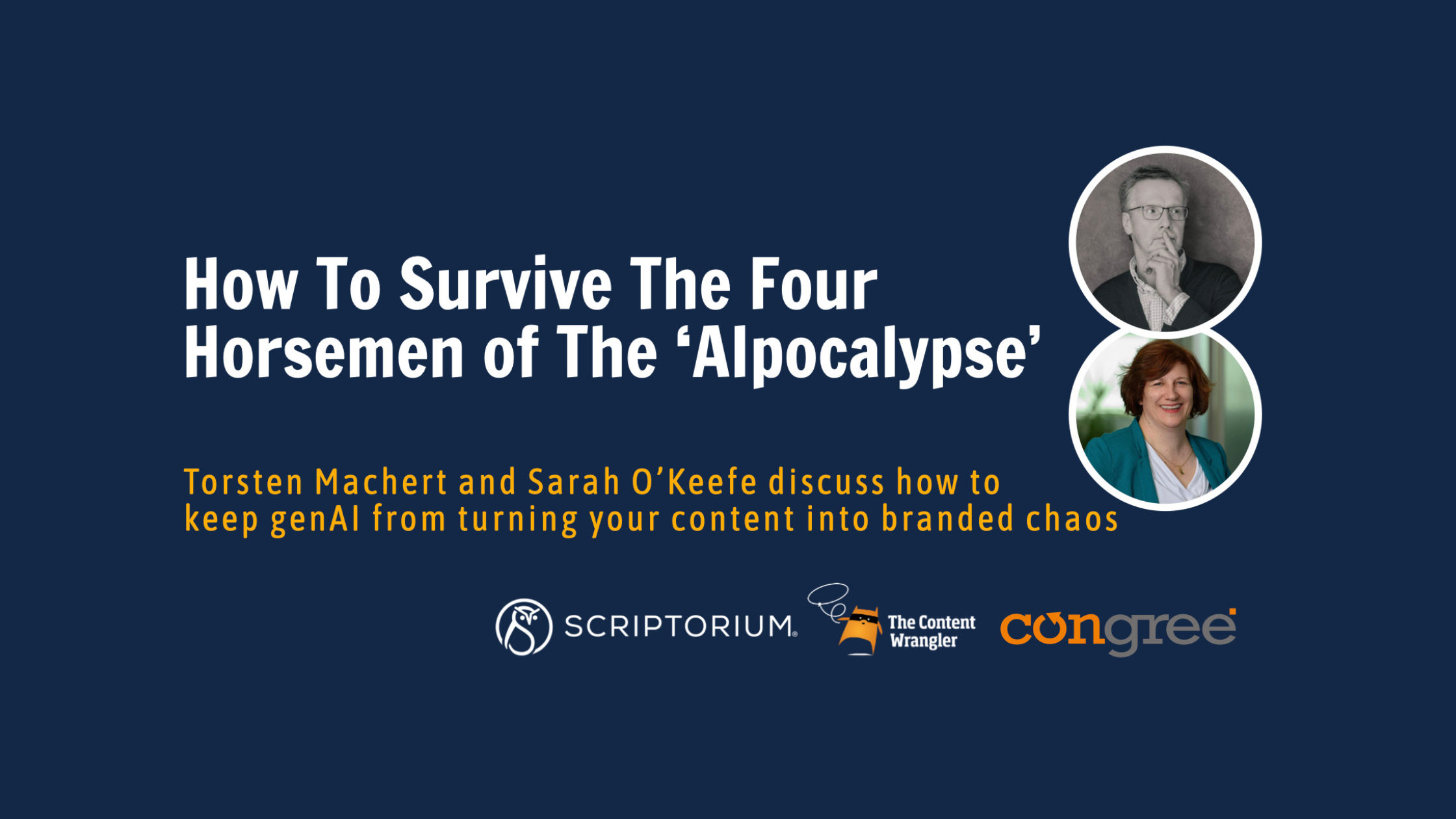
Confront the chaos that generative AI can unleash on your content and discover how to regain control. In this practical session, Torsten Machert (Congree Language Technologies) and Sarah O’Keefe (Scriptorium Publishing) revealed the four biggest threats that undermine quality when you rely on GenAI for content creation.
Sarah O’Keefe: It is way, way cheaper to build out the maturity of your content, to do the terminology work, to do the structure work, to do the metadata work, label everything, give it categories, give it classifications ahead of time than it is to try and remediate the content after the fact, after it’s been processed, after it’s been ingested into the AI and then spit back out. My fear right now is that we’re seeing a lot of, “Ingest everything, spit it back out, then consider how to fix it.”
How do you really choose the right documentation tool? In this podcast episode, Sarah O’Keefe (Scriptorium) talks with Paweł Kowaluk and Michał Skowron (Guidewire Software) about building a successful tool selection process, the realities of docs as code, and what happens when the technology becomes the unpredictable variable.
Paweł Kowaluk: It’s funny how programming used to be deterministic, and it was the people who were messy. We always knew that people are going to be whimsical and maybe harder to rein in, but the technology is going to be predictable. Whereas now, technology is not predictable anymore, and you give it a prompt and you hope it’s going to do what you want. You adjust the system prompts and change the weight of things which are retrieved versus metadata, et cetera, and it doesn’t always work the way you expect it to.
Sarah O’Keefe: And now the people are being asked to be the deterministic layer, right? To be the QA on top of the AI.
Paweł Kowaluk: That’s actually very insightful. I like that. That is true. The human in the loop or whatever you call it, that’s supposed to be the voice of reason.
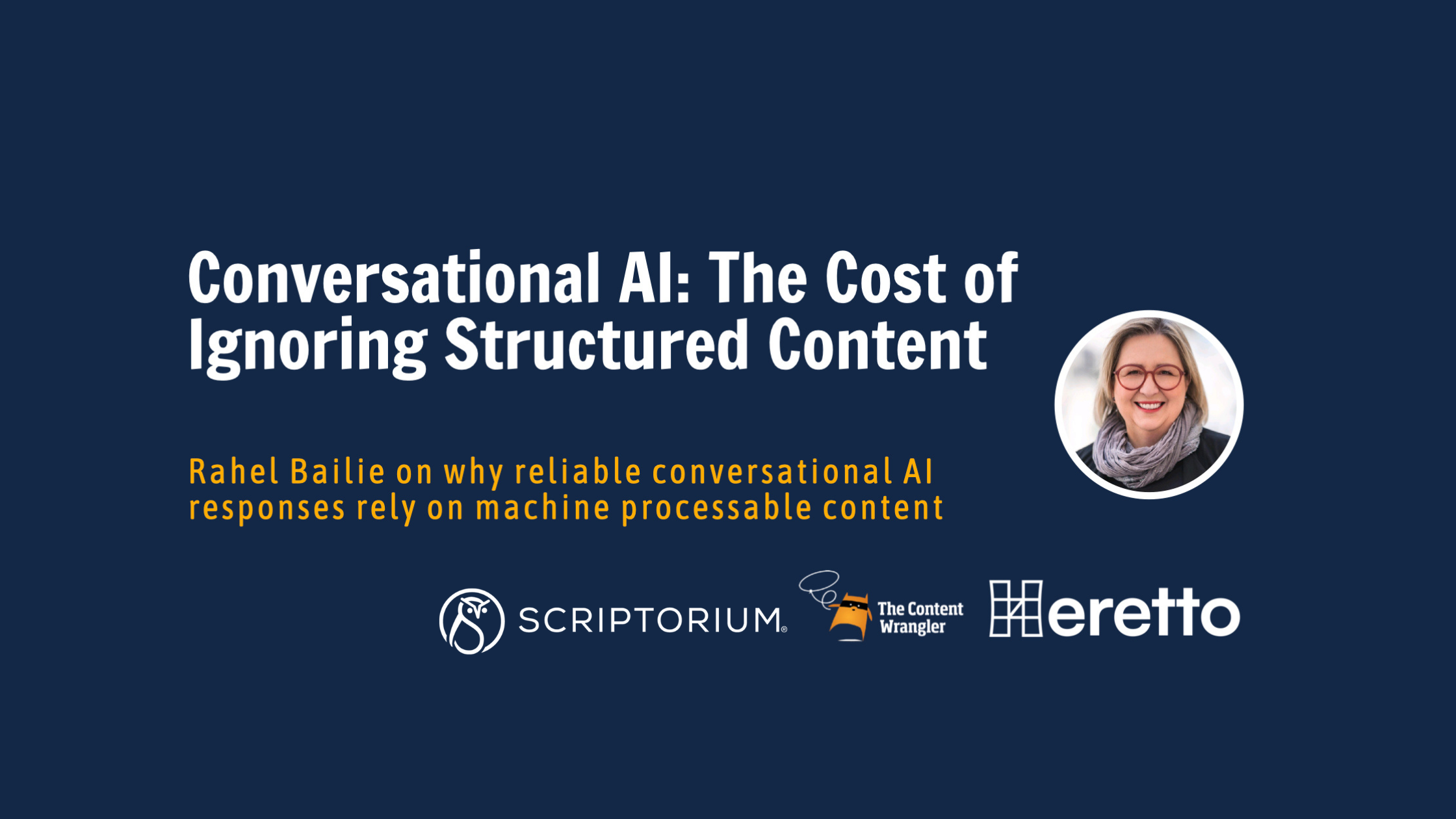
Conversational AI is everywhere, but reliable AI responses depend on reliable content. So, how do you ensure your content is reliable? In this webinar, guest Rahel Bailie, Content Solutions Strategist at Content Seriously, and host Sarah O’Keefe, Founder & CEO of Scriptorium, examined how the intersection of structured content and conversational AI has evolved. They also share practical next steps that organizations can take to create a successful AI content strategy.
Rahel Bailie: How do you know your content is ready for AI? The level 1 test is, “Is the AI agent working well?” If it’s working well, then you go to, “Why isn’t it getting the right answer?” Then, you go to the content. The content can be good or bad and can be measured in a couple of ways. Is the source content marked up well? Does it have the right semantics on it? Does it have the right metadata? Do you have a knowledge graph in the background that’s making these relationships, so that the AI can pull out the right content?
AI promises to transform content conversion, but what does it actually look like when you’re processing thousands of documents a day? In this episode, Sarah O’Keefe (Scriptorium) and Rich Dominelli (DCL) dig into the real-world challenges of using AI for large-scale structured content conversion.
Rich Dominelli: If you have millions of articles and you’re asking the AI, ‘What did we do for this project six months ago?” The AI has to find those articles, pull the relevant information out of those articles, summarize it, and hand it back to you. The best way of doing that is to give extra signals to the AI, structured relevant bits of information, front matter, back matter, publication date, keywords, abstract, that allows the AI to query the corpus and get the relevant chunks out of that corpus in a very quick manner. Then, it can summarize what those chunks are. So the AI almost becomes the user interface over that corpus. But to find that data in the first place, structured content is key. Structured content is key when you’re dealing with big indexes and the web, and it’s the same with AI.
With AI, users are taking control over content delivery through summarization, personalization, translation, and more. But what are the risks? In this webinar, Sarah O’Keefe, CEO of Scriptorium, and Fabrice Lacroix, CEO of Fluid Topics, explore strategies and share examples of UI for AI that empower users while protecting them—and your organization—from misinterpretation, incomplete information, and compliance breaches.
As somebody who works in structured content with metadata, taxonomy, and all those other fun things, we’re telling people, you have to do the work. You have to do the work upfront because once that ingestion step happens and the AI is ingesting not structured, not consistent, not governed, not accurate, not up-to-date content, then what chance does the AI have? The AI is not going to make your content magically more accurate. It’s not magic. I mean, it can do some magic looking things, but it is not magic. Your entropy always wins. Your content will always sort of degenerate, right? So you start for your best possible, and it goes down from there. So what’s the best possible thing that you can get into your database?
— Sarah O’Keefe
Your website may look great to humans, but can machines understand it? In this episode, Sarah O’Keefe (Scriptorium) and Tom Cranstoun (Digital Domain Technologies) explore the emerging discipline of machine experience (MX). Sarah and Tom discuss what AI agents actually encounter when they visit your web pages, why microdata and metadata are critical, and what content creators must do to ensure content is consumable for both human and machine audiences.
Tom Cranstoun: Humans are looking for pictures, they’re looking for text, and they can infer. You may think, “Well, we’ve already added information on the page,” but by putting it in as microdata, it doesn’t appear on the page for the humans. It appears on the page for the machine. I think that that’s a critical distinction. We are trying to design for both. We don’t want to overload a human with information, but we do want to give the machine as much information as it can take.
What does the content future actually look like? At ConVEx 2026, our team shared glimpses of the future and practical insights on how to prepare.

Hoping AI will solve all your content problems? Here are 10 reality checks for successful AI-enabled content operations.
What does it actually mean to govern your content in the age of AI, and who’s really in control? In this episode, Sarah O’Keefe sits down with Patrick Bosek, CEO of Heretto, to unpack why the quality, accuracy, and structure of your content may be the most critical factors in what your users experience on the other side of an AI model.
Patrick Bosek: In today’s world, you don’t have 100% control. There are a couple of different places where this needs to be broken up. One is the end user: what they physically get and what control they have versus what control you have. Then, there’s what control you have of how the AI model is going to behave based on your information and your inputs. Whether or that model is public, like a user accessing your documentation through Claude Desktop, or private, like a user accessing your documentation through your app or website, the governance piece comes down to what control you have immediately before the model. And that breaks down into a couple of things: completeness, accuracy, and structure of the content.
Good content fundamentals have been the foundation of effective product content for decades, and those same principles are exactly what make content AI-ready today. In this episode, Bill Swallow and Alan Pringle explain how attending to your hierarchy of content needs is the key to AI success.
Alan Pringle: Right now, AI is not going to fix bad content problems. It is going to regurgitate that bad information, giving your end users information that’s flat out wrong. If your content at the basic source level is wrong, your AI by extension is going to be wrong. And that is the unglossy, unvarnished, hard truth that is still, I don’t think, seeping in like it should across the corporate world.
Bill Swallow: It really does come back to the fact that, despite the world changing on a day-to-day basis, the fundamentals have not changed.
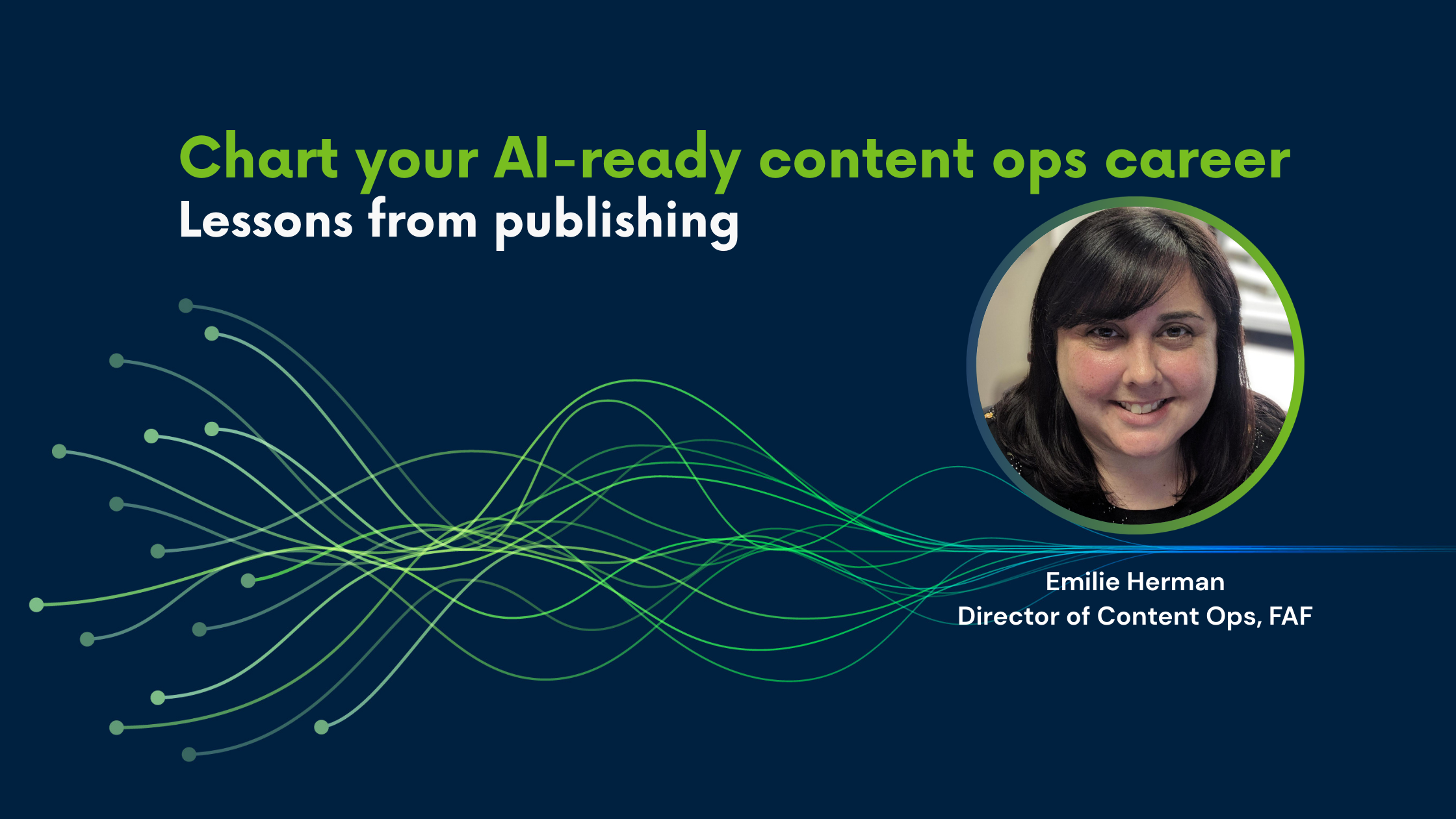
In this webinar, Emilie Herman, Director of Content Operations at the Financial Accounting Foundation (FAF), shares lessons from her career journey. Through the lens of publishing services and large-scale content workflows, Emilie shows how the shift from manual processes to automation mirrors what’s happening with AI, and how these adaptation techniques apply to your content ops career.
It’s isolating when you feel like it’s all on you to figure out how to reinvent your career. Reach out and talk to people. It’s nice to make a human connection, which is very important to get past AI, but also to look at what other people are doing. Collaborate, talk things through, and acknowledge that everybody’s trying to figure things out. People want to experiment! There’s strength in numbers. If you have a manager, mentor, or someone who can help put you in the room to be part of the discussion, you feel empowered to take control of your destiny.
— Emilie Herman