

Structured Learning Content That’s Built to Scale, featuring Becky Mann
Teams are under pressure to do more—more formats, languages, publishing outputs, and audiences. After an acquisition, CompTIA faced fragmented systems, manual processes, and time-consuming formatting. In this webinar, see how CompTIA used structured learning content operations to scale globally and meet evolving delivery demands.
Now, we have a central content ecosystem where everything connects into one spot—our CCMS—where we can actually publish in many different ways. We can do our translations very seamlessly now with our translation memory service linked in. We can publish directly to our LMS record, and we can also deploy PDFs. There’s some other little things that we’ve developed over the years. For example, we map our content to the exam objectives for our certifications. That was always a very manual process. It is now automated, which is amazing.
— Becky Mann
Resources
- CompTIA accelerates global content delivery with structured learning content (case study)
- CompTIA CertMaster training
- Get $200 off your LavaCon 2025 registration! LavaCon is a great event for networking with content professionals and finding insights from leading content experts. Use discount code Scriptorium25 during checkout.
- If you’re looking for more great content ops insights, download the latest edition of our book, Content Transformation.
- Check out other episodes in our Let’s Talk ContentOps! webinar series on YouTube.
Transcript:
CC: Hey, everybody, and welcome to our show, Structured Learning Content That’s Built to Scale. Our special guest today is Becky Mann, who is the vice president of content development at CompTIA, and our host today, as always, is Sarah O’Keefe, who’s the founder and CEO of Scriptorium.
Sarah O’Keefe: Thank you. And Becky, welcome. It’s great to see you.
Becky Mann: Great to see you too.
SO: You win some sort of an award for fun background there, and we’re going to refrain from asking you to explain what all the fun things are that are going on back there. We’ve been working together on this thing for what, two years now? I think it was previous-
BM: Yeah, it’s gone quickly though.
SO: Yeah, we had our first meeting that was like, “Hey, maybe let’s talk about this thing.” So first of all, looking at the poll that people are filling out, it looks as though most of the people on this call right now, 71%, are responsible for learning content.
BM: Yay! There’s more of us.
SO: Yes. The other 30 or so percent is evenly divided between no and not sure. So they might be responsible, but who knows? Which is that sounds like a sign of our times, right? Like, “I think, maybe, I don’t know. Maybe we have learning content. Who knows?” Could you give us a little bit of the background of where you came from? What was the before state? When you came into this situation and said, “We need to make a change,” where were you? What was going on?
BM: Yeah. A couple of years ago, we were looking to scale our operations and we were asked by our management to continue to grow both our certification business and our learning products that support that. As a global provider, we provide different types of learning depending on our different audiences. So we support e-books, we have supported print books or PDF resources, we support e-learning, and we also translate our products as well. And so we were actually looking to streamline our translation process and really struggling with that.
Here’s a little diagram of our before.
As you can tell, we were authoring all over the different places, and we actually didn’t see a finished course until we shoved it all together and were ready to deploy it for live, which makes it really hard to build an interactive, cohesive learning experience for our users. And so we were really looking at how can we streamline this? How can we know which assets are talking to each other? How can we know what’s happening before, a month before we go live? As well as just streamlining, like having a central repository for everything.
The other part-
SO: It’s so good-
BM: I was going to say though, this is only one half of the problem though because we also went through an acquisition. And so we had merged with another content provider and they had a completely different way of authoring things that was very different, a little bit more homegrown, HTML-based files, different platform that they were deploying to. And so we were like, “Okay, we have to work together. We don’t have the same systems at all.”
There was a steep learning curve and trying to figure out where things go. And so we were like, “Well, there’s a bunch of stuff we don’t like,” and we were already investigating that, and they were like, “there’s a bunch of stuff we don’t like either.” So we were like, “Let’s just throw it all out and start over,” and that’s when we started talking to you.
SO: That’s where you started. And I think that was one of the interesting things that you had. When you have a merger, a lot of times there’s conflict. I mean, even in the best merger, there’s my way and your way, and when you say, “Let’s do it my way,” what you’re actually saying to me is my way is bad, which can be a little squicky, to use a technical term. But in this case, everybody agreed that the before was not great and was united on, “Well, how do we move this forward and make it better?” which is great because it gave you an opportunity to come together.
So what were the big concerns going in? I mean, you had this thing, we called it the spaghetti diagram, and there was another one. It’s not a bad diagram. I mean, in terms of designing it, it’s not bad. It’s just there’s a lot there. So what were some of your biggest concerns going in other than, “This is broken and we need to fix it”?
BM: I mean, one of my biggest concerns is we had a mix of talent on our teams that we have very technical people. We work on networking and IT infrastructure stuff. I have a bunch of people on my team who are experts in the field, so working in technical documentation-type areas, they have no issue with that. They’re like, “Ooh, I can script something, let me do that.” But on the other hand, we also had more traditional editorial instructional designers who weren’t as comfortable with that, and then we also have to bring in contractors depending on different types of work.
So I wanted something that was scalable across the entire team, easy to use, and a clear, documented workflow that anyone on the team could follow along with.
SO: Okay, so that was before, and then I mean, we’re doing that thing, “And then a miracle occurs.” So then what’s the now? We pulled a completed thing out of the oven. What does now look like?
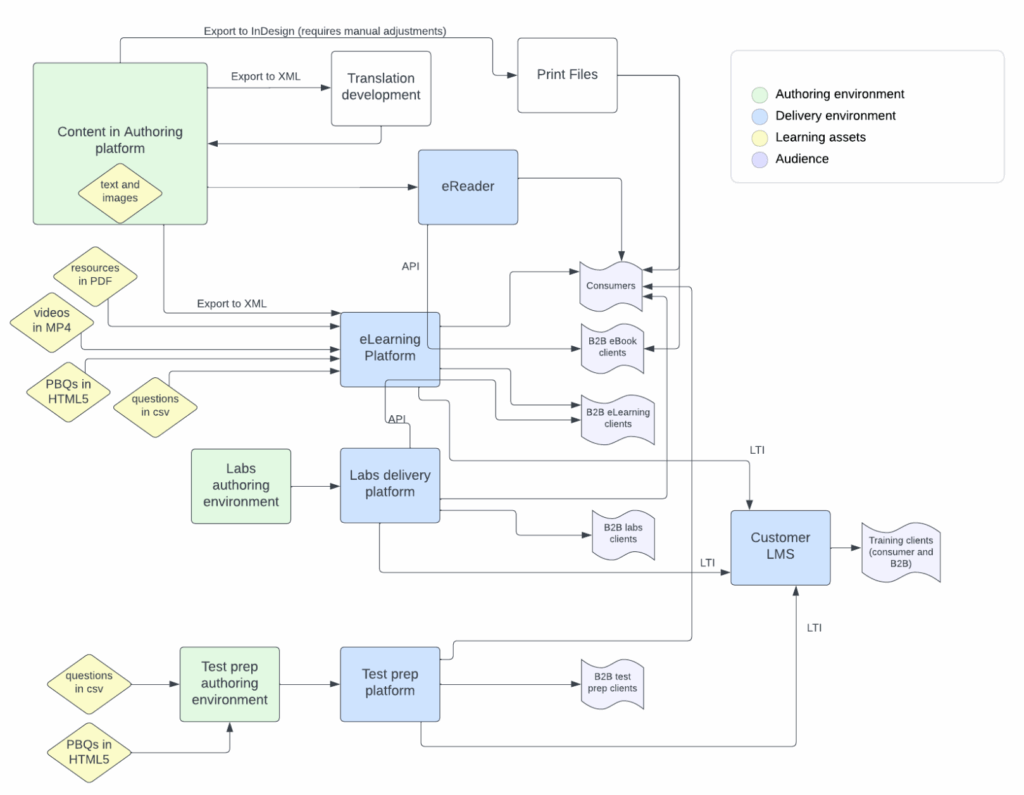
BM: Now, we have a central content ecosystem where everything connects into one spot, our CCMS, where we can actually deploy, publish in many different ways. Here’s our diagram here.

We actually can do our translations very seamlessly now linked in with our translation memory service. We can publish directly to our LMS record and we can also deploy PDFs. There’s some other little things that we’ve developed over the years, like we map our content to the exam objectives for our certifications. That was always a very manual process. It is now automated, which is amazing.
Even simple things like course outline, that was something that our course developers would go through and actually write out by hand, like, “This is the lesson, this is the topic.” That’s now all automated as well. So a lot of those instructor resources that we provide or just tools about our products we have automated as well.
SO: What did it look like to go from before to today? What was the process that you went through during that “and then a miracle occurs” phase of the project?
BM: Yeah. We did a lot of discovery and analysis of our content first. We worked with Sarah’s team on building a content model to see how do we need to structure things? And I think it was really great because it provided this neutral ground for our two parts of our team to come together and really evaluate, “Okay, what does our product look like? Where do we want it to go as we move forward? And how should it look so that it can work on our platform, our LMS of record?”
And so I think that was a really… It wasn’t a like, “Oh, your way is better than my way.” It was a really, “What is the best for the user and what can we learn from each other?” Because I think we both had good things that we were doing, but it gave us this neutral ground to really evaluate things, and also come up with a plan of, “What do we want our end goal to look like that wasn’t dependent on a specific platform?”
I think sometimes we’d jump into solutions and be like, “Oh, I got to use this platform, I got to use AI, I got to use this flashy thing.” And it was like, “No, no, no. Let’s take a step back and actually look at the strategy of how we want to structure things and how things need to work together to meet our end goal.”
SO: Yeah, and I think one of the interesting things I saw was that because a lot of the team members were so technical and were accustomed to doing weird workarounds, “Oh, that’s not working, so I’ll just write a script to fix it,” and we would get to a point of, “oh, yeah, that’s good enough. I can fix the rest of it. I’ll just script something,” and we’re like, “no, no, wait, back up. What are you scripting? Can we build it into the content model and fix it from day one?”
Because they were so… they just assumed that, “That’s as good as it’s going to get, and now we’re going to have to hand-fix the rest of it,” which was how it was. And so it was really fun to be able to say, “Well, wait, wait, wait. What are you doing? Wait, wait, what’s that script doing?”
BM: Pause!
SO: “Wait, we can fix it. We can make it better. This is not the end point.” The whole thing is extensible and flexible and configurable, so let’s bake that in at the beginning, unless, of course, it is a weird, truly one-off kind of requirement, in which case, sure, go write a script.
But that, I thought, was one of the really interesting things was that for us, usually we get, “Oh, that’s not good enough. Keep fixing it. Oh, you didn’t meet this requirement. Keep building.” And initially, we got a lot of, “Oh, wow, you got to 80%. I was expecting 50. I’ll just take this and I’m good.” And we would say, “But wait, wait. Tell us about the 20%, because I’m not saying it’s”-
BM: 20% is pretty big though, I got to say.
SO: It was, and it was like, “I’m not saying we can do 100%, but we can probably get closer, so let’s talk about that.”
So what happened to legacy production? During this process of making this transition, what happened to ongoing work?
BM: Oh, I kept going. Yeah, so it was very much a like, “Okay, we still have very big goals that we need to do.” Our first product was coming out as a merged company, and so we were focusing on that. So we were making decisions like, “Okay, how do we want this to go forward?” But we were still using our legacy authoring systems to get that done, but then we’re like, “Okay, when, looking down the timeline, when can we start authoring? When can we start moving into that direction and testing it and working with that?”
And so we had set out our first product to be… Let’s see. I think we started working in our content ecosystem in the beginning of 2024, and we had targeted our Q4 titles as like, “Okay, this is when we’re going to be able to… We’re at a starting spot here, so let’s use those as our first courses and then work through that.” But in the meantime, we had six other products still coming out that was in our pipeline, so we were like, “Okay, we’re going to keep working.”
And my leadership team was like, “Okay, we will bring in team members as you need to.” And we tried to step them along and exposing them, “Okay, this is what we need to know,” while building up the system and testing everything and making sure it was all working.
SO: We asked the people on the call about how they create their learning content, and actually, the number one answer is all of the above. About a third said all of these things, but a quarter said the usual suspects, PowerPoint and Word, and a quarter said learning tools. Nobody said video and animation, which is interesting because that’s a big part of what you’re doing. And then a tiny number said structured content, but mostly it’s all of the above.
Can you talk a little bit about video and animation and how you integrated that into the text-based XML files?
BM: Yeah, you don’t think of text-based and video going together, but what we were really focusing on around DITA is bringing in the objects that we needed to, whether that’s video or an interactive, and bringing in those tools to make sure that we could see all that material together in one map.
The other part we were looking at is, yes, video is obviously a dynamic moving object, but with that comes transcripts, and that is a requirement that we have for our learning platform. It also would help if someone’s looking at something, they can look at the transcript and see, “Oh, what is this video about that’s in the course?” You don’t have to go out elsewhere and see, “Okay, where is this video referencing to and how long is it?” And so we’ve made sure that we actually mapped in the transcripts in there.
We also automated stuff with our DAM, our digital asset manager, so that when we deploy to our CertMaster platform, it grabs the link to the DAM and shoves it into the platform. That’s all automated. Before we had to do this very convoluted process of uploading material into the platform and then linking it in and then adding in the transcripts. That’s all automated now, and it’s not something that my team has to do manually.
SO: So current state is that you’re basically in, I mean, is it fair to say full production?
BM: Yeah.
SO: Yeah. And what does that mean? Can you give people an idea of what the scope of that looks like?
BM: Yeah. We are authoring, so designing new courses. We are actually working on refreshes right now. That’s a new certification is revising and updating. We are taking existing material and updating it. We’ve just got our first reuse project that’s in motion there, which I’m really excited about because we’ll actually be able to test just the scalability of being able to reuse content and not having to touch it multiple times, which is pretty, pretty amazing.
SO: And the migration is done-ish? Almost?
BM: Yeah, I would say we are at the tail end of it. We’ve got our last English course that is going through final checks right now we’re deploying, and then we’ve got our localized content that we are moving over. But in the next two months, by the end of November, everything will be publishing directly from Heretto, including our localized content, which is really exciting.
SO: There was a question in here from the audience about getting people on board. How did you get people on board and did you run into change resistance? What does that look like in your organization?
BM: Yeah, no, we definitely had change resistance, and I think just trepidation, especially as we were also merging team members together. And so we’re also trying to figure out swim lanes and who is responsible for what.
SO: That’s a lot of change.
BM: And also like, “Oh, there’s these 20 other people that we’re working with. Okay, how do we all work together?” But I think it also was unifying in that, “Well, this is new for all of us. No one has a leg up on this. We’re all learning it together.”
And really, our leads really took an effort of, “Okay, we’re going to help you through this as much as possible.” And Sarah, your team did a great job too of also giving us the guidance to help prepare our teams for it and slowly easing them into it as well.
SO: Yeah, and I mean, it’s interesting because with mergers, there’s so much change just from the merger, your paycheck might come from a different place and your benefits are different, just stuff. And one of the things we’ve actually found is very helpful in a situation like this is this gives you a common goal and also a common complaint, something to bond over.
BM: Yeah, exactly.
SO: Like, “Ugh, I can’t believe we’re having to do this,” but you’re both having to do it. That’s very, very different from Company A and B merge, and A says to B, “Well, we hate your system and certainly we’re not using that. We’ll just be moving you into our vastly superior A system,” which then creates or can create resentment if you’re not careful and all the rest of it. But in your case, it was like, “I mean, we’re all suffering together,” and I mean, it went pretty well, but it’s a change.
BM: No, we definitely had hiccups and we definitely had certain team members who embraced it more than others. I found it really interesting though, of the people that I was like, “Ooh, I’m a little nervous about this,” they were like, “oh my gosh, this is great. I can actually see things now. I can move things a lot easier.”
And I think part of that change management is we were constantly talking about the benefits and what it’s going to gain us and how we’re going to be able to repurpose things as well. We are in the capability now of we can author our base content and shoot off derivatives with a click of the button, a literal click of the button, which is something that we could not do before. There was a lot of manual adjusting and fixing things, and fixing is something for a different platform, so we had to change formats and whatnot. And those days are done. That’s not happening anymore.
SO: And I think, I mean, in fairness, I think a hundred percent of the people that we work with have concerns about what’s it going to be like to author in structured content, unless they’ve done it before and they changed companies and they went to a place that’s not structured having done it, then they’re dying to get back to it. But generally, people come in and there’s a lot of trepidation, a lot of concern about authoring experience, right?
BM: Yep.
SO: A lot of concern about how painful is this going to be? And usually, usually they end up looking at it and saying, “Oh, well, this is okay.
An interesting question here, because somebody wants to know about volume of content, how much content do you have? Can you give them a little bit of an idea of the scale that you’re dealing with?
BM: Yeah. We have 40 products that are in various stages of production right now. I actually just got a report recently. It’s about 170,000 objects, content objects that are part-
SO: That’s roughly topics?
BM: Topics, yeah.
SO: Two objects per page, if you have an image-ish?
BM: Yeah, yeah. It’s around content objects that we have in the CCMS. Now granted, some stuff is probably duplicates because of migration or whatnot, but still, it’s a large volume of material and we’re continually growing. We’re looking to expand our business and scale and create more content. And so I think that’s also part of it as well.
SO: And then how many languages?
BM: We support five different languages, including Japanese, which is, I think, Sarah’s favorite of all of them.
SO: Including Japanese.
BM: But honestly, that was the one… So you were speaking of like, “Oh, someone who has worked in structured content before and wanting to go back,” it was our translation manager who was like, “Hey, Becky, have you considered DITA? This would really help us with translation.” And so she was the one who was beating the drum of like, “Hey, we should look at this” well before the acquisition had even taken place. And we were like, “Okay, we’ve got to solve for this problem.”
SO: Yeah. And so somebody’s asking about the tools, and Christine, I don’t know if you can put that after image back up, but they, CompTIA, you went into Heretto. You’ve got some other pieces and parts in there. Can you talk through a little bit of what that tool stack looks like? You’ve got the CCMS, the component content management system is Heretto. That’s where the text lives.
BM: Yep.
SO: And then what else do we have?
BM: Our digital asset manager, we use MediaValet, and that’s most of just holding our videos. We also do lab development outside of our CCMS. We’re a big believer in practicing your skills, and so we have in-house simulations that CompTIA builds and delivers. And then we also work with Skillable on live labs. Those are two different platforms that we have to connect into the CCMS. And then we use XTM for our translation management service.
So there’s a lot of different pieces flowing into that CCMS, and then being able to deploy that to our CertMaster platform, which is our LMS.
SO: Yeah, I have a lot of questions about exactly what you did here. People are clearly looking at this and going, “Hmm.” So there’s one here asking if this is more mechanical, electrical, or more software marketing, and I would say software, right? Software and technical.
BM: Yeah. CompTIA specializes in the IT industry. We do a lot around networking, your help desk technicians, cybersecurity. We also do data analysis content as well. So we have a lot of technical people that we are creating learning content for, but it is e-learning content. We want to make sure that people can practice those skills and be able to go and not just sit for the certification, but actually do those tasks related to those job roles.
SO: Okay. And then I’ve got somebody here asking about skills for the training content developers, which ties right into the question of change management, right?
BM: Yep.
SO: And I really hate the word upskilling, but that. So what skills did you have to or what skills are required for them to author?
BM: The Heretto system is actually pretty great in that it is very user-friendly. You don’t necessarily need to know all the ins and outs of how DITA works in order to author in there, but I did ask that all of my team members take your DITA introduction course. It was a great baseline of just what is the language, understanding how course maps work together and that structure of how we pull things together. Because our course developers are really… they’re not technical experts, but they are project managers. They’re making sure that all of our technical SMEs are working together and bringing things together, and so they are rearranging things and putting things into place and that first line of defense, if you will, on like, “Oh, my author has a question. How do we fix it?”
So having that baseline has really helped, but I haven’t heard, at least from our teams, of like, “Oh, we need more knowledge.” Our technical teams are probably going to go into more knowledge, but that’s part of who they are too.
SO: Yeah, seriously.
BM: They just like digging into those type of things and understanding like, “Ooh, if I do…” I’ve got a team member who’s like, “Oh, if I can script how to make these objects, I’ll put it into Heretto and that’ll save us X amount of time.” And so there’s little pieces of that that we’re leveraging. I don’t think it’s essential necessary, but it’s definitely something I’m leaning into because our team is showing aptitude there.
SO: Yeah. It’s been really fun because some of the very technical team members come up with these ideas to further automate things that are external to the system, but it’s like, “Oh, we could automate this and we could push it over here, and then we can just do the thing,” and it’s been great to watch them come up with all those fun ideas.
Okay. I’ve got a question about migration before we move on and talk a little bit about how it actually went and what some of the surprises were. But the question here is, “Is there a reasonable blueprint for migrating a large amount of content in the background while also continuing to update and publish the legacy content as long as the migration is not yet finished,” which editorially I’ll add, I think is exactly what you did, right?
BM: Yeah, it is exactly what we did. Basically what we’ve been doing is we worked with a conversion vendor and Sarah’s team to make sure that they understood that model and they programmed and looked at our content and ran it through that programmatically so that they could convert it.
And then honestly, we’ve spent the last six months, “Okay, we’re going to rebuild everything in Heretto and we’re going to test it and make sure it’s working,” and that’s part of why I had given my team… I was like, “Let’s get this done in June.” It’s now September. We are still just finishing things up, but I think it’s a testament to that, yes, we did, we worked with a conversion vendor. They did a great job on how our stuff works, but there’s that 5, 10, 15% that doesn’t quite fit the mold. And also, we were structuring things on how we want it to go, and we had to make adjustments of existing content.
So there’s been a lot of testing and moving things forward while still moving things. So we’ve done a lot of testing and double-checking, like, “Okay, is this all ready to move forward?” And then we’ve made the switch to our new platform and from the Heretto deployment.
SO: Okay. One more before we move over. I’ve got somebody asking, “Does using DITA make this very labor-intensive?”
BM: Not any more labor-intensive than it was before. I mean, honestly, I think I shy away from saying, “Labor-intensive.” Creating good, quality learning experiences should be labor-intensive, but where is our labor deployed? I guess that would be more of the issue.
My team is going to be able to focus more on really important things like, “Okay, what does that lab experience work? How do these assets work together? Are we choosing the right content asset for this learning experience we want to create?” Versus, “Okay, now I got to take this content and I got to transform it and put it into a PDF, and then I got to proof it and make sure that PDF is right. Oh, nope, something got missed. We got to make a correction. Okay, now we can deploy the print PDF,” or… So there was a lot of just manual busywork that the team was focused on instead of focusing on the real, true value-add that I want them to be working on.
SO: Yep, okay. So looking at this, we’ve talked a little bit about reuse, that you’re getting ready to scale that and scale production, and the migration is done, which felt… I mean, we had an external vendor, but we also had your team working on that so they have some more bandwidth. And then I don’t think I’m allowed to do a presentation anymore without asking you about plans for AI. So any plans for AI?
BM: That’s true, yeah. No, I mean, yeah, I mean, we not only use AI, like we’re creating courses about AI as part of our mission to serve the technology industry, and so where we’re looking at is structured content can be read by AI really well. And so that’s where we’re looking and hoping to be able to leverage some of these things so that we can use it for incorporating in an AI tutor, or we’re still in the ideation phase of these things, but having structured content will give us a lot of leverage to be able to repurpose and reuse that material that we’ve already created with AI.
SO: Okay. So I wanted to ask you about surprises. What happened that you were not expecting?
BM: Well, I mentioned the migration. We were like, “Okay, we’re going to get it all done by June because we want to get this done while courses aren’t in session,” or at least not as many classes are in session. And we kept running into like, “Ooh, this wasn’t quite formatting right,” or, “this isn’t deploying right,” or, “ooh, what happened to all these questions? They just disappeared.”
We uncovered all of these little gotchas or workarounds we had in our LMS platform and how things were deployed before that we had to standardize and fix and verify before coming out, and so that just took a lot longer than I thought it would happen. I mean, we’ve been tweaking our CertMaster transform, which is how we get the content out of Heretto and into our CertMaster learning platform. We’ve been tweaking that for a year and a half now. Well, actually two years, right?
SO: Yep.
BM: Since we started building it. It’s really powerful what it can do, and we’ve really expanded on it so we can publish things efficiently, but when things break, it’s like, “Ooh, okay, how do we go back and fix this?” Even just figuring out how to tag learning objectives, that was a lot harder than I thought it was going to be. I was surprised at that, but it works now, so that part is really great.
SO: And I think it’s fair to say that this content, as learning content goes, was actually pretty structured going in. And even so, those gotchas, those edge cases were just constant, right?
BM: Yes.
SO: We kept finding it was a thing of, oh, well, we built the transform, but we assumed it would look like this from a structure point of view, and then there’d be this thing over here, and of course that wouldn’t work. And then we had to figure out, “Well, do we shove it into the box so that it fits or do we look at it and say, ‘No, actually that is an edge case and we have to account for it'”?
And there was a lot of that work, but I think that the lack of exceptions… At the end of the day, any unstructured system that allows you to make exceptions, humans will make exceptions.
BM: Yes, they will.
SO: That’s just how it works. And what’s painful is finding them all and having to either invest in making them work or take them away. And then people get very cranky because you took away their favorite little tweak. And I am the worst at this, right? I am terrible. So I know exactly what I’m talking about because I tell people, “Structure is great and you should do it,” and then I go off to build my slides and I’m the worst offender in the country. So, lots of exception processing.
And then the content model’s still evolving, right?
BM: Yeah. I mean, we’re creating new products and we’re coming up with new things. And so we tried to build stuff so that it’s like, “Okay, this use case can work for…” For instance, LTI interactives, using the LTI standard, we want that to be a single thing that we allow, but similar to our exceptions, we were like, “Oh, well, our platform allows it in three different ways.” And so being able to make sure that what we’re doing is also working with the platform has been a little bit more challenging. And I think it’s where we’ve identified, “Oh, this is an exception that was built in, this was an exception that was built in.”
I’ve been joking with my team of like, “Exceptions are gone, we’re no longer doing that.” It’s not true. But I think it’s giving us the pause though of like, “Ooh, okay, this is what happens when we allow all these exceptions and can we move away from that?” We obviously want to support our legacy products, but “Okay, can we take what we really want to keep and move that forward and get it into the standard box” versus, “okay, this is an edge case, this is an edge case, this is an edge case”? Because then you’re left with your box is really small, and then your edge case are all over.
SO: Yeah. And I think, I mean, do you have some thoughts on how this project versus… So much of the stuff that’s DITA unstructured content-based is technical tech comm content. I mean, your content is technical, but it’s not technical writing or technical communication, it’s learning content. What are some of the differences that you’re finding in terms of how that experience works?
BM: Yeah. Things like tasks have been really challenging for us. We were actually just having a discussion yesterday on our lab activities. That should be a simple task process. You should be able to use a DITA task to walk through, “Okay, this is step one, step two, step three,” but in how we structure those lab activities, sometimes we want to group things together and give a little explanation or a little thought or a hint in there. That doesn’t fit as nicely into the DITA structure.
And so we’re trying to figure out, “Okay, what’s the best way to move this forward? It’s not really a tasked concept, it’s not really a concept. How do we make it best for what we need to deliver at the end?” Because at the end of the day, we need to be looking at what our learners need and not what we need and would make our life easier. We want to make our learners’ lives easier and better and more of that learning. That has to be our end goal.
SO: Yeah, and I do remember… Oh, sorry. DITA has a learning and training layer for things like learning objectives and course content and assessments. And one of the very first things we ran into was that the assessments has true-false questions and multiple choice and various other things. I mean, not quite day one, but pretty close we discovered that the assessment types that were in there were insufficient because there were some things that you needed to be able to do.
The one I remember in particular is that DITA has, or assessment, there’s an assessment type for matching. So there’s five things over here and five things over here, and you match them. And one of the things that you had in your content was this idea that there might be things that don’t match, so you want to put in distractors and force people to really think and not just, after the first three, you can guess and probably get there.
BM: Try to get them all, yeah
SO: Yeah. And we had to build out, we had to extend the learning and training specialization for that and a couple of other things like that. I feel like assessments were a place where we ran into some definite gaps in terms of what you needed and what was there.
BM: Well, yeah, and it wasn’t just like, “Oh, this is the structure,” but it was also just other base information that our platform was looking for in order to serve up information around how content’s related to… that question’s related to other material or the difficulty of that item or other such things of just even where it’s deployed in the platform. That was all things that we had to kept coming into like, “Oh, we forgot about this rule. Oops, we forgot about this one.” But there was a lot, I feel like, we had to extend there as well.
SO: There’s a question here about the ultimate bottom line, which I don’t know that we can get into the specifics, but broadly, where do you land on what the ROI and was it worth it and are you saving time or money or both or what are the success factors that you’re looking at?
BM: Yeah, so I mean, we’re definitely looking at where are we spending our time and can we create more products during a given year? And so I would definitely say we’ve seen ROI around that aspect of things.
I was talking with Sarah earlier today about just latest on how we’re developing and deploying things. We’re in the process of moving some content over into our platform. My team was able to deploy 15 courses in the span of a month, which was about the time it would take us to take one e-book and get it into the platform and run it up and get it deployed for just one thing.
And so that’s just an example of just the scale that we’re seeing of we were able to basically redo these things with just two people across 15 products, which normally would take us multiple people, multiple rounds of proofing, double-checking everything. So I think that’s where we’re definitely seeing some efficiencies there, for sure.
SO: Yeah. I think, I don’t know that there are any specific, somebody’s asking about KPIs, which I don’t know that we specifically have, but it feels to me like the get rid of all of the really labor-intensive, repetitive formatting and reformatting and re-reformatting and it’s not working, and turning that into a pipeline that just works, which then means the people that were doing all of that, that production, can go do content.
BM: Right, exactly. I mean, the other thing too that we are just starting to see, and probably the part that my team is most excited about, is maintaining content going forward. So now that we have everything in our single repository, we can actually correct things in one spot and deploy it to wherever it needs to go if we get a content correction. Before we were making content updates in two, three, sometimes four different platforms depending on what the product was. And so just that time of addressing an error was just very, very labor-intensive, and so now we can do it in one spot and we have a way to deploy it quickly and efficiently.
SO: On your AI, I’ve got a question here about AI and how to make your content easy to read for AI. I’m not sure, can you say anything about generating content that is AI-friendly, I guess, for AI ingestion?
BM: I mean, I think we haven’t done much work around this, but just from the basics that I’ve learned and talked with areas, it’s a machine talking to a machine. And so with having our content structured and layered, we can share, “This is the stuff that you’re looking for.” It would understand what an assessment looks like, it would understand how things are related to each other because that’s all in the structured documentation. It’s looking at the code base, if you will, for that. So I think that’s where we’ll see some of the efficiencies.
SO: Yeah, and I would just add to that that basically the plain language standards, the general “how do you write well?” standards apply to AI content or to content that you want the AI to consume. There are issues like consistent terminology. If you always call the one thing the same word, then the AI will have an easier time with that than it does with you saying “monitor,” “screen,” and some other word for what I’m looking at. So the more consistent you are, the better off the AI is going to be in potentially refactoring that content, so all that stuff that you’re talking about. And then there’s also a question of semantic markup. So the markup, the tags, and the metadata, which we haven’t really touched on, but the metadata that you have in DITA or elsewhere can also help support that.
So the question here is about best practices, and I think the real answer there is do what you’ve been… I mean, do content well, and the AI will be happy enough. One place you can look where you’ll actually find best practices is localization.
BM: I was just going to say the same thing. That’s exactly what I was thinking of, too, and that’s where we are seeing some really great efficiencies. We’re in the migration process for our localized content that’s been out in the world right now. And the reason we’re going to be able to move that so quickly is because we’ve already… it’s referring to our term base that we already have, it’s matching things up correctly, and it’s just identifying actually, “Oh, hey, this content changed. You need to take an adjustment for it.” But we’ve actually seen a lot of efficiency just in terms of how long it takes us to develop localized content with AI that we haven’t seen before, so that part is really exciting.
SO: Okay. For the people on the call, if you want your questions, get them in because I’m going to jump over there and start just rattling them off as we go, and we’ve got a little bit of time.
So there’s a question here about your team, “Is it a combination of tech writers and training developers?” And I think you have tech writers?
BM: Yes. I mean, I want to caveat tech writers a little bit. We have subject matter experts in technical fields. We have people with cybersecurity expertise, networking expertise, cloud networking expertise, but they also have an instructional design background as well. They have teaching experience. It’s a really unique blend. That’s some of our team, and then we also have people who are more editorial, instructional design-based materials.
SO: And then a similar question around what are you producing? What kind of training, trainings, training resources are you producing?
BM: We create e-learning products, we create lab activities, we create exam prep, we create books, e-books, print books. It’s you think of it, we create some type of form of it.
SO: All right. And then a couple of other interesting ones. Do you have a style guide for the e-learning content or not?
BM: Yeah, no, style guides are great and definitely my best friend as well, just to make sure everyone’s on the same page on what things should be looking like, how we use certain terms, things we want to stay away from as well. So yeah, definitely we have style guides and design systems as well. We use both.
SO: Yeah, I mean, I think looking at it from the outside, I think it’s fair to say that the organization actually had a very high level of process maturity in the context of a very fragmented workflow that required a lot of workarounds, but big picture, there was a lot of process maturity there. It was not like, “Oh, just go write a course and deliver it.” And it is and was much more organized than that, which I think then made it easier to make this transition because if you do one of those terrible five-step maturity models, you were already pretty high up the scale in terms of content. And then it was a matter of looking at systems and saying, “Well, let’s bring those up so that the content creators, content producers, and all the rest of them have an easier time delivering to the standard that you expect, demand, need, and have.”
Okay. There’s an interesting question here about moving to DITA, and the question is, “Is it reasonable to initially aim low, creating more or less uniform topic types, simple maps, generated content that’s good enough, valid in DITA, but good enough, and then sort of move on to something more sophisticated?” I guess that’s a yes or no question, but I don’t know that that’s what you did.
BM: I mean, yeah, I feel like we never do anything simple. We tried that though. I don’t know if you remember this. We had a need with the Japanese market to create a PDF for one of our products, our Security+ product. And so we were like, “Okay. Well, we have a pressing need here. We’re not fully baked in terms of our content model and everything else, so we’re just going to use some basics, the more basic, out-of-the-box structures,” and it worked, kind of.
SO: We got the content out the door.
BM: We got the content out, but it’s all just one use case. Whereas our goal was, “Okay, we want to be able to publish directly to our learning platform. That’s where everyone is going to be interacting with our content, and we want to make that process seamless and smooth.” And so that’s where it took us a long time to get there, but it’s been so worth it in terms of being able to get that done.
And I think the other part too is because we know all this stuff is automated, we can rely on our less technical subject matter team members to be like, “Okay, well, I know how to publish. I know what to look for to make sure that we get all our green check marks,” and then that they can oversee and manage that process rather than having to have someone technical running the builds and that publish process, which is what was happening before.
SO: Yeah. Just a side note that there’s one last poll that’s live for the audience.
I would add to this that the screaming need, the “we have this emergency and we have to do it and maybe we can deliver it in the legacy platform, but we’re not sure we can,” that is a really, really common use case for us, that people come in and by the time they get the project going, because it takes a long time, they get the project going and they’re looking, they’re staring down a deliverable just like this. “We have to ship this thing,” in your case in Japanese, which was a super fun [inaudible 00:47:32] but, “we have to ship this thing and we’re not sure we can do it in the old platform. So can we make that the test bed, the beta, the whatever to get it out the door so that we can meet this deadline that we have with our client or our regulator or whatever?”
You’re not the only one that’s run into this. And it’s one of these situations where it’s very high-stakes because if we get it right and we deliver, everything’s great. If that thing goes sideways, then the entire project is in jeopardy. And at the same time, we’ve said… So we always come in and say, “Well, we can do it, but it won’t be perfect and we have to be willing to negotiate on the quality.” It’s literally, “We can get it out the door and it’ll be this level of quality. It won’t be done, it won’t be production, it won’t have all your nice edge cases. And if that’s okay, then we can do it, but we can’t promise that it’s going to be a hundred percent done because we’re one month into this or two months, I think, into this project.”
So we hear it all the time, and it is terrifying, right?
BM: Yeah.
SO: Because if we don’t deliver this, we’re in big trouble with the customer and then that gets us off on the wrong foot on the project right off the bat.
With that said, I think it is common to go into a DITA implementation and say, “Let’s just do the 80% solution and then we’ll fix all the other things.” I also think it’s fair to say that the training learning content generally is much more complicated than the tech comm content. You’ve got all these different types of deliverables and, and I’ve talked about this with some other people, the focus on the learning experience is basically everything. If the learners aren’t learning, that’s bad.
With tech comm, we talk about customer experience and that’s the thing that’s coming along, but broadly, tech comm is focused on efficiency. How fast can we get this content out the door? And learning content historically has been focused on how do we make good learning experiences? Now the two are coming together, like, “We need some efficiency and we need some better experience,” but they’re coming from opposite sides.
BM: No, that’s a good point. I think what’s interesting too, for us, we’ve always had a pretty strict deadline because we always want our learning content to come out with our exam, our certification exams, so that set us a firm deadline. And I’ve always joked with our other exam services members, like, “Oh, you guys have it easy. You’re just creating an exam.” Granted, solutions, they have a very rigorous process that they go through, but we’re creating a whole lot of other different types of assets that need to be QA’d and checked and brought together.
And so it’s just a different animal, and frankly, we just start later because we get exam objectives later than they do. And so it’s like, “Okay, this is what we’re doing. How do we map this?” It almost feels like we’re on the back pedal beginning with, and we know, “Okay, we’ve got this deadline we got to hit. How do we get there fast and efficiently?”
SO: Okay. I think most of the people on this call do have an LMS somewhere in their organization. It looks like, well, 60%, which is more than half, but not so much.
And then in terms of we asked this last question, “What do you think of this approach? Would this make sense for you?” and half the people are saying, “other.” So it appears that I did not write this question very well, which leads me to the question of what does other look like? And I would love to get some of that in the comments or the questions. Sorry.
While we wait for that to come in, Becky, do you have any closing wisdom for people that are entertaining something like this?
BM: Yeah.
SO: Is it run screaming? Is it…
BM: No, no! I mean, I think I’ve been talking with my team. The past two months, we’ve been like, “We’re almost there. We’re almost there. This is going to be so great.” We’re almost over this huge hurdle. We can go back to stop talking about migration and just work, which we’re all really excited to do.
But I think my number one piece of advice, make sure you give yourself a long enough runway on it. Really, it’s going to take longer than you think. It took us two years or a little bit over two years, but I’m glad we took that time to get it done because we got it done right instead of trying to rush through stuff and maybe miss the boat because it’s a lot harder to go back and correct it, especially when content goes live versus, “Okay, I’m going to slowly kind work through it.”
We had that with our first course that we published, our first certification training product that we published. We didn’t get it right, and six months later, we went to do our translations and our translation manager was like, “Ooh, there’s a lot of issues here.” And so it was good though. She was our first customer and helped us identify a lot of those issues as we were getting into more of the other migration, but it was just a good learning experience of like, “Okay, we’re not going to get it right and that’s okay, but we’re going to learn from it and move forward on it.” So I think that’s where my two pieces of advice would be.
SO: I think we can tell people, somebody’s asking about the conversion vendor who we have not identified, but you did a webinar with them a couple of months ago. So the conversion vendor was a company called DCL, Data Conversion Labs. That was not us. That was a third vendor that was involved and we’ve actually done a lot of work with them.
I wanted to touch briefly before we close this out on the decision to go into DITA and a CCMS because we just zoomed right past that to where you said, I mean, by the time you showed up on our doorstep, you’re like, “Hey, we think we need a DITA CCMS.” So you had already done this entire investigation of all the normal traditional solutions to this problem. What pushed you to go in this direction?
BM: I mean, part of it was we were using some of those other, I would say, more traditional solutions and it wasn’t working for us. We just had too many different use cases that we were trying to support that that tool couldn’t support for us.
The other part was our localization aspect of things. We were looking to accelerate and do things faster with our localization process. It was taking us six-plus months to localize our content. We really wanted to get that down as quickly as possible to a short amount of time.
And so we were working with a couple of different translation vendors and saying, “Hey, we have this problem. What do you recommend?” And that’s where they were like, “Have you thought about DITA? You already have somewhat structured content. If it’s more formulaic, you can actually really leverage things here.” And so that was where we were like, “Eh, that actually makes a lot of sense.”
And then the idea around reuse, I think that’s the one that really sold us on it of not being able… not copying and pasting, but really reusing content. With networking and cybersecurity, there’s a lot of concepts and a lot of skills that overlap between a network engineer and a cybersecurity specialist. We should only be creating that content once and repurposing it, not recreating it, and slightly tweaking it unless there’s really a really good use case of why we want to change that. But most of the times, it’s like, no, we just have five videos on IP addressing when one would do, but we didn’t know where those five videos were.
SO: Okay. I think I’m going to close this out and throw it back to Christine. Thank you. There were just an enormous number of questions that came in. So clearly people are looking at this and are interested, so I appreciate you giving them an overview of how this thing went and where it went and what it was like. And with that, Christine, I think you’ve got some closing stuff.
CC: Yes. Yeah, thank you so much, Becky, for talking about this today. And for all you viewers, if you are able to go ahead and rate and provide feedback on today’s webinar, things you like, things that stuck out, other topics that you’re interested in, or maybe content issues or questions that you have, that would be really helpful to us. So please go ahead and do that before you leave today.
Also, save the date for our next webinar, which is going to be on November 5th, same time, 11:00 AM Eastern here on BrightTalk. You can also subscribe to our newsletter in order to get notifications about that and other updates from us. And thank you so much for being here today. We really appreciate you taking the time and we hope you have great rest of your day!
About the author