
Chart your AI-ready content ops career (webinar)
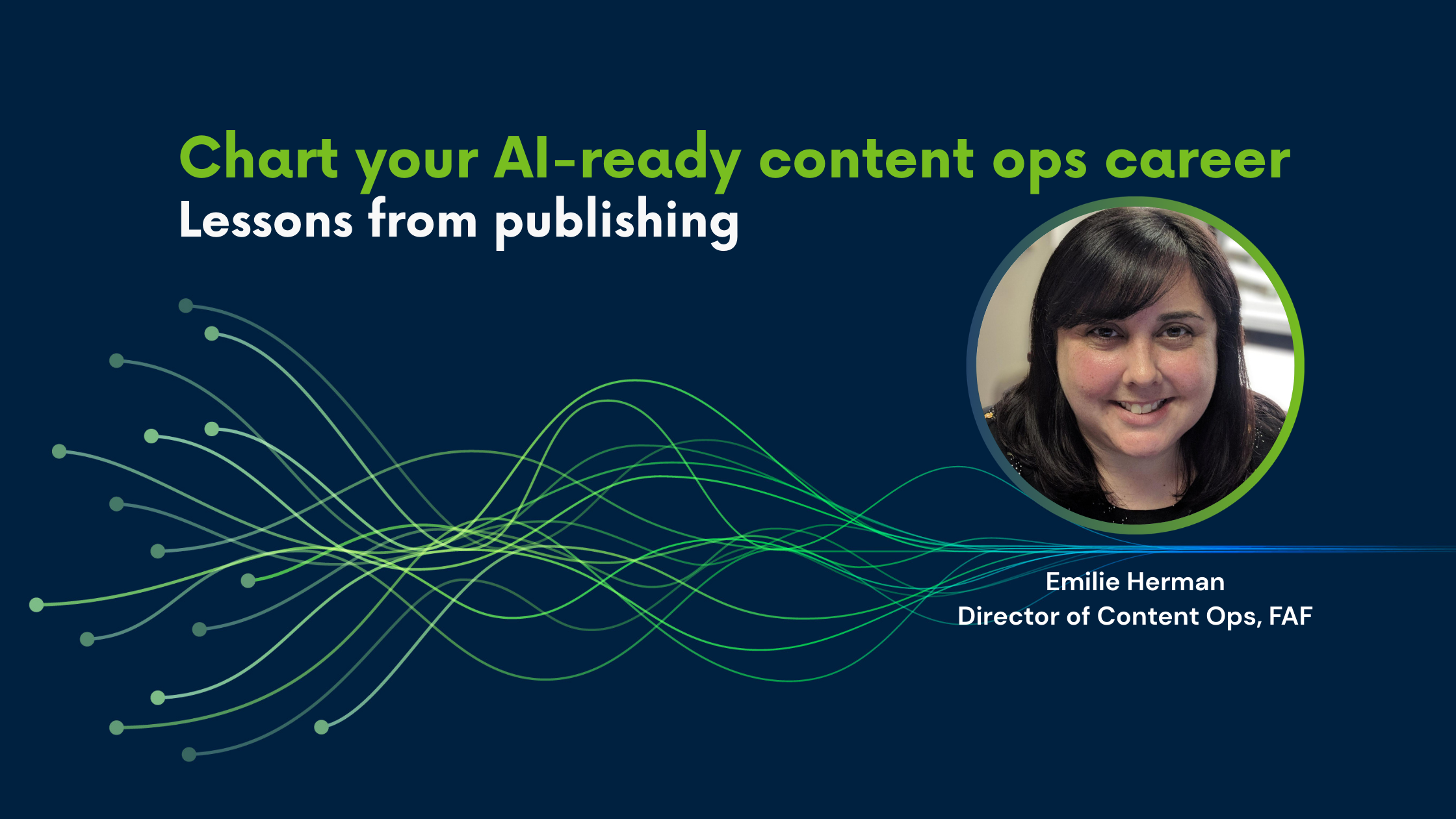
In this webinar, Emilie Herman, Director of Content Operations at the Financial Accounting Foundation (FAF), shares lessons from her career journey. Through the lens of publishing services and large-scale content workflows, Emilie shows how the shift from manual processes to automation mirrors what’s happening with AI, and how these adaptation techniques apply to your content ops career.
It’s isolating when you feel like it’s all on you to figure out how to reinvent your career. Reach out and talk to people. It’s nice to make a human connection, which is very important to get past AI, but also to look at what other people are doing. Collaborate, talk things through, and acknowledge that everybody’s trying to figure things out. People want to experiment! There’s strength in numbers. If you have a manager, mentor, or someone who can help put you in the room to be part of the discussion, you feel empowered to take control of your destiny.
— Emilie Herman
Resources
- The true measure of success for AI initiatives (podcast)
- AI in the content lifecycle (white paper)
- Want to stay updated on key industry insights? Subscribe to our newsletter!
Transcript
Sarah O’Keefe: Hello, everyone, and welcome to our latest webinar. I’m here with Emilie Herman. Hey, Emilie.
Emilie Herman: Hello.
SO: There she is over there and also on screen. And we wanted to talk today about charting your AI-ready content ops career. What we really want to do is talk a little bit about other big changes that have happened in publishing and what those look like in terms of careers and changes and evolution. You can find Emilie on LinkedIn, and you can find our newsletter at scriptorium.com/newsletter. And now we know why Christine gets to do these announcements.
Okay. I’m going to turn off the screen sharing and I’m going to launch our poll as soon as I find the poll launching button as you do. Because the question we wanted to ask you all as we get started here is how has AI affected your role and your workflow? That is in fact not a multiple choice question, but rather a full-on essay answer. So I’m going to encourage you at your convenience to go take a look at that. And with that, Emilie, welcome.
EH: Thank you. Great to be here.
SO: We are glad to have you. And what we wanted to do today was talk a little bit about your career in publishing and some of the lessons that you and we can draw from … I don’t want to quite say the history of publishing. You haven’t been around that long. But the span of a publishing career and what it looks like. So give us a little bit of background on who you are and where you are these days, but also where you came from.
EH: Sure. So I probably, like many of you, started out as an English major with no idea how to turn that into a viable career. So my parents suggested teaching. That was not for me. I think I tried out advertising for a year or two, that didn’t fly. I had interned at a publishing house in New York City and I thought, aha, I like to read. I can sit and read books all day. It turned out it wasn’t quite that. But I decided to pursue a career in publishing. So I was interviewing all over, and it sounds a little like an episode of House Hunters when I tell you where I was interviewing, but where I ended up was the one that let me move out of my parents’ house and get my own place. So I ended up at Wiley, which is all nonfiction or professional and trade publishing. They also do journals or research and higher education. And I ended up in technology books, which tickled my program or father, but the English major in me wasn’t sure. But I found that I really enjoyed working with authors, helping them craft a message, helping people who weren’t professional writers find a voice. And on the publisher side of things, working to figure out series guidelines and helping them write into a specific series or brand or voice and just helping bridge that gap between SMEs or experts and their audience.
So I was tracking to be an acquisitions editor and through an acquisition, I ended up being pushed into more of a development role and really doubling down on working with authors. And then I spent about a year and a half, or as one of my colleagues called it my boomerang year, spent a year at a higher education publisher and did technology textbooks, went back to Wiley and ended up in finance. And so I think Sarah probably invited me to do this partly because I said, I feel like Nostradamus, I survived the tech bubble bursting in tech publishing and the financial crisis in finance publishing. So I’ve seen some things or maybe you want to hang up and burn some sage around me. But in any case, finance books became finance and accounting and business, and then it became ebooks and courseware and test prep and online reference works, which we used to call encyclopedias. That’s my dog sneezing in the background. If you can hear it, he’ll probably be joining us soon. And in a case, there was a lot of change going on in the publishing industry, the consolidation, the acquisitions, and then the offshoring and vendor consolidation and all the roles and a lot of reorging. And so at some point I opted out and decided to get into the nonprofit space.
So for the past eight plus years, I’ve been at the Financial Accounting Foundation doing their production. So I’ve shifted from more of the editorial side to production and work with a team, some of whom are on the call today. I ask them to be kind. And working on producing financial accounting standards for the FASB and GASB. And if you’ve ever written financial reports, you would know maybe GAAP accounting, but pretty far from the English major side of things, but it’s been an interesting journey.
SO: So you started out looking at, I assume, fiction and being a book editor like Jackie Kennedy Onassis, which was also my original plan. And then I found out that you don’t get paid anything. The way to do this is to be independently wealthy first and then be a book editor.
EH: Yeah. That was definitely the challenge. I did get an offer from a literary fiction imprint and I’d already started at Wiley and I thought about it. And sometimes I like to think about the road not traveled. And I think that version of me is probably still living in a one bedroom apartment with four other girls on the Upper West Side or Upper East Side probably of New York and attending some great parties, but still not able to make rent. So it’s a challenging path and very rewarding if you go down that. But I quickly found that I actually liked this space in between the fiction that I read and that I could keep that at arm’s length and enjoy reading without knowing all of the behind the scenes horror stories of how those books got to the shelf.
SO: You had an offer from a trade book publisher and an offer from a literary publisher. And I think there might’ve been a third one in the mix.
EH: A romance book publisher. They kept calling me back to work on … I think it was their young Christian series, which wasn’t the romance that I was reading at the time so I thought if I was going to do it, I was going to go all in. So I ended up in techbooks, which is equally as exciting. But no, it was a really interesting education and in a weird way, a great foundation for the things that came after because obviously so much of publishing is about technology. And so I got a little taste of that. I did a lot of data warehousing, database programming books. And so like I said, my dad was really happy because I could actually understand what he was saying when I had dinner with him, but also it gave me a little bit of a taste of what was to come. We were doing at the time, and it seemed avant-garde then to have backup book CDs, CD-ROMs or floppy discs at times, which became companion websites, which became learning modules, which then turned into courses and the idea of chunking information and sharing online resources. And so Yeah. I somehow became the in house person who always knew how much it cost to put CDs in the books. My publisher thought I was a one-trick pony with that.
But it was an interesting introduction to publishing to publish to a beta cycle of software and think about those things and timing and think a little more about the business side instead of just when you come into it as a lit major, you’re thinking about the books, the authors, the writing, the experience. Although they did have me take a development class and I was thinking about that when we were talking about this. I took a developmental editing course and it was with, I think, the last in-house development editor at Penguin. And she was horrified because I edited in Word with Track Changes turned on. I didn’t write in the margins of paper copies of manuscript. And you could already see things were shifting to a more online editing and template-driven experience. And she was wonderful and it was fascinating, but the closest I came to editing anything like techbooks with her was really cookbooks because there was a recipe and steps and a way to follow it in Microsoft wording and language. So it was an early exposure to thinking about series guidelines and branding and what I think a lot of probably people who come to you are looking at for tech comms and documentation.
SO: So when we look at this, I think the story of working in trade book publishing and computer book publishing is one of disruption and automation and fragmentation, offshoring and job, certainly destruction, but also creation. And so I think from our point of view, having been inside that in 20 years ago, more, I look at this AI thing that’s coming down the pipe and I see a lot of the same stuff happening, a lot of change, a lot of disruption, a lot of, well, we had this old established pattern and this way of doing things and this vision of what it means to be a person in this content that is being completely, I’m going to say changed. I want to say destroyed, but the thing—
EH: Upended.
SO: Oh, yes. Very good. By this technology and these new business processes, business realities coming into the world. So from your point of view, where do you see some of those parallels? What are some of the things that are happening now that happened then and what … So Nostradamus, tell us, what is happening here?
EH: I was thinking, and I was looking a little at some of the LinkedIn profiles of people that I’ve worked with over the years and where did they end up? And it was an interesting mix. Some of the development editors became instructional designers. Some of them manage teams of offshore vendors who do that. So they’re writing the guidance and training teams of people to review and they’re scaling a lot of the jobs. So it’s an abstraction of what you did and distilling what you do on an individual book basis up to a series of books, a list, a different type of book. A lot of them went in and became instructional designers, and a lot of them got out of the higher education space, textbook space, because that’s been a tough spot, but they’re still doing it. A couple of them work at real estate companies because they’re training a lot of agents. And so there’s online training for all of this. I think the quote that has stuck with me is, if content isn’t your first business … And for all of us, it’s our first business. But if it’s not your first business, it’s your second. So even if you make plain parts or you manufacture something else, you need literature, you need explanation, you need content to explain how that all works. And so you have to invest in that.
And so there are a lot of places. The obvious places to do publishing were big trade publishers in New York, but it’s become much more fragmented, whether it’s through remote working or through the upending or disruption and consolidation of the business. But we had production editors who became content technologists. Some of them are working at the W3C and writing the rules and guidance, the specs for how you create ebooks and taking their individual experience to that level. I know we’ve talked about indexers who became taxonomists. The hard part is when you’re in it’s really hard to see how your skills apply. I was at Wiley for close to 20 years and someone coined the … And I’m sure there’s a version of this that you called at some point GFW, you’re only good for Wiley and you can’t really see the forest through the trees. And you think, I’ve turned myself into this thing that can only be employed here, but you actually have a huge collection of skills if you step back and know how to talk about it and apply it in different ways or look outside the industries that you’ve been in and find something in parallel.
It’s interesting to see who went back to school and became librarians. And again, the taxonomist thing comes up a lot. And some of them went and worked for organizations like the FAF, or really more for other nonprofits who do certification and work directly at the source creating content for that. So it’s heartening, I think, to see that people figured out how to move their skills when there wasn’t an opportunity. Or sometimes it wasn’t even that it wasn’t just through the layoffs, you could just get tired, to be candid. The churn can be exhausting in and of itself, and you just want to put yourself somewhere that feels a little more stable. And I think what’s tough right now is it feels like there’s no corner of the earth that’s not affected by AI, and that’s a challenge. But stepping back and looking at where people have gone and how we’ve adapted already gives me hope that we’ll figure this one out too.
SO: Yeah. I started my career as a production editor. That was the thing I did. I was responsible for making sure that the content created by other people was properly formatted, which I’ll come back to that in a second. And then would go out the door and it would work. The postscript files would render properly at the printer, that type of thing. The index or taxonomist is really interesting to me because they’re both concerned with the question of classifying information. It’s just a different way of looking at … Indexing is the very specific thing that you do to a book, but taxonomy is the next order version of that. And the same thing happened to production editors. All that work got basically automated. It got put into the formatting layer that is scripted. Now, I know a lot of obscure things about fonts and letting and kerning and page breaks and widows and orphans, and it’s really sad and ligatures. Ligatures. But no, nobody cares.
EH: I guess a lot of people on this call care.
SO: Welcome to our people. But nobody else cares. And so the reality is that those kinds of skills, unless you’re doing at this point in time, art books of some sort, coffee table books, those skills have been automated away. And that I think is what we’re seeing now, that specific skillsets are not the thing. It’s more like the bigger picture understanding of what you’re doing and what you’re trying to do. So as we look at this and when you think about where this is going in terms of AI, considering this perspective, what do you do going forward? What’s the best way of looking at a career right now and making sure that if you are the equivalent of the production editor, you’re going to have a job as a template developer, an XSLT program or something like that. What’s that transition and what are the roles that are going to have to transition?
EH: Yeah. I think I don’t have all the answers. Obviously, we’re all still figuring this out. I think the things that have worked for me in the past that I will continue to lean on is look at your team, who you work with around you. Sometimes look outside of it and it’s take a team approach. I think this can be really isolating when you start to feel like this like it’s on you to figure out how to reinvent your career and find 12 skills. It sometimes doesn’t bring out the best in us and you get turn inward. And to reach out and talk to people and see … People want to experiment and want to try. That in itself. A, it’s nice to make a human connection, which is very important with AI is to get past the AI of it, but also to look at what other people are doing and collaborate and talk it through in part to acknowledge that everybody’s in this boat and trying to figure things out, and in part because there’s strength in numbers, I think, to figure it out. I think to me, if you have a manager or a mentor or someone who can help put you in the room to be part of the discussion, that’s always the more you can feel empowered and in control of your destiny.
And then once you’re in the room, I think the hard part and the tension that’s always existed, I think … And I say this as someone who’s on the editorial and the production side, the tension between business and production, the perfection and good enough discussion, and sometimes that gets lost. We tend to come at it like, well, we know what the standard of quality is to deliver that AI doesn’t meet it or it needs to do these 52 things. And at some point someone’s going to override you and say, “This is good enough.” And so if you can be in the room and take the approach of … To borrow an improv term, the yes and. So if someone’s pitching using AI and in the back, your first instinct is this doesn’t seem like a good use, you can say yes, and we should also look at and own it and make it yours so that you’re a little more in control of your own destiny, I think, and experimentation.
But I think it goes to a lot of the business books I edited back in the day around the experimental mindset and broadening your horizons and being open to that. It’s not all going to work. It won’t, but I feel like when you say no, you’re automatically closing a door for people and then perception is tough to overcome. You’re putting up valid concerns. I hear it all the time, but you want to make sure it’s heard. And so to do that, you have to do the yes and and keep the conversation going and keep the door open.
SO: Yeah. I think the reality is that saying no to AI isn’t going to work in general, and being perceived as a person who says no to AI is definitely not going to work. I’ve compared it to a Gold Rush. The people who were on the sidelines of the Gold Rush going, “This is a terrible idea. You should stay home. Nobody’s going to make any money in Alaska.” these things were mostly true, but it didn’t matter because there was this fad, hype, rush to go prospect for gold because you might strike it rich. And so until people come around and you go … We talked about the Gartner Hype cycle and going into the valley of whatever it is, despair. And then eventually you reach this plateau of, okay, now we’ve figured out how to do this properly.
But I think the real key with AI is to understand not just AI, it’s only two letters, how bad could it be. But rather where it falls into the publishing process. So when we look at the different pieces of publishing, whether it’s there’s authoring, there’s editing and there’s production and there’s this, that, and the other thing, and we need to understand really clearly where it works and where it doesn’t work.
And I keep drawing these analogies to desktop publishing or even the rise of structured authoring, which they have their pros and cons. Desktop publishing came along and a lot of people picked up a copy of PageMaker or Microsoft Publisher and decided that they could be their own publisher and it was going to be great and they could, and it wasn’t. There were all these things coming … Everything’s in ComicSans all of a sudden because …
So it’s that that nuanced understanding that you will not get on day one. And the risk is that on day one, when you say this is a terrible idea and it uses all this power and the results are not better and it only looks as though we’re doing good work, those things are all true and we have to be much more like, well, I think we could use it over here and this would be helpful. So I guess then the question for you is, and especially as a person that works in standards, which tend to be less amenable to just making things up for fun, where do you see potential and risk? Where are the opportunities and where are the challenges as we’re looking at this and as we’re looking at jobs in the AI world?
EH: I think the place where I’ve tried to start and encourage my team and to look at is productivity tools. So what’s the stuff that we can automate that is painful for us? Reporting, tracking things, reporting, summarizing, all of the pieces that we’ve seen it can be helpful with and the things that make your day … Pain points in your day and start there. So it’s actually solving some problems and expect that it’s actually going to take longer for a while to do it that way until you get the hang of it because it’s also a way to get your feet wet, I think, and understand the full capabilities of what it can do and what the different models can do. AI is also not a monolith. There’s all these different models, there are ways to improve it and it’s changing every week.
I think my favorite term of the month is vibe coding. I’m sure I shouldn’t be doing it. I think it’s like your desktop publishing comment, which is I’d be basically coding with ComicSans, so nobody wants me vibe coding right now, but I think those tools are only getting better. And if you can understand where it’s making leaps and bounds and pay attention to it, then that can be helpful. Carving out time, whether you’re setting goals for your team or for yourself, carving out time and incentivizing your team to experiment without repercussion is important. The stuff where it’s public-facing is a little trickier, obviously, and where our organization is understandably cautious about that because it’s potentially giving out advice. If you slap a chatbot on top of the codification, that could be … But it doesn’t mean that we can’t look at it internally and see where we can start to develop something and see if you get it to a point where the technology and our understanding of it and our ability to add in, whether it’s adding more metadata or looking at the structure of the content or how to improve the overall experience, to keep your hand in it so that by the time things get good enough to actually use externally, you’re not back at the starting line when everybody else is approaching the finish line in some race.
So I think those are the areas where I start to get excited about it and interested and start to see … For me, a place to start that’s comfortable is to see if it can replicate human results because then at least you can measure it against something and see if it did it right. Or if you’re asking it to do some complex calculation that you could never do yourself, then who knows? And we’ve talked about numbers not really being a thing, being great.
But that’s, I think, where I recommend starting or where I’ve started to just figure out how to get comfortable with it. The lingo is all different, and it’s changing so dramatically. So just staying on top of what’s out there, the different newsletters, the information, all of the models. I think yesterday, Microsoft announced that they did a deal with Anthropic and they have a Cowork or whatever, and that turns everything again on its side where I know Microsoft had invested in it, and so obviously they were going to partner up on something, but it just seems to change. It’s like the drinking from the fire hose problem to try and get your head around all of this information out there and then figure out what on earth to do with it. But to me, it’s pick something relatively simple just to get your head in the game.
SO: Yeah. There’s a lot of different aspects of this, but there’s generative AI. I’m going to use the AI to generate new content. That seems actually very problematic. Summarizing is one thing, but creating net new is tricky. There’s some prompt engineering work, and then I want to talk about AI as the audience, but in terms of prompt engineering, I guess this is a question to you. Do you think that’s a long-term job? It looks to me like it’s going to be just like being an HTML webmaster where you can make a pile of money for about a year and then it becomes embedded in the product somewhere.
EH: Yeah. I don’t know if everyone else is getting daily emails from people wanting to train you in AI and everyone’s an expert, and I feel like the prompt engineering is going to become a … What is the word I’m looking for? A monetized skill. It’s going to become a baseline or just cost of entry to understand the prompt.
SO: Or it’ll be your vibe coding. You vibe code and it does the prompting.
EH: And to bring it back to the publishing thing, I do think there are probably for prompt engineering for people who come up through publishing or tech comms and these businesses, prompt engineering probably is a pretty natural extension. You think about how someone’s going to ask a question of the system and what help they’re going to need. So you’re already thinking in those ways about how to structure information, how to structure questions. I’ve spent years giving feedback on manuscript and thinking about that. There are skills in all of that that are transferable, but I do think that eventually I’ll just get baked into … like the Gold Rush, it probably sprung up a bunch of immediate career options that disappeared pretty quickly. But the stuff that remained, when you think about it and they say the railroads, Levi’s genes stuck around and they adapted and continued to grow and adapt and support that industry as much as participate in the Gold Rush itself, that you can see the structure around it being built, but it’s happening in real time. So Yeah. I don’t know that that’s here.
SO: So you don’t want to be the prospector, but you want to be the person operating the ancillary businesses that were profitable around the Gold Rush?
EH: It’s interesting, and you can see a lot of people trying to do that now with trying to spin up expertise or startup, but maybe it’s a way to think about it, I think, but …
SO: So this concept of the AI or the chat as the place that people to go to get your content. And of course, as you said, if you’re a person who’s producing a set of standards that are like, here are the rules for accounting, there’s not a lot of, please generate a new version of this. The standard is the standard, but I guess people don’t really ask the question, what is the standard? They ask the question, how do I do X while complying with the standard?
EH: Right. Yeah. And we’re not giving that advice anyway, so that would be you’re going to-
SO: Right. But you’re just saying, here’s the standard.
EH: Here’s the standard.
SO: But of course what they’re going to do, whether you provide a chatbot or not, what they’re going to do is go to a public-facing chatbot and ask this question. And so I think, I believe, and we’re recording this, so great, you can play it back in five years. But I think that the concept of AI as being the delivery endpoint for your content and being the thing that you have to target because then your actual end user is not reading your content, but is rather going to the AI as an intermediary for your content is going to be the thing about AI that is most transformative. This idea that if I’m the end user, I go look at the standard and I’m like, well, that’s scary. Also, I’m not an accountant, so I’m not your target audience. But I go to a public facing chatbot and I say, “Hey, tell me about the XYZ standard, FASB standard for leasing.” And it’ll give me a rundown of what’s in there, may or may not be accurate, which is of course a big risk. But that’s what people are doing.
Because for whatever reason, they prefer the chatbot interface to the interface, which is to say the website or PDF or print or whatever package deliverable you and I have lovingly created for our end customers. So thinking about this from sitting inside of a content ops organization that is responsible for producing content, what does it look like to think about this future or today, this present, where people have injected a chatbot into the discussion? They are voluntarily going there.
EH: I think … And maybe this is me coming out of techbooks because I’m always of the, if you build a wall around your content, people are just going to build a better taller ladder. You can’t stop it from happening. People will always find a workaround. But I think for us, it’s an unusual situation. When you go to our site, it’s the pure standard. There’s no advice or anything layered on top of it, interpretive guidance, things like that. You would go to a big four or to an accounting firm or something, and they layer our content with that. And so they’re obviously experimenting with this because they have the plain English and other explanations that they can draw on, where ours is the pure technical language. And so we focus on making sure the structure of it makes sense so that anyone else who’s using it, that it can always be clearly interpreted. The links always make sense. And you’ve spent a lot of time thinking about our linking other things. It’s a very different discussion.
But I think it’s more when we think about how are people going to access this? It’s almost internal to the technical staff who’s writing the standards to go to the source material and say, tell me not just about leases, but what links to leases. Tell me about what’s changing over here, what we said about industry and the rules as a self-contained thing. That gives us a little bit safer of a sandbox, if you will, for that discovery, partly because it’s internal. I know you go to any site and they put a million disclaimers on this to say, “Don’t construe this as tax advice, anything like that. ” But you’re right. I think the same concern that people had about going through Google and getting a summary, and now what is the first page and a half of your Google results are all AI generated, whatever.
And you hope that someone’s going to scroll all the way through to the source. And so we think a lot about making sure that we can clearly link back to source material and it’s somewhat on people and some people aren’t going to care, but the people who know to care … It’s one thing for me, English major, to go in and look up leases or fair value. That’s always my go to example for some reason. And pull that as a test search on something. It’s quite another for someone who is doing someone’s 10K writing their financial reports. They’re going to go to the source material or to their trusted guidance. They’re not necessarily going to go through the OpenAI through ChatGPT. But it will go that way because everyone’s now getting used to asking questions and not doing search. And so I think it’s more about where is search going with all of this or what does that look like?
And we’ve spent a lot of years trying to optimize with SEO and this becomes something else now when you’re optimizing for … Is it AEO?
SO: It is AEO.
EH: It’s something I’m curious to see if we have to tweak how we’re constructing the content or tagging it so that it is more consumable by our bot readers as much as our human readers. It’s accounting code. Some would say it’s not super accessible for humans, but it’s …
SO: Ultimately, it feels to me like a really, really big change because if you think about publishing, just the world of, it has always been author to editor, to this, to that, to the other to publish. And then there’s an artifact, there’s a document, there’s a deliverable, there’s a website, there’s a thing, and we just push, push, push, push, push, and we push it down the line to the end consumer who gratefully or not receives the content that’s been written. But what’s happening now is that the end user is getting to push back because they ask the chatbot for information and it gives them a thing and they say, “Can you make it simpler?” Or, “I’m not an accountant, dumb it down.” Or, “I am an accountant, give me more details or cite your sources, or my English isn’t great, show it to me in French.” So suddenly your end consumer has the ability to package their content in a way that is better based on what they want. I shouldn’t say it’s better. They think it’s better. They like it better.
EH: Customizable in a way that maybe we hadn’t, but I think it’s actually a really interesting opportunity. So the hard part about book publishing is, as you said, it starts with someone’s got an idea or they wrote a manuscript already or whatever and it goes through all these steps and a year later, sometimes six months, sometimes two years later, a book comes out the other end and then you get your feedback and it’s pre-sold. And there are always intermediaries. There’s someone at Barnes & Noble or Amazon deciding what placement it gets. If it’s in higher education, there are schools and professors that shape what the curriculum looks like and what the books look like and whether they wrote it. And so there are always people who are directing you in. And so it’s an interesting way to get more immediate feedback on how your content is striking, is hitting your audience and how they’re responding to it. So you can respond closer to real time instead of then it makes its way all the way back and you do a second edition of the book and it goes all the way back through the chain. And I’m just thinking this through now to be honest, but an interesting opportunity to take feedback in a real-time way and construct your content.
It means you have to think about it differently. I think for this crowd, we’re used to thinking about content in a more modular way. When I started, I used to think about the book and then it was a series of books, but even then the books themselves within it, they had a similar design and maybe they had a similar format and covers and things, but the content itself, you could go off on whatever the topic was. This is forcing you into more structure to make sure that it’s consumable at that end in a way that is correct and makes sense. That’s the part.
So structure becomes more important than ever, which I think is often what you hear at a lot of the structured content conferences and webinars like this, that that rigor is more important than ever when you’re talking about not being able to control how people are accessing and consuming it on the other end. You can’t force it out. This is the ebook, you should read it. I had a business book editor say, just focus on the first three chapters because people don’t read the last eight or 10. I shouldn’t use that. It always upset me because you give it to them and think, we want you to read. All 12 chapters are critical to your understanding. But also understanding the human behavior is you get the nugget of it in the first few chapters. And if you’re not that reader, you may just move on to the next one. And like you said, that becomes the person who says, “Summarize this for me and give me an article or just give me an audio.”
SO: And so we’re sitting inside this on the backend, producing the content that will then probably get fed into AI so that people can … Give me two sentences on fair market or fair value and nothing else. Nope, that’s too much information. Make it shorter. So the implications then … There’s a bunch of technology, right? There’s a bunch of understanding. You should understand as a publishing person how AI works. Not as a data scientist necessarily, but at a reasonable level of AI uses vector databases and vector databases are math. And personally, I think of it very much as an auto suggest or autocomplete thing that it’s going to give you the next closely related word. There’s a lot of guardrails you can put around that. So then we talk about things like retrieval augmented generation, RAG. And what it means to put guardrails in that prevent it from going off the mountainside. This is the piece I struggle with, publishing literally is take content and package it up and deliver it as a thing. And now we’re taking content and we’re not packaging it up and we’re delivering it to the AI, which is going to do whatever it feels like. Okay. Yeah. AI does not feel.
EH: No. No. But the analogous thing is when reflowable text and ebooks, when we stopped doing ebooks as PDFs and you stopped controlling the layout of a book, people were very unsettled by that, especially the ligature people will say of your club. The people who cared about widows and orphans and fonts and having an immersive experience that you couldn’t-
SO: I feel seen and/or attacked.
EH: And it was a real struggle because how do you QC that because someone could go in and keep saying, “This is not right, this is not right.” But at some point people, I don’t want to say the end user didn’t care or didn’t notice that stuff. And so you had to desensitize yourself to it. Because in fairness, there’s two really, really nice things about ebooks. A, you can make the font bigger or smaller because I don’t care about your beautiful … I do care. About the beautifully laid out page, but if you like me can’t read the tiny, tiny text that it was laid out in and you make it bigger and then obviously all the hyphenation shifts, well, then maybe you shouldn’t hyphenate if it’s going to leave a hard-coded hyphen in the middle of a line all of a sudden. That’s one. The other thing that’s really, really nifty is as you’re reading a book, you can tap on a word and you’ll get a definition of that word if you’re reading a book maybe in a second language that you’re not as good at, or you’re just reading something where the author was showing off and I used a bunch of words. So objectively annoying to lose page control, but potentially better for the end user. Also, ebooks way less than books, which is a significant concern for some of us. There’s a space issue. A physical space.
SO: There’s an enormous space issue. There’s nothing like traveling with 12 books for the space of a half of one. I still buy physical books to stack next to my bed. Will attest to that. But I also have two different e-readers. And it’s not a perfect analogy, but I think anything that opens up more people to your content should ultimately be a net good. It’s not going to be a perfect good. I think that’s the hard part. And I say this, working in the content I work with, we’re very thoughtful about where the content flows because you don’t want to be perceived as giving bad advice or have it be outdated. And I think a lot of people work in regulatory type spaces where that’s a huge concern. And it’s a concern when I see stories about people going online and using ChatGPT as your doctor, as your significant other, which is a whole different discussion. But to use that for financial advice or use it for medical advice, that’s terrifying that we’ve all got to train up on what are the caveats to using this? And do you look at some of the RAG stuff seems a little safer because you can put more guardrails around it and make sure that what you get back is sourced and look at that alongside the generative and see how close you’re getting and use that maybe as a quality check on something.
But the GenAI stuff continues to get better. Although my sister tells me she’s still generating images of herself with an extra arm, so I’m not super worried about images, but it will only continue to improve. So you have to start figuring out what’s the baseline and what’s the threshold you’ve got to get to where it makes sense to bring that in. I think that the GenAI is, to me, the most speculative and the hardest to predict and the scariest around the implications depending on what industry for creative fun stuff, then sure, it’s a hoot. But then there are, as you said, some environmental concerns certainly and energy concerns and other …
The medical thing is a really interesting example because we look at that and we’re like, this is a terrible idea because it’s going to tell you to do terrible incorrect things. And we’ve all seen that stuff about how it tells you to add gravel to your recipe or all these really fun fails. However, what I keep coming back to is when you think about it, we’re comparing the GenAI or the generated medical potentially wrong output to go to a doctor and get good advice, but we exist on a continuum between get no medical care at all, get it from the chatbot, really go to the not great doctor, go to the specialist. There’s a whole range of stuff. And so circling back to ebooks, you can either have a book that is perfectly laid out, but is inaccessible to me because the print is too small, whereas an ebook, not quite as nice, but I can fix the print. And so when you think about medical advice or we think about self-driving cars or we think about any of these automation things, we’re comparing them to the ideal driver, let’s say. But what we should probably be comparing them to is the person that goes to the bar, leaves at 3:00 AM drunk and hops in their car.
EH: Yeah. We’ve all gone to Dr. Google.
SO: We have all gone to Dr. Google.
EH: I try to sort through and look for the answer that comes from WebMD or something that feels more doctor-adjacent at least. And I think it’s also when you have something, I do it all the time and I think Leo’s about to join us, but what’s going on with my dog? Do I actually need to call the vet here or something? But you know when something is turning a color, it shouldn’t be that’s not the time to be Googling the results or ChatGPTing it. It’s knowing where you are in that continuum, your symptoms or your experience, where you need an actual person to look at you or where are the limitations? I think that’s the hard part is everything seems unlimited right now. And so it means it can be unlimited bad, I guess, too, as well as theoretically unlimited good and figuring out whether that’s there’s legislative or other restrictions and things that need to happen to make this more … Or just education around it because it’s also new, to be honest, that it’s just hard to see where you are in it. Everyone’s in an experimental stage with all of this. It’s only a handful of companies that really have so sunk so much time and invested so much into it that they’re really automating huge parts of their business.
Sorry, Leo’s got something to add, which is my another recommendation for everyone. If you’re looking … Nope, he’s back to eating. I was going to say, you should get yourself a really old emotional support dog who’s not at all supportive, but they’re a lot of fun. So it makes the days go faster and more fun. Yeah. I think it’s all, to me, too new to assume. The disclaimers, the legalese around all of it is important disclaimers around this, especially when you’re talking about generative AI and talking about high stakes content and experiences that are literally, for some people, life and death. And so I think it’s just figuring out how to be smart with all of this. And the hard part is in the Gold Rush, pausing to be smart often gets you run over, and that’s the challenge. How do you take part in the Gold Rush without getting swept up in the hysteria of it? I don’t know.
SO: How about some pickaxes? I think we could make a lot of money selling pickaxes. Let’s try that in addition to maybe staking a fun gold claim over here that we think is going nowhere.
Okay. If anyone on the call has questions that they want to ask, now would be your chance as we circle into the last few minutes of this. So Emilie, what I wanted to ask you is … This is the ultimate big picture question, especially for the people that are on this call that are at the beginning of their careers and facing this pretty big change as AI … As the AI comes in, this is not the job that you signed up for. You signed up for A, and now it’s a completely different thing. So what advice do you have for people as they’re thinking about how to structure their career inside this world that now includes AI? What does that mean? Where do you go with that?
EH: Yeah. I think some of the things I said earlier were around find people who are in the same boat, talk to them and figure out if you want to experiment with some things and then show off a little. I think people are curious underneath it in addition to a little fearful about where this is going and what it means for them personally. So connecting with people about where they are with it and seeing if other people are willing to experiment alongside with you and learn with you. In some ways, probably if you’re early on, you’re not entrenched in how you do things and you’re probably in a really good position to be a sounding board for other people about how things could be because you’re not set and you don’t necessarily see the eight reasons why not, why this hasn’t worked or things we’ve tried before, and you can take a fresh set of eyes to it so it’s a nice place to be in some respects. But I would be looking at … There’s a lot of reading out there, a lot of daily newsletters about all the things that are changing and acquaint yourself with all of the different models and tools and things that are happening out there. You could drown in all of that information, but also if you curate a list.
And I think if you can find a champion or a mentor, I think that’s huge. When I think back on my publishing career, and it was my direct boss at the time, so I wouldn’t have necessarily called her a mentor, but she definitely championed me and put me in rooms that I had no business being in a lot of ways. I didn’t know anything about test prep, but I knew how to put a book together, I knew how to work with authors, and I knew how to ask questions and listen and figure stuff out, and I was willing to try it. And when you’re willing to try things like that and people see an opportunity for you to grow, a lot of times they’re happy to give it to you and not have to think through it themselves. And so I don’t think there’s ever anything wrong with asking for that and asking to be in the room and for that opportunity to learn and see something different.
I think I found it helpful. Some of the conferences that we go to. Obviously it’s a huge topic with AI and understanding how everyone else is approaching it. Because our use case when we talk about structured content, because we’re actually basically publishing almost the taxonomy itself is a bit different from Marcom or technical documentation and communications, but I always learn something. There’s always something adjacent to all of it that I can pull in and understand where things are going and where there’s opportunity.
And so like I said, to me, you just have to be open to experimenting with some of this. This isn’t the career, like I said, I envisioned when I set out at age whatever, 22, 23, to edit the next Great American novel or romance novel, I guess it turns out … Or write it. I grew up wanting to be Judy Blume, so I’m a long way from that series, but I think you find what interests you in all of this. The things that drew you to working in these fields, there are elements of it in working with AI, I think, at the end of the day, and you just have to tease out what that means to you and how to get yourself if it means some additional education. Like I said, I have a lot of friends who went back to school and did master’s in information science or user experience and all these other things. I didn’t know that those things … Well, some of them didn’t exist when I started. I thought if you went to school to become a librarian, you became a librarian and I could work in my town library.
I took a course, the first thing they wanted you to do was build a website, which seemed wild to me at the time, but that’s table stakes these days. And so I think be willing to go places. And I don’t mean to make it sound like I had just charted out, this was a lot of happy accidents, but like I said, saying yes to things that seemed a little outside my comfort zone.
SO: Yeah. And I think that the question of luck or serendipity or recognizing opportunities when you see them is perhaps the key. I look back at some of the things that happened that were random and not to be … Maybe some of you on this call have planned your careers to a T, and if so, congratulations. Yeah. I think that it’s about your network. And maybe more so than ever before, it’s about being a real person in a sea of AI-generated slop that’s overrunning my inbox and my LinkedIn and my everything basically. And the opportunity to get together with people who are real and have actual interests, professional or otherwise is what makes the difference at the end of the day. You also need some technical expertise and some things like that.
So okay, any closing words? And we talked about books. Are there any books you’d like to recommend, work-related or not? Mostly not.
EH: Not work-related.
SO: Not work-related.
EH: I guess the one I’ll recommend came from my workbook club, so shout out. I really enjoyed God of the Woods by Liz Moore. I think it’s a year, a year and a half old maybe. But anything that my book club is recommending. So we’re all excited for Project Hail Mary is coming out on film, I think later this month. So we did that the last time. I’m a big mystery and serial novel and spy novel so Kate Atkinson is always a big … I know Life After Life is a somewhat controversial book of hers, but I enjoyed it and I enjoy all of her Jackson Brodie stuff. And then I enjoy Stephen Fry and some random … I know my tastes are all over the place. Yeah. I know you had recommended something. And then because I’m a person of limited interests, I realized I was looking at my bookshelf and it included something called My Backpages, which is a history of publishing. So I will be digging into that. How about you?
SO: Oh, that’ll keep people going for a while. Well, speaking of lowbrow, there’s a new Deanna Raybourn book out and she has this one heroine, but she had a different series about 10 years ago and they have now cameoed. They showed up in this book, which was startling. But the thing that I read most recently that I really, really enjoyed was something called The Astral Library by Kate … Not Atkinson, but Kate Quinn. It is all about what if you could go live in a book as a character.
EH: I love that.
SO: And she had some really interesting thoughts about maybe don’t live in a Game of Thrones type book. That’s not going to end well.
EH: I don’t need ChatGPT to tell me that, but yeah.
SO: Really, really, really fun book, especially if you’ve already read all the things that she was calling out to because she put people in Sherlock Holmes and Jane Austin and all the places that you would expect and a few that you would not expect. And for everybody on this call who is a book person, which is probably everybody on this call, it was just a delightful, fluffy three hours of my life. Well, it was on an ebook reader, but not on a screen. Not on a screen looking at great big financial, medical whatever things. Okay. Well, this has been super fun. I’m going to wrap things up. Emilie, thank you.
EH: Thank you.
SO: And I will see you soon, but maybe we won’t talk for a couple of weeks while there’s a basketball tournament happening and we’re—
EH: Sarah and I are going to regroup in about a month and we’ll have some connection.
SO: We’re great friends in all things except basketball fandom.
EH: You should have done a follow-up and forced each other to wear the winner’s jersey in the next-
SO: Oh, yes. There we go.
EH: Excellent.
SO: Nope. Nope. Nope. Okay. Thanks again. See you later.
EH: Go blue.
SO: We’ll agree on that. Bye.
EH: Bye.
Watch to ask our content experts questions during the next live show?
Stay updated on future webinars by subscribing to our monthly newsletter.
About the author