
Tag:

AI Structured content Webinar

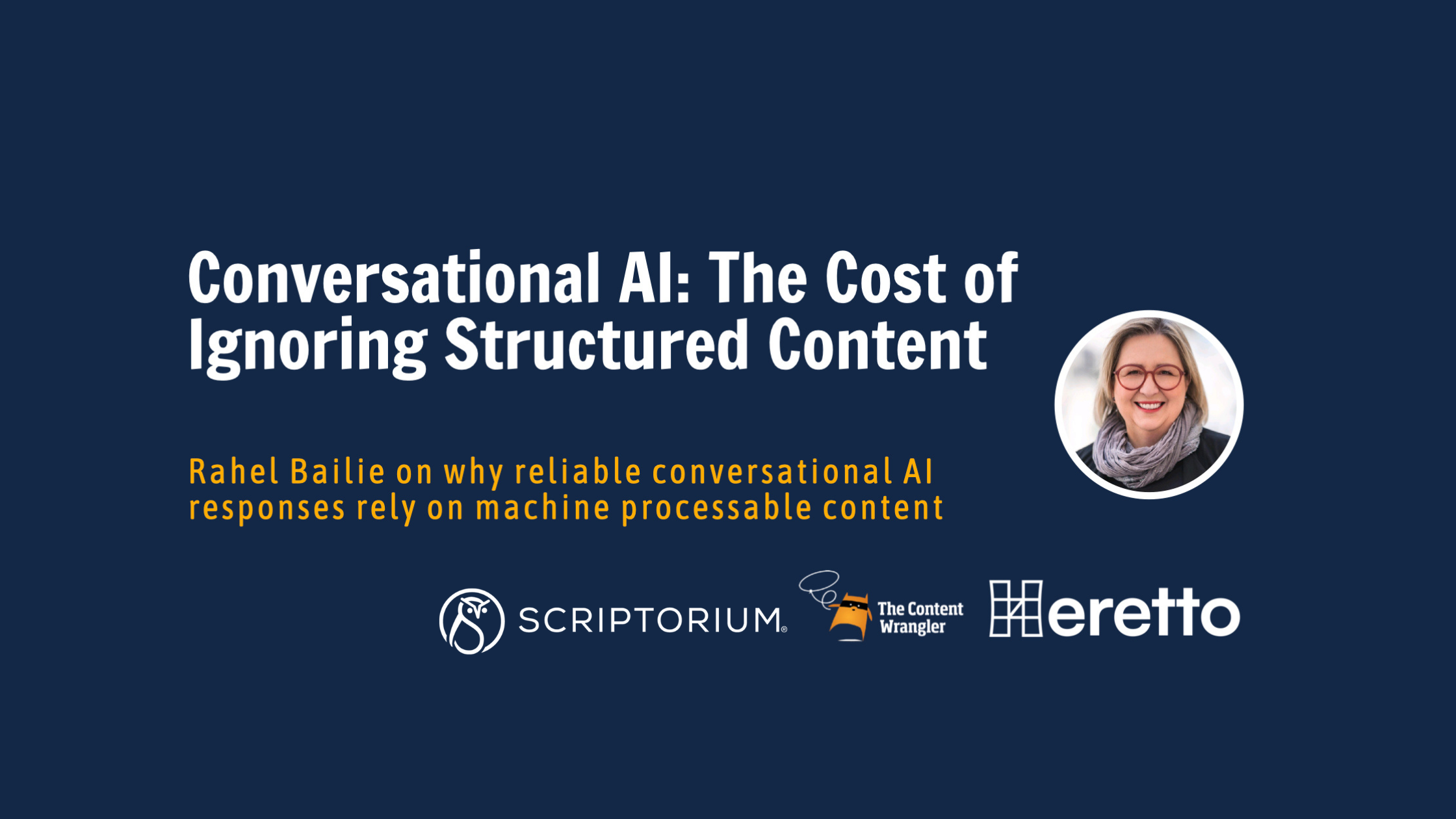
Conversational AI: The cost of ignoring structured content (webinar)

Conversational AI is everywhere, but reliable AI responses depend on reliable content. So, how do you ensure your content is reliable? In this webinar, guest Rahel Bailie, Content Solutions Strategist at Content Seriously, and host Sarah O’Keefe, Founder & CEO of Scriptorium, examined how the intersection of structured content and conversational AI has evolved. They also share practical next steps that organizations can take to create a successful AI content strategy.

Rahel Bailie: How do you know your content is ready for AI? The level 1 test is, “Is the AI agent working well?” If it’s working well, then you go to, “Why isn’t it getting the right answer?” Then, you go to the content. The content can be good or bad and can be measured in a couple of ways. Is the source content marked up well? Does it have the right semantics on it? Does it have the right metadata? Do you have a knowledge graph in the background that’s making these relationships, so that the AI can pull out the right content?


Read More
AI Content management Podcasts Structured content

Taming AI: Using AI for content conversion at scale

AI promises to transform content conversion, but what does it actually look like when you’re processing thousands of documents a day? In this episode, Sarah O’Keefe (Scriptorium) and Rich Dominelli (DCL) dig into the real-world challenges of using AI for large-scale structured content conversion.

Rich Dominelli: If you have millions of articles and you’re asking the AI, ‘What did we do for this project six months ago?” The AI has to find those articles, pull the relevant information out of those articles, summarize it, and hand it back to you. The best way of doing that is to give extra signals to the AI, structured relevant bits of information, front matter, back matter, publication date, keywords, abstract, that allows the AI to query the corpus and get the relevant chunks out of that corpus in a very quick manner. Then, it can summarize what those chunks are. So the AI almost becomes the user interface over that corpus. But to find that data in the first place, structured content is key. Structured content is key when you’re dealing with big indexes and the web, and it’s the same with AI.

Read More
AI Content delivery portal Industry insights Webinar

UI for AI: Responsible content delivery (webinar)

With AI, users are taking control over content delivery through summarization, personalization, translation, and more. But what are the risks? In this webinar, Sarah O’Keefe, CEO of Scriptorium, and Fabrice Lacroix, CEO of Fluid Topics, explore strategies and share examples of UI for AI that empower users while protecting them—and your organization—from misinterpretation, incomplete information, and compliance breaches.

As somebody who works in structured content with metadata, taxonomy, and all those other fun things, we’re telling people, you have to do the work. You have to do the work upfront because once that ingestion step happens and the AI is ingesting not structured, not consistent, not governed, not accurate, not up-to-date content, then what chance does the AI have? The AI is not going to make your content magically more accurate. It’s not magic. I mean, it can do some magic looking things, but it is not magic. Your entropy always wins. Your content will always sort of degenerate, right? So you start for your best possible, and it goes down from there. So what’s the best possible thing that you can get into your database?

— Sarah O’Keefe

Read More
AI CCMS Content management Industry insights Podcasts

Machine experience (MX): Making content work for humans and machines

Your website may look great to humans, but can machines understand it? In this episode, Sarah O’Keefe (Scriptorium) and Tom Cranstoun (Digital Domain Technologies) explore the emerging discipline of machine experience (MX). Sarah and Tom discuss what AI agents actually encounter when they visit your web pages, why microdata and metadata are critical, and what content creators must do to ensure content is consumable for both human and machine audiences.

Tom Cranstoun: Humans are looking for pictures, they’re looking for text, and they can infer. You may think, “Well, we’ve already added information on the page,” but by putting it in as microdata, it doesn’t appear on the page for the humans. It appears on the page for the machine. I think that that’s a critical distinction. We are trying to design for both. We don’t want to overload a human with information, but we do want to give the machine as much information as it can take.

Read More