Upcoming events: An exclusive book preview and more
Get industry-leading insights from Scriptorium at these upcoming events!

Get industry-leading insights from Scriptorium at these upcoming events!
There are five levels of maturity for AI-driven content operations. Which level are you in? In this episode, Sarah O’Keefe and Bill Swallow walk through the AI content ops maturity model, from ad hoc experimentation to fully autonomous workflows.
Sarah O’Keefe: We want this automation, right? We want the ability to go in and extract release notes and do something with them. We have to have a certain level of maturity on the software development process so that we can grab the appropriate information. The same thing is true on the content side. You have to have a certain level of maturity in your content development processes, in your content management, so that you can identify the right things to process and the right things to access.
To a lot of people, the word “taxonomy” sounds intimidating. But what I want content professionals to know is that metadata doesn’t have to be painful. You don’t need to start with a blank page, and you don’t need to reinvent the wheel. The framework already exists, and it’s Dublin Core.
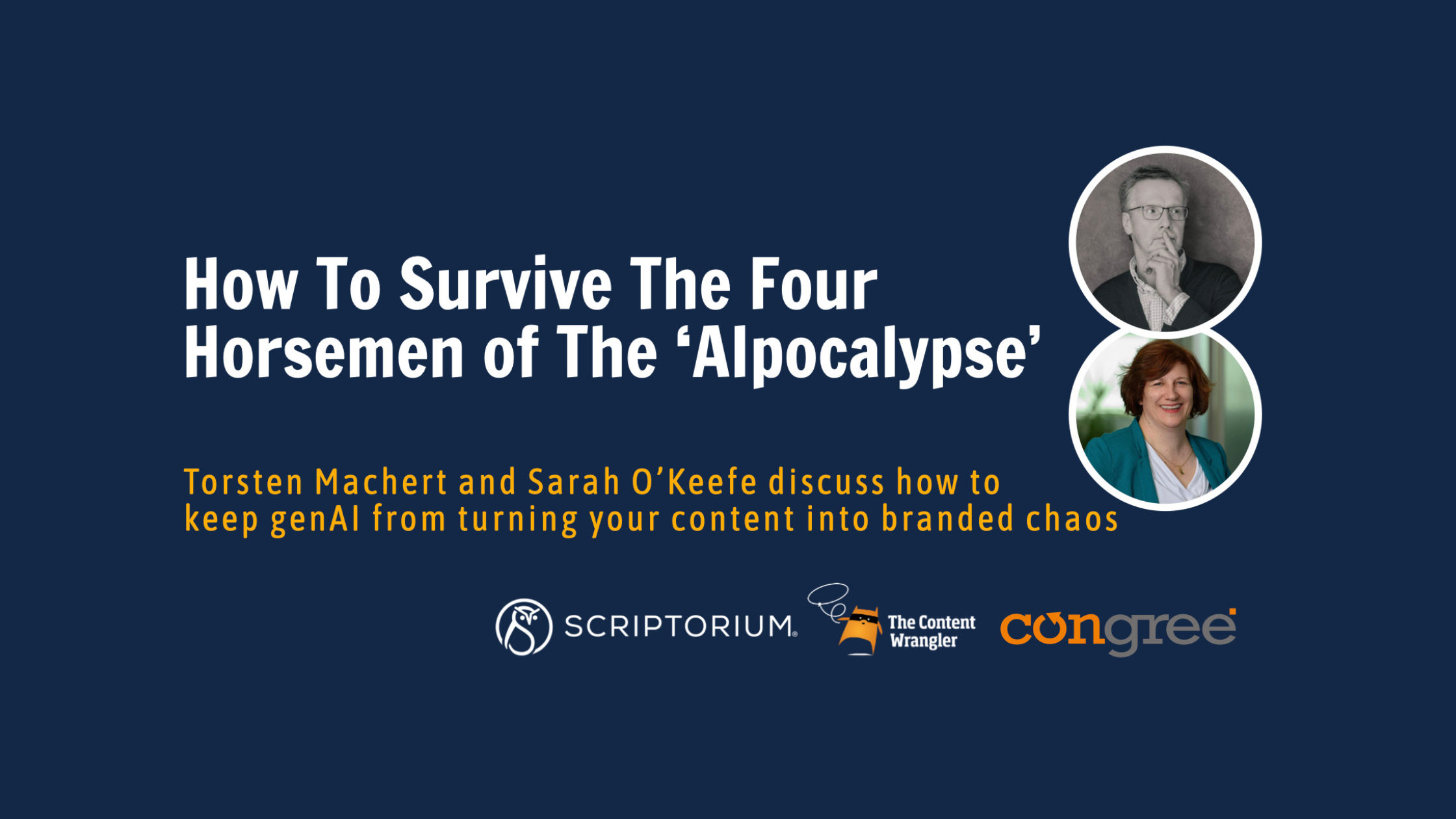
Confront the chaos that generative AI can unleash on your content and discover how to regain control. In this practical session, Torsten Machert (Congree Language Technologies) and Sarah O’Keefe (Scriptorium Publishing) revealed the four biggest threats that undermine quality when you rely on GenAI for content creation.
Sarah O’Keefe: It is way, way cheaper to build out the maturity of your content, to do the terminology work, to do the structure work, to do the metadata work, label everything, give it categories, give it classifications ahead of time than it is to try and remediate the content after the fact, after it’s been processed, after it’s been ingested into the AI and then spit back out. My fear right now is that we’re seeing a lot of, “Ingest everything, spit it back out, then consider how to fix it.”
How do you really choose the right documentation tool? In this podcast episode, Sarah O’Keefe (Scriptorium) talks with Paweł Kowaluk and Michał Skowron (Guidewire Software) about building a successful tool selection process, the realities of docs as code, and what happens when the technology becomes the unpredictable variable.
Paweł Kowaluk: It’s funny how programming used to be deterministic, and it was the people who were messy. We always knew that people are going to be whimsical and maybe harder to rein in, but the technology is going to be predictable. Whereas now, technology is not predictable anymore, and you give it a prompt and you hope it’s going to do what you want. You adjust the system prompts and change the weight of things which are retrieved versus metadata, et cetera, and it doesn’t always work the way you expect it to.
Sarah O’Keefe: And now the people are being asked to be the deterministic layer, right? To be the QA on top of the AI.
Paweł Kowaluk: That’s actually very insightful. I like that. That is true. The human in the loop or whatever you call it, that’s supposed to be the voice of reason.