Author: Bill Swallow

AI Content debt Content management Content pitfalls Localization Podcasts Translation

The debt crisis: AI edition

What happens when you feed years of messy content into AI? In this episode, Bill Swallow and Alan Pringle dig into the content debt crisis, including increased system costs, neglected localization, and the fallout of “just use AI” mandates. They share practical insights to help organizations get back on track.

Alan Pringle: Is your content updated? Does it reflect the latest information? Is it created for all the different locales that your company serves? Is it in different languages? That is another pile of debt that when you start looking at AI, all the problems will be very brutally magnified, and you’re going to have to address them to really have a large language model that works at all.

Read More
AI Content management Podcasts Structured content

From ad hoc to autonomous: The AI content ops maturity model

There are five levels of maturity for AI-driven content operations. Which level are you in? In this episode, Sarah O’Keefe and Bill Swallow walk through the AI content ops maturity model, from ad hoc experimentation to fully autonomous workflows.

Sarah O’Keefe: We want this automation, right? We want the ability to go in and extract release notes and do something with them. We have to have a certain level of maturity on the software development process so that we can grab the appropriate information. The same thing is true on the content side. You have to have a certain level of maturity in your content development processes, in your content management, so that you can identify the right things to process and the right things to access.

Read More
AI Structured content

Good content = good AI: The fundamentals that never change

Good content fundamentals have been the foundation of effective product content for decades, and those same principles are exactly what make content AI-ready today. In this episode, Bill Swallow and Alan Pringle explain how attending to your hierarchy of content needs is the key to AI success.

Alan Pringle: Right now, AI is not going to fix bad content problems. It is going to regurgitate that bad information, giving your end users information that’s flat out wrong. If your content at the basic source level is wrong, your AI by extension is going to be wrong. And that is the unglossy, unvarnished, hard truth that is still, I don’t think, seeping in like it should across the corporate world.

Bill Swallow: It really does come back to the fact that, despite the world changing on a day-to-day basis, the fundamentals have not changed.

Read More
AI Localization Podcasts

Balancing automation, accuracy, and authenticity: AI in localization

How can global brands use AI in localization without losing accuracy, cultural nuance, and brand integrity? In this podcast, host Bill Swallow and guest Steve Maule explore the opportunities, risks, and evolving roles that AI brings to the localization process.

The most common workflow shift in translation is to start with AI output, then have a human being review some or all of that output. It’s rare that enterprise-level companies want a fully human translation. However, one of the concerns that a lot of enterprises have about using AI is security and confidentiality. We have some customers where it’s written in our contract that we must not use AI as part of the translation process. Now, that could be for specific content types only, but they don’t want to risk personal data being leaked. In general, though, the default service now for what I’d call regular common translation is post editing or human review of AI content. The biggest change is that’s really become the norm.

Steve Maule, VP of Global Sales at Acclaro

Read More
Webinar

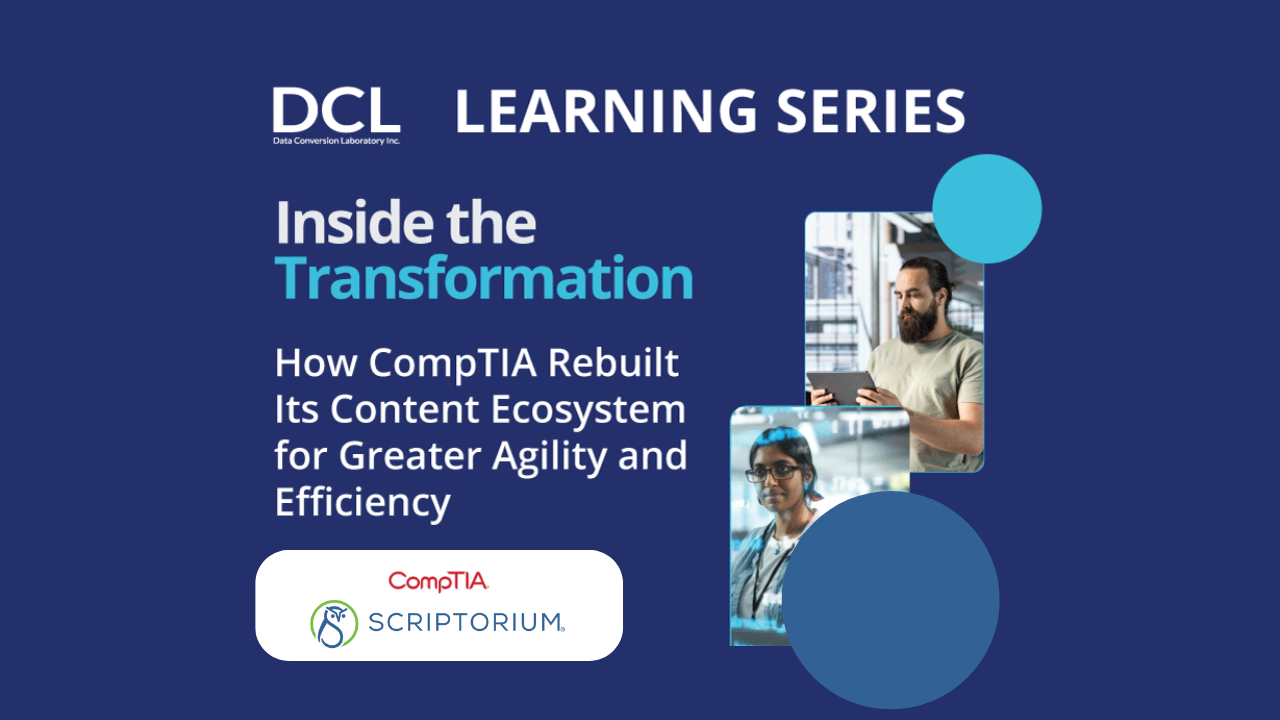
How CompTIA rebuilt its content ecosystem for greater agility and efficiency (webinar)

After an acquisition, CompTIA faced the challenge of unifying multiple content systems, editorial teams, and delivery formats. To tackle this, they implemented a centralized, structured content model supported by a robust content management system. This webinar details how CompTIA overhauled its content operations from strategy through implementation without a pause in production.

Now we’re going to start seeing the true benefits of working in DITA, which is what I’m most excited about. We can maintain our content easily and focus on where things are changing versus converting, rearranging, or recopying content. I’m excited to see how our efficiencies gain as we move into our refresh cycle.

— Becky Mann

Read More
CCMS CMS Content management Content pitfalls Headless CMS Learning content LMS Podcasts

Tool or trap? Find the problem, then the platform

Tempted to jump straight to a new tool to solve your content problems? In this episode, Alan Pringle and Bill Swallow share real-world stories that show how premature solutioning without proper analysis can lead to costly misalignment, poor adoption, and missed opportunities for company-wide operational improvement.

Bill Swallow: On paper, it looked like a perfect solution. But everyone, including the people who greenlit the project, hated it. Absolutely hated it. Why? It was difficult to use, very slow, and very buggy. Sometimes it would crash and leave processes running, so you couldn’t relaunch it. There was no easy way to use it. So everyone bypassed using it at every opportunity.

Alan Pringle: It sounds to me like there was a bit of a fixation. This product checked all the boxes without actually doing any in-depth analysis of what was needed, much less actually thinking about what users needed and how that product could fill those needs.

Read More
Localization

Going global: Getting started with content localization

Have you been asked to deliver your content in another language but don’t know where to begin? The decisions you make early on when designing and developing your content can make or break your translation and production processes. It’s very hard (and expensive) to make changes as you run into problems during translation or production. It’s even worse when the problems are discovered by the consumers!

Let’s begin with some definitions and then take a look at what you can do to prepare for localization and how translators perform their work.

Read More
CCMS Content reuse DITA Localization Podcasts Structured content

Conquering content localization: strategies for success (podcast)

Translation troubles? This podcast is for you! In episode 173 of The Content Strategy Experts podcast, Bill Swallow and special guest Mike McDermott, Director of Language Services at MadTranslations, share strategies for overcoming common content localization challenges and unlocking new market opportunities.

Mike McDermott: It gets very cumbersome to continually do these manual steps to get to a translation update. Once the authoring is done, ideally you just send it right through translation and the process starts.

Bill Swallow: So from an agile point of view, I am assuming that you’re talking about not necessarily translating an entire publication from page one to page 300, but you’re saying as soon as a particular chunk of content is done and “blessed,” let’s say, by reviewers in the native language, then it can immediately go off to translation even if other portions are still in progress.

Mike McDermott: Exactly. That’s what working in this semantic content and these types of environments will do for a content creator. You don’t need to wait for the final piece of content to be finalized to get things into translation.

Read More
Case studies CCMS CMS Content management DITA Replatforming Structured content

Replatforming an early DITA implementation

Bill Swallow, Director of Operations at Scriptorium, and Emilie Herman, Director of Publishing at the Financial Accounting Foundation (FAF), shared lessons learned from a DITA implementation project. 

What did we want to accomplish with our project? One was to develop a single source of truth for our content, a single system to host all of it. Secondly, we wanted to modernize our information architecture and our content models and document all of it clearly. Lastly, we wanted to futureproof our content operations and go to a digital-first workflow.

— Emilie Herman

Read More