Author: Sarah O'Keefe

Learning content LMS Structured learning content Webinar

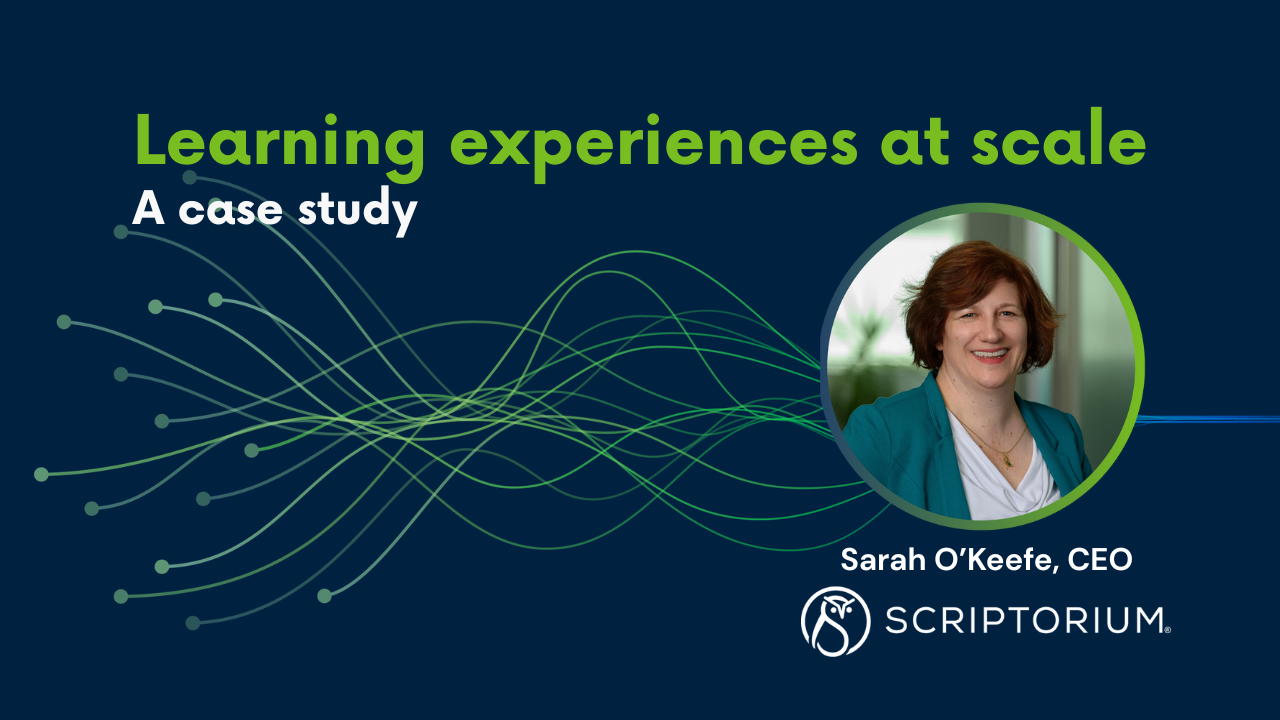
Learning experiences at scale, a case study presented by Sarah O’Keefe

Ready to learn how robust content operations keep pace with evolving and complex learning demands? In this webinar, Sarah O’Keefe, the founder and CEO of Scriptorium, describes the successful implementation of a component content management system (CCMS). This project was for a major organization that supports technology professionals with training and certifications.

The level of interest and commitment that we had from the client’s team was a big deal. They now have structured learning content. They have the scalability and reuse they needed and could not get any other way. We aligned their content ops with their business goals of scalability, reuse, and time to market.

Sarah O’Keefe

Read More
AI Industry insights Podcasts

From black box to business tool: Making AI transparent and accountable

As AI adoption accelerates, accountability and transparency issues are accumulating quickly. What should organizations be looking for, and what tools keep AI transparent? In this episode, Sarah O’Keefe sits down with Nathan Gilmour, the Chief Technical Officer of Writemore AI, to discuss a new approach to AI and accountability.

Sarah O’Keefe: Okay. I’m not going to ask you why this is the only AI tool I’ve heard about that has this type of audit trail, because it seems like a fairly important thing to do.

Nathan Gilmour: It is very important because there are information security policies. AI is this brand-new, shiny, incredibly powerful tool. But in the grand scheme of things, these large language models, the OpenAIs, the Claudes, the Geminis, they’re largely black boxes. We want to bring clarity to these black boxes and make them transparent, because organizations do want to implement AI tools to offer efficiencies or optimizations within their organizations. However, information security policies may not allow it.

Read More
AI Structured content Webinar

Why Cheap Content Is Expensive and How to Fix It, featuring Dawn Stevens

Will cheap content cost your organization more in the long run? In this webinar, host Sarah O’Keefe and guest Dawn Stevens share how poor workflows, inaccurate source data, and the commoditization race can undermine both product quality and brand trust. Sarah and Dawn also discuss why strategic staffing and mature content ops create the foundation your AI initiatives need to deliver reliable content at scale.

Sarah O’Keefe: I write content that’s great for today. Tomorrow, a new development occurs, and my content is now wrong. We’re down the road of “entropy always wins.” We’re heading towards chaos, and if we don’t care for the content, it’ll fall apart. So what does it look like to have a well-functioning organization with an appropriate balance of automation, AI, and staffing?

Dawn Stevens: I think that goes back to the age-old question of, “What are the skills that we really think are valuable?” We have to see technical documentation as part of the product, not just supporting the product. That means that we, as writers, are involved in all of the design. As we design the documentation, we’re helping design the UX.

Read More
AI Content pitfalls Podcasts Structured content

Futureproof your content ops for the coming knowledge collapse

What happens when AI accelerates faster than your content can keep up? In this podcast, host Sarah O’Keefe and guest Michael Iantosca break down the current state of AI in content operations and what it means for documentation teams and executives. Together, they offer a forward-thinking look at how professionals can respond, adapt, and lead in a rapidly shifting landscape.

Sarah O’Keefe: How do you talk to executives about this? How do you find that balance between the promise of what these new tool sets can do for us, what automation looks like, and the risk that is introduced by the limitations of the technology? What’s the roadmap for somebody that’s trying to navigate this with people that are all-in on just getting the AI to do it?

Michael Iantosca: We need to remind them that the current state of AI still carries with it a probabilistic nature. And no matter what we do, unless we add more deterministic structural methods to guardrail it, things are going to be wrong even when all the input is right.

Read More
AI Content debt Podcasts

The five stages of content debt

Your organization’s content debt costs more than you think. In this podcast, host Sarah O’Keefe and guest Dipo Ajose-Coker unpack the five stages of content debt from denial to action. Sarah and Dipo share how to navigate each stage to position your content—and your AI—for accuracy, scalability, and global growth.

The blame stage: “It’s the tools. It’s the process. It’s the people.” Technical writers hear, “We’re going to put you into this department, and we’ll get this person to manage you with this new agile process,” or, “We’ll make you do things this way.” The finger-pointing begins. Tech teams blame the authors. Authors blame the CMS. Leadership questions the ROI of the entire content operations team. This is often where organizations say, “We’ve got to start making a change.” They’re either going to double down and continue building content debt, or they start looking for a scalable solution.

— Dipo Ajose-Coker

Read More
AI Learning content Podcasts

From classrooms to clicks: the future of training content

AI, self-paced courses, and shifting demand for instructor-led classes—what’s next for the future of training content? In this podcast, Sarah O’Keefe and Kevin Siegel unpack the challenges, opportunities, and what it takes to adapt.

There’s probably a training company out there that’d be happy to teach me how to use WordPress. I didn’t have the time, I didn’t have the resources, nothing. So I just did it on my own. That’s one example of how you can use AI to replace some training. And when I don’t know how to do something these days, I go right to YouTube and look for a video to teach me how to do it. But given that, there are some industries where you can’t get away with that. Healthcare is an exampleyou’re not going to learn how to do brain surgery that someone could rely on with AI or through a YouTube video.

— Kevin Siegel

Read More