Author: Sarah O'Keefe

AI Content delivery portal Industry insights Webinar

UI for AI: Responsible content delivery (webinar)

With AI, users are taking control over content delivery through summarization, personalization, translation, and more. But what are the risks? In this webinar, Sarah O’Keefe, CEO of Scriptorium, and Fabrice Lacroix, CEO of Fluid Topics, explore strategies and share examples of UI for AI that empower users while protecting them—and your organization—from misinterpretation, incomplete information, and compliance breaches.

As somebody who works in structured content with metadata, taxonomy, and all those other fun things, we’re telling people, you have to do the work. You have to do the work upfront because once that ingestion step happens and the AI is ingesting not structured, not consistent, not governed, not accurate, not up-to-date content, then what chance does the AI have? The AI is not going to make your content magically more accurate. It’s not magic. I mean, it can do some magic looking things, but it is not magic. Your entropy always wins. Your content will always sort of degenerate, right? So you start for your best possible, and it goes down from there. So what’s the best possible thing that you can get into your database?

— Sarah O’Keefe

Read More
AI CCMS Content management Industry insights Podcasts

Machine experience (MX): Making content work for humans and machines

Your website may look great to humans, but can machines understand it? In this episode, Sarah O’Keefe (Scriptorium) and Tom Cranstoun (Digital Domain Technologies) explore the emerging discipline of machine experience (MX). Sarah and Tom discuss what AI agents actually encounter when they visit your web pages, why microdata and metadata are critical, and what content creators must do to ensure content is consumable for both human and machine audiences.

Tom Cranstoun: Humans are looking for pictures, they’re looking for text, and they can infer. You may think, “Well, we’ve already added information on the page,” but by putting it in as microdata, it doesn’t appear on the page for the humans. It appears on the page for the machine. I think that that’s a critical distinction. We are trying to design for both. We don’t want to overload a human with information, but we do want to give the machine as much information as it can take.

Read More
AI Content governance Content management Podcasts

Who controls your content? AI and content governance

What does it actually mean to govern your content in the age of AI, and who’s really in control? In this episode, Sarah O’Keefe sits down with Patrick Bosek, CEO of Heretto, to unpack why the quality, accuracy, and structure of your content may be the most critical factors in what your users experience on the other side of an AI model.

Patrick Bosek: In today’s world, you don’t have 100% control. There are a couple of different places where this needs to be broken up. One is the end user: what they physically get and what control they have versus what control you have. Then, there’s what control you have of how the AI model is going to behave based on your information and your inputs. Whether or that model is public, like a user accessing your documentation through Claude Desktop, or private, like a user accessing your documentation through your app or website, the governance piece comes down to what control you have immediately before the model. And that breaks down into a couple of things: completeness, accuracy, and structure of the content.

Read More
AI Industry insights Webinar

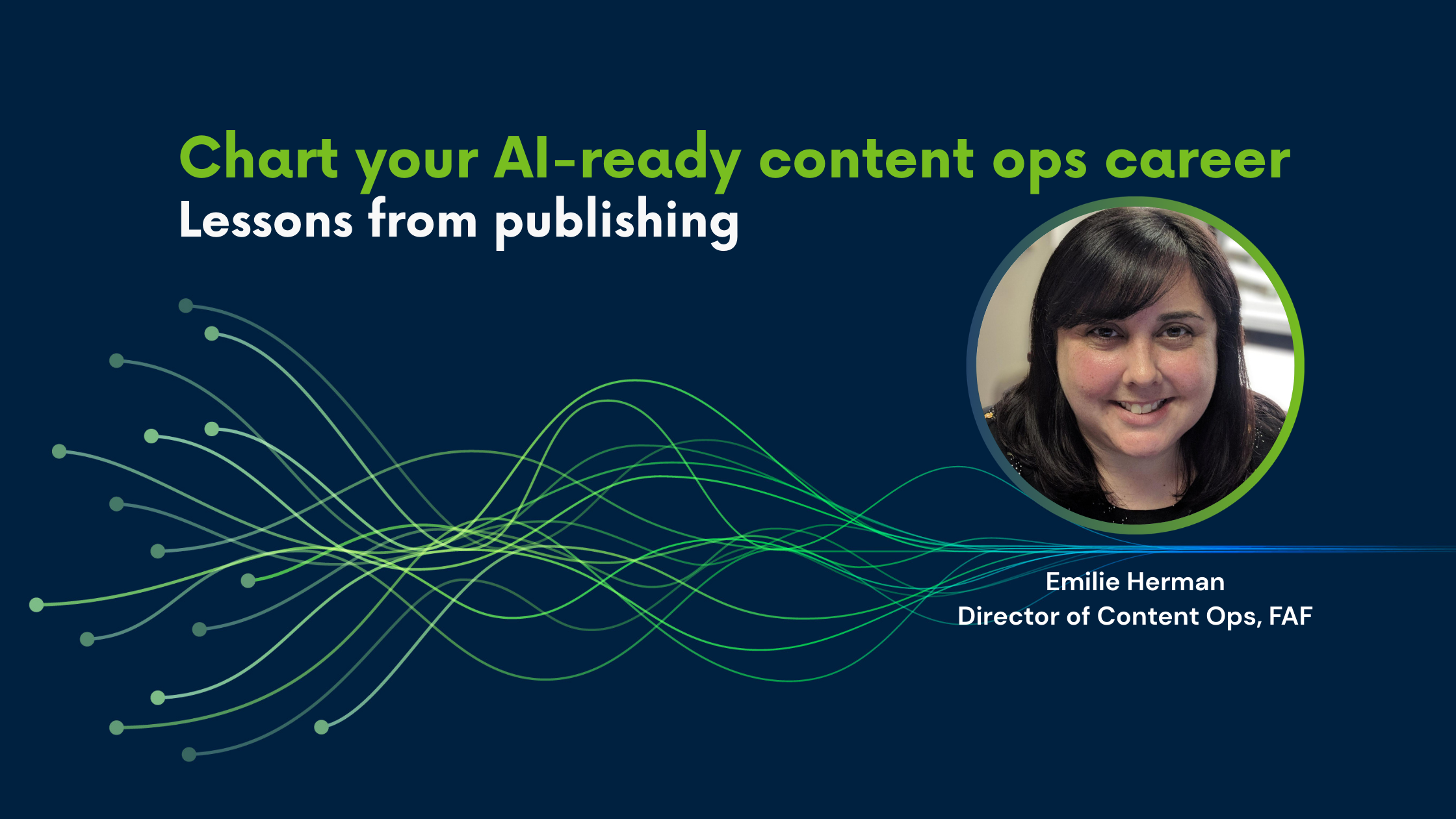
Chart your AI-ready content ops career (webinar)

In this webinar, Emilie Herman, Director of Content Operations at the Financial Accounting Foundation (FAF), shares lessons from her career journey. Through the lens of publishing services and large-scale content workflows, Emilie shows how the shift from manual processes to automation mirrors what’s happening with AI, and how these adaptation techniques apply to your content ops career.

It’s isolating when you feel like it’s all on you to figure out how to reinvent your career. Reach out and talk to people. It’s nice to make a human connection, which is very important to get past AI, but also to look at what other people are doing. Collaborate, talk things through, and acknowledge that everybody’s trying to figure things out. People want to experiment! There’s strength in numbers. If you have a manager, mentor, or someone who can help put you in the room to be part of the discussion, you feel empowered to take control of your destiny.

— Emilie Herman

Read More
Learning content LMS Structured learning content Webinar

Learning experiences at scale, a case study presented by Sarah O’Keefe

Ready to learn how robust content operations keep pace with evolving and complex learning demands? In this webinar, Sarah O’Keefe, the founder and CEO of Scriptorium, describes the successful implementation of a component content management system (CCMS). This project was for a major organization that supports technology professionals with training and certifications.

The level of interest and commitment that we had from the client’s team was a big deal. They now have structured learning content. They have the scalability and reuse they needed and could not get any other way. We aligned their content ops with their business goals of scalability, reuse, and time to market.

Sarah O’Keefe

Read More
AI Industry insights Podcasts

From black box to business tool: Making AI transparent and accountable

As AI adoption accelerates, accountability and transparency issues are accumulating quickly. What should organizations be looking for, and what tools keep AI transparent? In this episode, Sarah O’Keefe sits down with Nathan Gilmour, the Chief Technical Officer of Writemore AI, to discuss a new approach to AI and accountability.

Sarah O’Keefe: Okay. I’m not going to ask you why this is the only AI tool I’ve heard about that has this type of audit trail, because it seems like a fairly important thing to do.

Nathan Gilmour: It is very important because there are information security policies. AI is this brand-new, shiny, incredibly powerful tool. But in the grand scheme of things, these large language models, the OpenAIs, the Claudes, the Geminis, they’re largely black boxes. We want to bring clarity to these black boxes and make them transparent, because organizations do want to implement AI tools to offer efficiencies or optimizations within their organizations. However, information security policies may not allow it.

Read More
AI Structured content Webinar

Why Cheap Content Is Expensive and How to Fix It, featuring Dawn Stevens

Will cheap content cost your organization more in the long run? In this webinar, host Sarah O’Keefe and guest Dawn Stevens share how poor workflows, inaccurate source data, and the commoditization race can undermine both product quality and brand trust. Sarah and Dawn also discuss why strategic staffing and mature content ops create the foundation your AI initiatives need to deliver reliable content at scale.

Sarah O’Keefe: I write content that’s great for today. Tomorrow, a new development occurs, and my content is now wrong. We’re down the road of “entropy always wins.” We’re heading towards chaos, and if we don’t care for the content, it’ll fall apart. So what does it look like to have a well-functioning organization with an appropriate balance of automation, AI, and staffing?

Dawn Stevens: I think that goes back to the age-old question of, “What are the skills that we really think are valuable?” We have to see technical documentation as part of the product, not just supporting the product. That means that we, as writers, are involved in all of the design. As we design the documentation, we’re helping design the UX.

Read More