
Curation analytics take a step forward
My 2011 predictions post included a brief mention of curation analytics. This week, we have news from MindTouch that supports my thought that accountability in technical communication will increase.

My 2011 predictions post included a brief mention of curation analytics. This week, we have news from MindTouch that supports my thought that accountability in technical communication will increase.
Technical communication is in the midst of a huge transition from a craft/artisan model to an engineering model. Our consultants are the vanguard of this transition, and as a result, we are experiencing significant challenges in finding new employees.
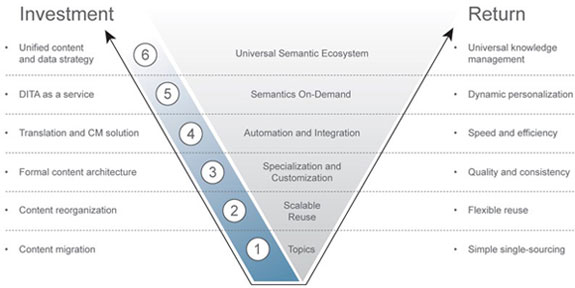
The initial wave of DITA implementations is still building, but we are already seeing the early adopters move on to what I am calling DITA, The Sequel.
In addition to mixed column and copyfitting, the shift from desktop publishing to structured authoring may result in the demise of the traditional index.
Originally published in tcworld e-magazine, July 2011
In Europe before the 1450s, books were precious, rare objects and were usually copied by hand over a period of months or years. Johannes Gutenberg and his printing press changed the economics of information distribution.
I’m having some trouble with the idea of “extending DITA” outside the world of technical communication. DITA is obviously important in the right environment, but should we be advocating the use of DITA for more and more content?
I have struggled to understand the keyref and conkeyref features added in DITA 1.2.
It wasn’t until we started applying them to our proposal workflow that I finally understood them. I hope this use case also helps others.
“Content is an asset worthy of being managed,” says Scott Abel. I agree that good content is an asset. Bad content is a liability. It’s time to talk about the shameful underbelly of technical communication.
Most of the DITA work that we do at Scriptorium is “full-on” implementation. That is, our customer decides to move their content from [something that is not DITA] to a DITA-based system. There are variations on the theme, of course, but nearly all of our customers are concerned about managing localization costs and increasing content reuse.
The Darwin Information Typing Architecture (DITA) provides an XML architecture for technical communication. Although implementing DITA is likely to be faster and easier than building your own XML architecture from the ground up, DITA is not suitable for everyone.