ConVEx

Are you ready for Content as a Service? Join Sarah O’Keefe on Tuesday, May 3rd at 8:30 a.m. Mountain Time and explore what it means to make information available upon request with Content as a Service (CaaS).

More customers are demanding personalized content, and your organization needs a plan to deliver it. But where do you start, and how do you coordinate your efforts for consistent content personalization across the enterprise? Gretyl Kinsey presents Personalized content: Steps to success on Wednesday, May 4th at 8:30 a.m. MT.

Connect with us in the Community Hall!

Read More
AI CCMS Content management Industry insights Podcasts

Digital sovereignty in the age of AI

Are you in control of your digital destiny? In this episode, Alan Pringle and Sarah O’Keefe define digital sovereignty. They break down what organizations need to consider as they bring AI into content operations, from data leakage and competitive intelligence to shifting international regulations.

Sarah O’Keefe: The working definition that I’m using is that digital sovereignty is control over your own digital assets, digital destiny. That could be you personally, it could be you as an organization, or it could be you as a country or as a group of nations. And when I say group of nations, probably 98% of the time I’m talking about the EU, which has some laws in this regard. Digital sovereignty is your ability to control, own, and manage your digital assets and how they are used, reused, processed, resold, repurposed, and all the rest of it.

Read More
Learning content LMS Structured learning content Webinar

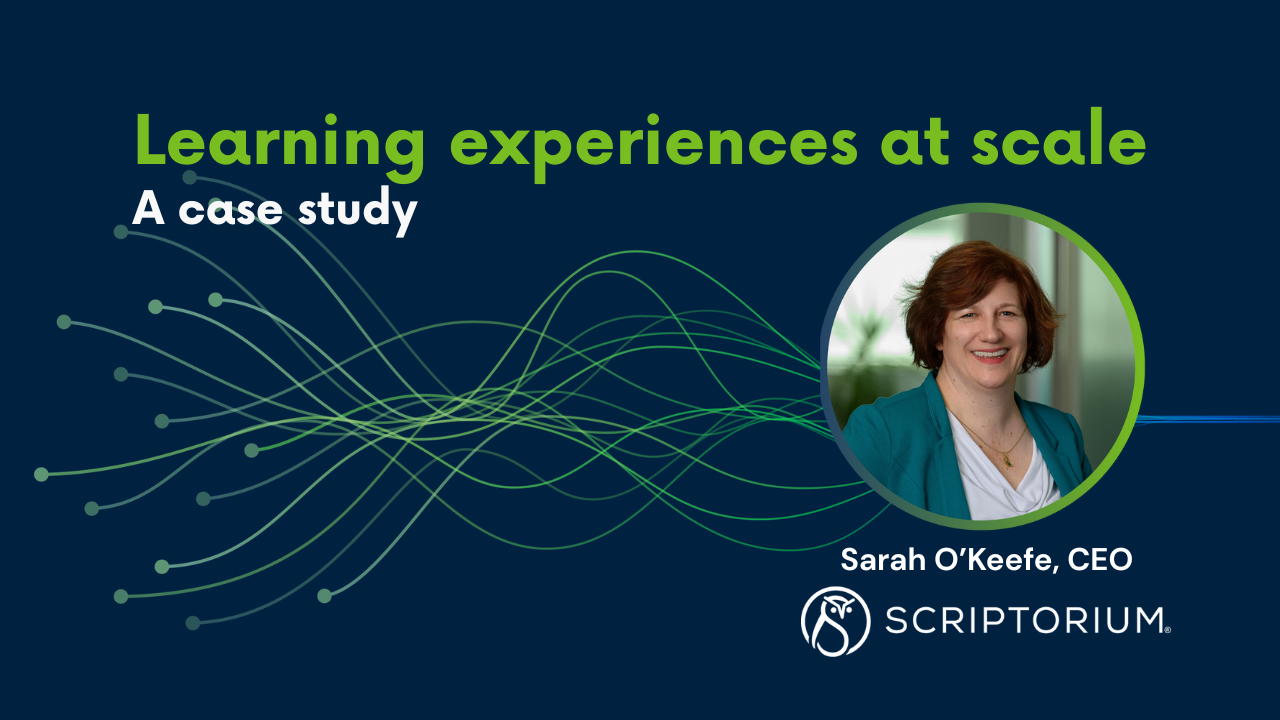
Learning experiences at scale, a case study presented by Sarah O’Keefe

Ready to learn how robust content operations keep pace with evolving and complex learning demands? In this webinar, Sarah O’Keefe, the founder and CEO of Scriptorium, describes the successful implementation of a component content management system (CCMS). This project was for a major organization that supports technology professionals with training and certifications.

The level of interest and commitment that we had from the client’s team was a big deal. They now have structured learning content. They have the scalability and reuse they needed and could not get any other way. We aligned their content ops with their business goals of scalability, reuse, and time to market.

Sarah O’Keefe

Read More
AI Industry insights Podcasts

From black box to business tool: Making AI transparent and accountable

As AI adoption accelerates, accountability and transparency issues are accumulating quickly. What should organizations be looking for, and what tools keep AI transparent? In this episode, Sarah O’Keefe sits down with Nathan Gilmour, the Chief Technical Officer of Writemore AI, to discuss a new approach to AI and accountability.

Sarah O’Keefe: Okay. I’m not going to ask you why this is the only AI tool I’ve heard about that has this type of audit trail, because it seems like a fairly important thing to do.

Nathan Gilmour: It is very important because there are information security policies. AI is this brand-new, shiny, incredibly powerful tool. But in the grand scheme of things, these large language models, the OpenAIs, the Claudes, the Geminis, they’re largely black boxes. We want to bring clarity to these black boxes and make them transparent, because organizations do want to implement AI tools to offer efficiencies or optimizations within their organizations. However, information security policies may not allow it.

Read More
AI Localization Podcasts

Balancing automation, accuracy, and authenticity: AI in localization

How can global brands use AI in localization without losing accuracy, cultural nuance, and brand integrity? In this podcast, host Bill Swallow and guest Steve Maule explore the opportunities, risks, and evolving roles that AI brings to the localization process.

The most common workflow shift in translation is to start with AI output, then have a human being review some or all of that output. It’s rare that enterprise-level companies want a fully human translation. However, one of the concerns that a lot of enterprises have about using AI is security and confidentiality. We have some customers where it’s written in our contract that we must not use AI as part of the translation process. Now, that could be for specific content types only, but they don’t want to risk personal data being leaked. In general, though, the default service now for what I’d call regular common translation is post editing or human review of AI content. The biggest change is that’s really become the norm.

Steve Maule, VP of Global Sales at Acclaro

Read More
AI Localization Podcasts

AI in localization: What could possibly go wrong? (podcast)

In this episode of the Content Operations podcast, Sarah O’Keefe and Bill Swallow unpack the promise, pitfalls, and disruptive impact of AI on multilingual content. From pivot languages to content hygiene, they explore what’s next for language service providers and global enterprises alike.

Bill Swallow: I think it goes without saying that there’s going to be disruption again. Every single change, whether it’s in the localization industry or not, has resulted in some type of disruption. Something has changed. I’ll be blunt about it. In some cases, jobs were lost, jobs were replaced, new jobs were created. For LSPs, I think AI is going to, again, be another shift, the same that happened when machine translation came out. LSPs had to shift and pivot how they approach their bottom line with people. GenAI is going to take a lot of the heavy lifting off of the translators, for better or for worse, and it’s going to force a copy edit workflow. I think it’s really going to be a model where people are going to be training and cleaning up after AI.

Read More