Come see Scriptorium at these upcoming events
We’re ready to bring you more industry-leading content ops insights in 2026! Check out these upcoming events.

We’re ready to bring you more industry-leading content ops insights in 2026! Check out these upcoming events.

The second most common question we get about DITA-based systems is “How do we publish nice-looking PDFs?” (First, by far, is “How do we migrate our content into DITA?”)

Ready to maximize your publishing opportunities? Learn how to customize the DITA-OT in our new course.
Struggling to get the right content to the right people, exactly when and where they need it? In this podcast, Scriptorium CEO Sarah O’Keefe and Fluid Topics CEO Fabrice Lacroix explore dynamic content delivery—pushing content beyond static PDFs into flexible platforms that power search, personalization, and multi-channel distribution.
When we deliver the content, whether it’s through the APIs or the portal that you’ve built that is served by the platform, we render the content in a way that we can dynamically remove or hide parts of the content that would not apply to the context, the profile of the user. That’s the magic of a CDP. It’s delivering that content dynamically.
— Fabrice Lacroix
In this episode, Alan Pringle, Bill Swallow, and Christine Cuellar explore how structured learning content supports the learning experience. They also discuss the similarities and differences between structured content for learning content and technical (techcomm) content.
Even if you are significantly reusing your learning content, you’re not just putting the same text everywhere. You can add personalization layers to the content and tailor certain parts of the content that are specific to your audience’s needs. If you were in a copy-and-paste scenario, you’d have to manually update it every single time you want to make a change. That scenario also makes it a lot more difficult to update content as you modify it for specific audiences over time, because you may not find everywhere a piece of information has been used and modified when you need to update it.
— Bill Swallow

With a LearningDITA group license, your company has centralized course management for your DITA team training. You can buy course licenses in bulk, assign courses to individual team members, and keep track of course completion. As your team grows, you can increase your quantity of course licenses or add new courses. Our group licensing page tells you how!
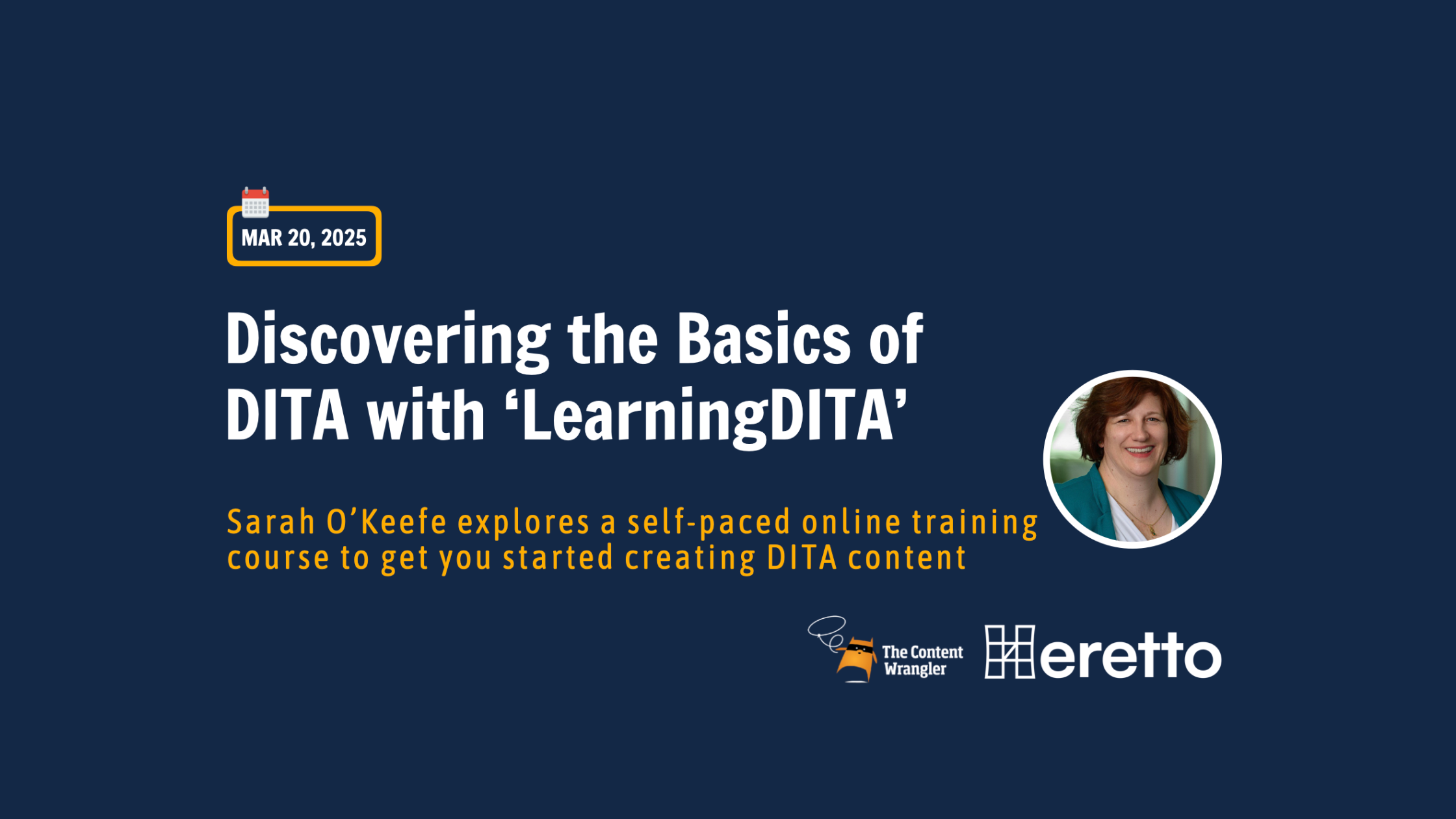
In this webinar, Sarah O’Keefe shares the basics of DITA—what it is, why it’s crucial for creating structured content, and how it revolutionizes consistency and efficiency in documentation. By exploring core elements such as topics, maps, and metadata, along with DITA specializations like task, concept, and reference topics, you’ll learn why organizations around the globe use DITA to craft modular, reusable content and put it to work.
You’ll be introduced to a self-paced, online DITA training resource called LearningDITA. Lessons include exercises, links to additional resources and videos, and quizzes to test your knowledge.
What DITA offers is a mechanism for extensibility that doesn’t break the standard. If you’re going to try to build out a system that is futureproof, as best we can without knowing the future, then we need flexibility. We need the ability to change things as we go, to extend, to add new output types, to add new semantics, to add new metadata, to add new systems into the equation.
— Sarah O’Keefe
In this episode of our Let’s Talk ContentOps webinar series, Scott Abel, The Content Wrangler himself, talks about the future of content operations in the age of artificial intelligence. You may know Scott from his work as a consultant, conference presenter, and talk show host, but in this session, we turn the spotlight back on Scott and ask him what HE thinks about the future of content ops.
Viewers will learn how AI is reshaping content operations, including:
In this episode, Alan Pringle, Gretyl Kinsey, and Allison Beatty discuss LearningDITA, a hub for training on the Darwin Information Typing Architecture (DITA). They dive into the story behind LearningDITA, explore our course topics, and more.
Gretyl Kinsey: Over time that user base grew and grew. And now it boggles my mind that it got all the way up to 16,000 users. I never expected it to grow to that size.
Alan Pringle: Well, we didn’t really either, nor did our infrastructure. Because as of late 2024, things started to go a little sideways, and it became clear our tech stack was not going to be able to sustain more students. It was very creaky. The site wasn’t performing well. So we made a decision that we needed to take the site offline, and we did, to basically redo it on a new platform.
Your wait is over! LearningDITA is open again, and it’s running on a new platform to give you a better learning experience.

Will DITA bring enough value to your content operations to justify the investment costs? Calculate your DITA ROI to decide.
I found this article in the 2010 (!!) archives and have updated it. Surprisingly, the general gist is still accurate.
There are numerous alternatives for producing PDF output from DITA content. The approach you choose will depend on your output requirements—do you need images floating in text, sidebars, and unique layouts on each page? How often do you republish content? How much content do you publish? Do you need to create variants for different audiences? Do you provide content in multiple languages?

LavaCon 2024 delivered actionable insights, emphasizing that your business case for content operations requires strong alignment with business goals. Successful content modernization hinges on executive support, effective change management, and a wary eye on AI.

Whether you’re surviving a content operations project or a journey through treacherous caverns, it’s crucial to plan your way out before you begin. In episode 176 of the Content Strategy Experts podcast, Alan Pringle and Christine Cuellar unpack the parallels between navigating horror-filled caves and building a content ops exit strategy.
Alan Pringle: When you’re choosing tools, if you end up something that is super proprietary, has its own file formats, and so on, that means it’s probably gonna be harder to extract your content from that system. A good example of this is those of you with Samsung Android phones. You have got this proprietary layer where it may even insert things into your source code that is very particular to that product line. So look at how proprietary your tool or toolchain is and how hard it’s going to be to export. That should be an early question you ask during even the RFP process. How do people get out of your system? I realize that sounds absolutely bat-you-know-what to be telling people to be thinking about something like that when you’re just getting rolling–
Christine Cuellar: Appropriate for a cave analogy, right?
Alan Pringle: Yes, true. But you should be, you absolutely should be.
Are you looking for real-world examples of enterprise content operations in action? Join Sarah O’Keefe and special guest Adam Newton, Senior Director of Globalization, Product Documentation, & Business Process Automation at NetApp for episode 175 of The Content Strategy Experts podcast. Hear insights from NetApp’s journey to enterprise-level publishing, lessons learned from leading-edge GenAI tool development, and more.
We have writers in our authoring environment who are not writers by nature or bias. They’re subject matter experts. And they’re in our system and generating content. That was about joining us in our environment, reap the benefits of multi-language output, reap the benefits of fast updates, reap the benefits of being able to deliver a web-like experience as opposed to a PDF. But what I think we’ve found now is that this is a data project. This generative AI assistant has changed my thinking about what my team does. Yes, on one level, we have a team of writers devoted to producing the docs. But in another way, you can look at it and say, well, we’re a data engine.
— Adam Newton
Translation troubles? This podcast is for you! In episode 173 of The Content Strategy Experts podcast, Bill Swallow and special guest Mike McDermott, Director of Language Services at MadTranslations, share strategies for overcoming common content localization challenges and unlocking new market opportunities.
Mike McDermott: It gets very cumbersome to continually do these manual steps to get to a translation update. Once the authoring is done, ideally you just send it right through translation and the process starts.
Bill Swallow: So from an agile point of view, I am assuming that you’re talking about not necessarily translating an entire publication from page one to page 300, but you’re saying as soon as a particular chunk of content is done and “blessed,” let’s say, by reviewers in the native language, then it can immediately go off to translation even if other portions are still in progress.
Mike McDermott: Exactly. That’s what working in this semantic content and these types of environments will do for a content creator. You don’t need to wait for the final piece of content to be finalized to get things into translation.

It’s hard to believe that the DITA standard needs additional tags. I tried counting them, but gave up at 150, when I had only reached the letter G. (Be my guest: https://www.oxygenxml.com/dita/1.3/specs/langRef/quick-reference/all-elements-a-to-z.html)
When organizations replatform from one content management system to another, unchecked technical debt can weigh down the new system. In contrast, strategic replatforming can be a tool for reducing technical debt. In episode 172 of The Content Strategy Experts podcast, Sarah O’Keefe and Bill Swallow share how to set your replatforming project up for success.
Here’s the real question I think you have to ask before replatforming—is the platform actually the problem? Is it legitimately broken? As Bill said, has it evolved away from the business requirements to a point where it no longer meet your needs? Or there are some other questions to ask, such as, what are your processes around that platform? Do you have weird, annoying, and inefficient processes?
— Sarah O’Keefe

Technical debt, hereafter called “content debt,” is “the implied cost of future reworking required when choosing an easy but limited solution instead of a better approach that could take more time,” Wikipedia, “Technical debt.”. Like financial debt, content debt isn’t always a bad thing. You can use a loan to buy a house right away (at least in the U.S.) and then pay off the debt over time while living in the house. Content debt allows you to create something quickly instead of doing it exactly right and taking much longer.
Too much content debt, though, will hamstring your work. The trick is to find the Goldilocks solution.

In this episode of our Let’s Talk ContentOps! webinar series, Scriptorium principals Sarah O’Keefe (CEO), Alan Pringle (COO), and Bill Swallow (Director of Operations) provide practical insights on the future of content operations. They’ll deliver sunny predictions, warn of upcoming storms, and equip you to weather unprecedented fronts in the content industry.

In the wide world of content, we’ve got a lot of terms. Some may be new to you, and others have contested definitions, which makes clear communication—typically our bread and butter—a challenge. If you’re exploring efficiency in your organization’s content processes, this post clarifies the foundational concepts of an enterprise content strategy.

In this episode of our Let’s talk ContentOps! webinar series, Pam Noreault, Principal Information Architect at Ellucian, and Sarah O’Keefe, CEO of Scriptorium, discuss the dynamics of authoring teams whose tools are controlled by IT or third-party SaaS ecosystems.

Bill Swallow, Director of Operations at Scriptorium, and Emilie Herman, Director of Publishing at the Financial Accounting Foundation (FAF), shared lessons learned from a DITA implementation project.
What did we want to accomplish with our project? One was to develop a single source of truth for our content, a single system to host all of it. Secondly, we wanted to modernize our information architecture and our content models and document all of it clearly. Lastly, we wanted to futureproof our content operations and go to a digital-first workflow.
— Emilie Herman
In episode 165 of The Content Strategy Experts Podcast, Sarah O’Keefe and guest Patrick Bosek of Heretto discuss how the role of customer self service is evolving in the age of AI.
I think that this comes back to the same thing that it came back to at every technological shift, which is more about being ready with your content than it is about having your content in the perfect format, system, set of technologies, or whatever it may be. The first thing that I think either of us will say, and a lot of people in the industry will tell you, is that you need to structure your content.
— Patrick Bosek