Lightbulb moments from ConVEx
If you didn’t see our team in action at ConVEx this year, here are the highlights from our sessions.
In episode 137 of The Content Strategy Experts Podcast, Sarah O’Keefe and guest Larry Swanson talk about the fragmentation of content over the past 30 years, from the delivery of books to UX writing.
“What are the changes that this fragmentation has introduced from a business or an economic point of view? One is the notion that we’re all publishers now. This is where the whole field of content marketing comes from — this notion that it’s a better way to promote yourself if you demonstrate expertise around what you’re doing.”
In episode 124 of The Content Strategy Experts podcast, Sarah O’Keefe and Kevin Nichols of AvenueCX discuss omnichannel publishing.
“Omnichannel involves looking at whatever channels are necessary within the context of your customer’s experience, how your customers engage with your brand, and then figuring out how to deliver a seamless interaction.”
– Kevin Nichols
A Content as a Service (CaaS) model lets you provide on-demand content that integrates information from various sources to enable richer, customized user experiences.
Digital content is great, but sometimes, I really need the experience of a physical book. To celebrate Scriptorium’s 25th anniversary, we have published a collection of our most popular white papers. All of these featured white papers are available (for free!) on our website, but if you’re having one of those days where only a book will do…this one is for you.
Enterprise content strategy means including all customer-facing content in your planning. Our enterprise content strategy maturity model provides requirements for that strategy. This article focuses on content integration. How do you unify content across disparate content teams and technology stacks?
I’m pleased to introduce myself as the newest Scriptorium team member. I’m so excited to work in such a productive environment and join the efforts to help clients get the most out of their content.
When we look at structured content, the first priorities are usually efficiency and cost savings. These savings are gained through intelligent content reuse and automated content delivery. The implicit promise of structured authoring is consistency; use structure, get consistent content. But this isn’t always the case, nor should it be.
It’s always dangerous to make predictions, but for 2019, we are defining “smarter content in unexpected places” as our trend in content strategy.
The catalyst is recognition of content value. Once you decide that delivering certain information is valuable, you then start to think about the best ways to create, manage, and deliver that information. How can you maximize its value?
After an arduous job search process that took place during my senior year in the Professional and Technical Writing program at Virginia Tech, I was recently hired here at Scriptorium. One thing I have learned is that matching candidates, especially new college graduates, and jobs in the world of technical communication can be difficult.
Content strategy—or should I say, #contentstrategy—has been picking up steam over the years on social media. Twitter is especially saturated with the #contentstrategy tag. But what exactly is being positioned as content strategy?
00:01 Sarah O’Keefe: Welcome to The Content Strategy Experts podcast brought to you by Scriptorium. Since 1997, Scriptorium has helped companies manage, structure, organize, and distribute content in an efficient way. In Episode 20, we discuss our New Year’s resolutions for content.
Last week’s LavaCon conference in Portland, OR was the highest attended ever. And with good reason; the program was very compelling. Regardless of session focuses (web copy, chatbots, virtual reality, and more), nearly every session echoed the same themes: change is constant, collaboration is critical, find your tribe.
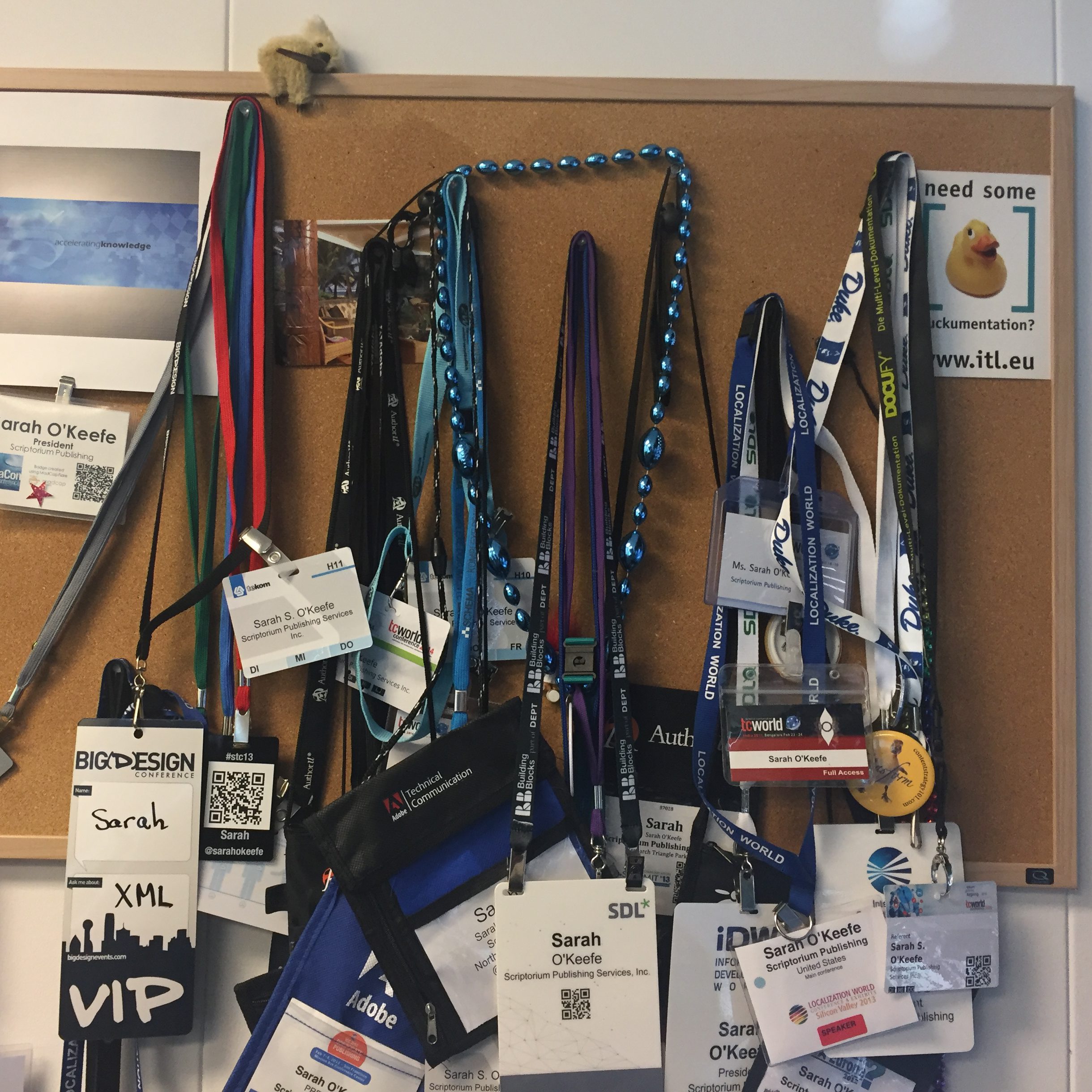
I’ve lost count of the number of conferences I’ve attended. I average five or so per year, so over 20 years, that’s at least 100 events. Here are some things I’ve learned about successful conference attendance.
Back in 2013, I used the phrase content velocity in several posts. These posts also had a certain doomsday theme, as I compared the rise of digital workflows in publishing to the comet that wiped out the dinosaurs.
Two weeks ago, The LavaCon Conference made its return to Dublin, Ireland. Before I dive in, thanks to Jack Molisani for yet another fun and insightful LavaCon conference!
You. You over there with the finicky formatting and the inability to use templates and the hours of adjusting graphics when you add a paragraph.
Yes. You.
Positive, optimistic, energetic. Once again, the tcworld India conference in Bangalore did not disappoint.
This post is part of Scriptorium’s 20th anniversary celebration.
I’m finding it surprisingly difficult to write a recap of Scriptorium from 1997 to today. It feels as though the company has been around forever, but also as though 20 years went by in a flash.
My 2017 trend is the impact of machine translation on content strategy.
Mergers and acquisitions often result in a new content strategy. In a typical scenario, the merged company needs to align disparate content organizations. Before the merger, the companies had different tools, technologies, workflows, deliverables, and content culture. A goal of the merger is to unify company products, and therefore, the merged organization must also unify content development.
Even if you aren’t twitchily checking your phone and resisting the urge to run outside to catch a Pikachu or Gyrados, you’ve probably heard all about the phenomenon of Pokémon GO. One of the most common criticisms of the game is that the in-app documentation is sparse at best. In response, the community banded together and began to document their theories and findings. You can readily find articles covering “eeveelutions,” theories on how to more easily capture Pokémon, and how to capture opposing gyms. It hearkens back to a time of meeting up in schoolyards to swap tips and rumors.
The tcworld China event took place in Shanghai April 18 and 19. I was there to present on content strategy and advanced DITA (yes, I hear your gasp of surprise), but for me, the most interesting part of the trip was getting a chance to connect with the technical communication community in China.