
LavaCon Dublin 2017: spanning silos, building bridges
Two weeks ago, The LavaCon Conference made its return to Dublin, Ireland. Before I dive in, thanks to Jack Molisani for yet another fun and insightful LavaCon conference!

Two weeks ago, The LavaCon Conference made its return to Dublin, Ireland. Before I dive in, thanks to Jack Molisani for yet another fun and insightful LavaCon conference!

You. You over there with the finicky formatting and the inability to use templates and the hours of adjusting graphics when you add a paragraph.
Yes. You.
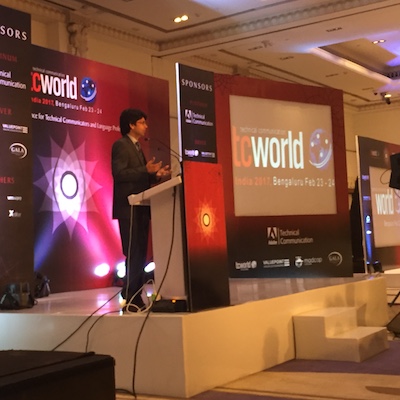
Positive, optimistic, energetic. Once again, the tcworld India conference in Bangalore did not disappoint.
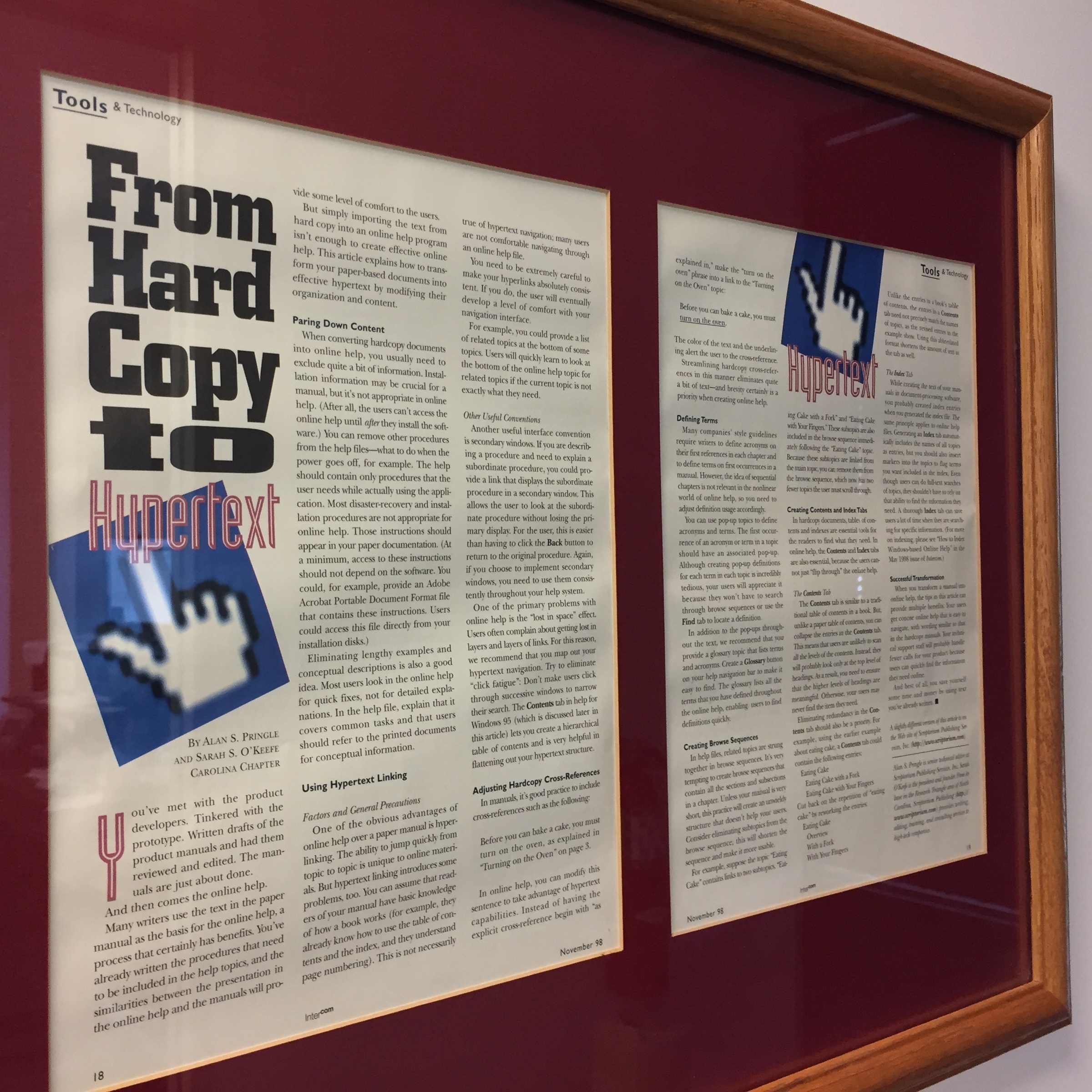
This post is part of Scriptorium’s 20th anniversary celebration.
I’m finding it surprisingly difficult to write a recap of Scriptorium from 1997 to today. It feels as though the company has been around forever, but also as though 20 years went by in a flash.

My 2017 trend is the impact of machine translation on content strategy.

Mergers and acquisitions often result in a new content strategy. In a typical scenario, the merged company needs to align disparate content organizations. Before the merger, the companies had different tools, technologies, workflows, deliverables, and content culture. A goal of the merger is to unify company products, and therefore, the merged organization must also unify content development.


Yes, I’m playing.
Even if you aren’t twitchily checking your phone and resisting the urge to run outside to catch a Pikachu or Gyrados, you’ve probably heard all about the phenomenon of Pokémon GO. One of the most common criticisms of the game is that the in-app documentation is sparse at best. In response, the community banded together and began to document their theories and findings. You can readily find articles covering “eeveelutions,” theories on how to more easily capture Pokémon, and how to capture opposing gyms. It hearkens back to a time of meeting up in schoolyards to swap tips and rumors.

The tcworld China event took place in Shanghai April 18 and 19. I was there to present on content strategy and advanced DITA (yes, I hear your gasp of surprise), but for me, the most interesting part of the trip was getting a chance to connect with the technical communication community in China.

Do you need a content strategy consultant? If the following signs are uncomfortably familiar to you, the answer is yes:

In this webcast recording, Scriptorium’s Alan Pringle, Bill Swallow, and Gretyl Kinsey look at 2016 trends in content and content strategy. Sarah O’Keefe moderates.

Let’s wrap up 2015 with a look back at popular posts from the year.
Scriptorium wishes you the best for 2016!
This year’s tekom/tcworld conference reinforced the ongoing doctrinal chasm between North American technical communication and German technical communication.
I am speaking, of course, of the proper role of DITA in technical communication. If any.

Content strategy implementations require substantial planning, coordination, and hard work. The effort involved in keeping planned work moving along can be difficult. Scope creep–discovering new requirements along the way–can potentially derail your entire effort if you’re not careful.
We’re about to begin the last quarter of 2015, and that means CONFERENCES. Scriptorium is attending many tech comm and content strategy events.
Will we see you at these conferences?
Design and automation are often positioned as mutually exclusive–you have to choose one or the other. But in fact, it’s possible to deliver content in an automated workflow that uses a stellar design. To succeed, you need a designer who can work with styles, templates, and other building blocks instead of ad hoc formatting.
More content across more devices requires scalability–and that means more automation. A strategic approach to content needs to incorporate both design and automation as constraints and find the right balance between the two.

This post is a recap of the presentation I delivered at Localization World Berlin on June 4, 2015. It describes how and why to adapt a content strategy in support of The Internet of Things. The presentation slides are available on SlideShare.
What is the content strategy of things? To simplify definitions, content strategy is the planning for and governance of the content lifecycle, and the Internet of Things is the connecting of devices and software to provide greater value. To adapt content strategy to the Internet of Things, the content strategy of things can be defined as the planning for and governance of connected content to provide greater value.
It’s a new year, which means it’s time for Scriptorium to discuss—and wildly speculate about—the latest trends in content. Here’s what Bill Swallow, Gretyl Kinsey, and I had to say about 2015 content trends.
We have a full schedule of stellar conferences coming up this fall. We hope to see you at one or more of these events.
Are you thinking about engaging a content strategy consultant? Here are some thoughts on successful content strategy consulting relationships.
In this webcast recording, Sarah O’Keefe discusses how content initiatives are putting new demands on technical communication—improving customer experience, building interactive documents, including advanced visualizations, integrated translations, and more.
Some thoughts after a trip to Bangalore for the tcworld India event.
Some thoughts after a trip to Bangalore for the tcworld India event.
Our annual prognostication, along with an assessment of our predictions from last year.