Perplexed by complex syntax: understanding syntax diagrams in DITA
What DITA elements are available for syntax diagrams? And how does one go about using them?

What DITA elements are available for syntax diagrams? And how does one go about using them?
After a number of years using PowerPoint and OpenOffice/LibreOffice Impress to create slide decks, I’ve grown frustrated with the enforced separation of information in PowerPoint-like products.
A few weeks ago, I described some of the issues we faced in producing a PDF of Content Strategy 101 from DITA sources. Time and space didn’t permit me to finish the list of changes out. Now I can.
In which we uncover some unpleasant realities about distributing ebook editions.
In which we jump through flaming hoops for EPUB and Kindle.
In which we bend PDF publishing to our will. Eventually.
In this webcast recording, guests Alyssa Fox (NetIQ) and Toni Mantych (ADP) discuss their differing DITA implementation decisions.
In which we are boxed in by the limitations of DITA indexing support.
In which we build assorted graphics and develop style guidelines.
In which we develop narrative content in a modular architecture.
In this webcast recording, Sarah O’Keefe gives an overview of DITA, one of the major structured authoring standards in tech comm. You’ll also learn about DITA concepts, the business case for DITA, and typical scenarios where DITA is used.
The problem: DITA does not provide a default mechanism for encoding context-sensitive help information. This article discusses a new approach that avoids specialization and provides a maintainable approach for context-sensitive help mapping.
The mantra of XML is that you separate content from formatting. Authors do content; formatting happens later. During a panel discussion at last week’s (excellent) UA Europe conference, I realized that this is only half the story.
In this webcast recording, George Bina shows you how to create DITA content from zero to a full deliverable using oXygen. The full deliverable leads to multiple publishing formats.
Simon Bate provides a planning framework for implementing an XML-based structured authoring environment.
Paul Wlodarczyk shows how cloud-based tools like easyDITA can change the way you approach collaboration, and in turn speed your time to publish and simplify your work process.
Need some basic metrics on your DITA files? Wondering whether your topics are the right length or not? Check out this new feature in oXygen version 13.
“What a curious feeling!” said Alice; “I must be shutting up like a telescope.”
And so it was indeed: she was now only ten inches high, and her face brightened up at the thought that she was now the right size for going though the little door into that lovely garden.
Lewis Carroll in Alice’s Adventures in Wonderland
Simple answers are appealing and are easy to remember. [Refrain from gratuitous political joke here, mostly.] But the real world is full of complex issues that are not easily reduced to soundbites. This also applies to technical communication and XML adoption.
The slides from my tekom/tcworld session on the economics of information are below.
A wise man once told me that the goal of marketing is to frame the question so that what you are selling is the best possible answer. In the world of tech comm publishing, the default question has been: “What tool should I use?”
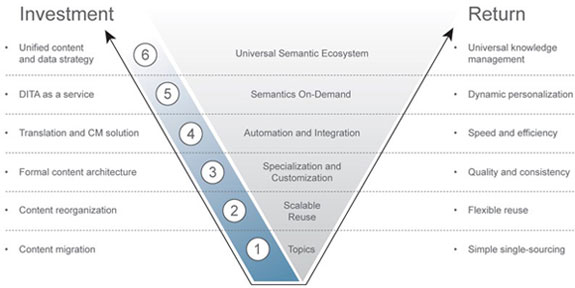
The initial wave of DITA implementations is still building, but we are already seeing the early adopters move on to what I am calling DITA, The Sequel.
I’m having some trouble with the idea of “extending DITA” outside the world of technical communication. DITA is obviously important in the right environment, but should we be advocating the use of DITA for more and more content?