Structured content

Brand credibility Business case/ROI Structured content

Why having an enterprise content strategy is important to your UX

Implementing a content strategy in a single department is a great way to get your feet wet, but doesn’t mean you solve all of your content problems. All customer-facing content needs to be findable and usable. Your clients and prospects expect a seamless user experience across all of your content. If you aren’t delivering on that expectation, it may be time to implement an enterprise content strategy by expanding your current content strategy across your entire organization.

Read More
Brand credibility Structured content

Enterprise content strategy maturity model

“Whether you like it or not, your prospects already use technical content.” 

In the paper age, it cost money to distribute information. That gave big organizations some control over information flow. A prospect interested in purchasing a product would get “pre-sales” information–marketing materials, sales pitches, and perhaps a data sheet. Only after buying the product could the prospect access “post-sales” information, such as technical content. (Buyers could and did request technical information from their sales representative, but the decision whether or not to provide the information rested with the organization.)

But in the digital age, information distribution is free, and that makes it difficult or impossible to control what information people receive. As a result, the distinction between pre-sales and post-sales content is blurring. If you are in the market for a new desk, and you’re considering “some assembly required” options, you might take a look at the assembly guide. If the build process looks daunting, a not-so-handy person may look elsewhere. If you’re considering a piece of software, you might glance at the user documentation to see whether tasks are explained clearly at a level that makes sense to you. 

Read More
DITA Migration

DITA migration strategies

Migrating to DITA means more than just adding element tags. There are a few common holes in migration strategies that can prevent you from reaping all of the benefits of the converted DITA content. To avoid that mistake, make sure you have a plan in place for:

  • Identifying and migrating reused content
  • Managing links
  • Processing images

These should be important factors when migrating your content to DITA, and they will require new workflows and changes in the way you handle the relationships in your content.

Read More
Structured content

The challenge of digital transformation

Digital transformation touches on every aspect of business operations. At Scriptorium, our focus is on high-value content, so our definition of digital transformation is also content-centric:

“Digital transformation is the use of technology to enrich information delivery.”

“Enriched” information is usually divided into two major categories:

  • Content delivery
  • Context

Read More
Brand credibility Business case/ROI Content pitfalls Content silos Structured content

Smarter marcom content

Smarter marcom content has advantages, but marketers are used to writing and formatting content at the same time. Smart content separates writing and formatting. Although getting used to this separation may take some effort, the benefits are well worth it.

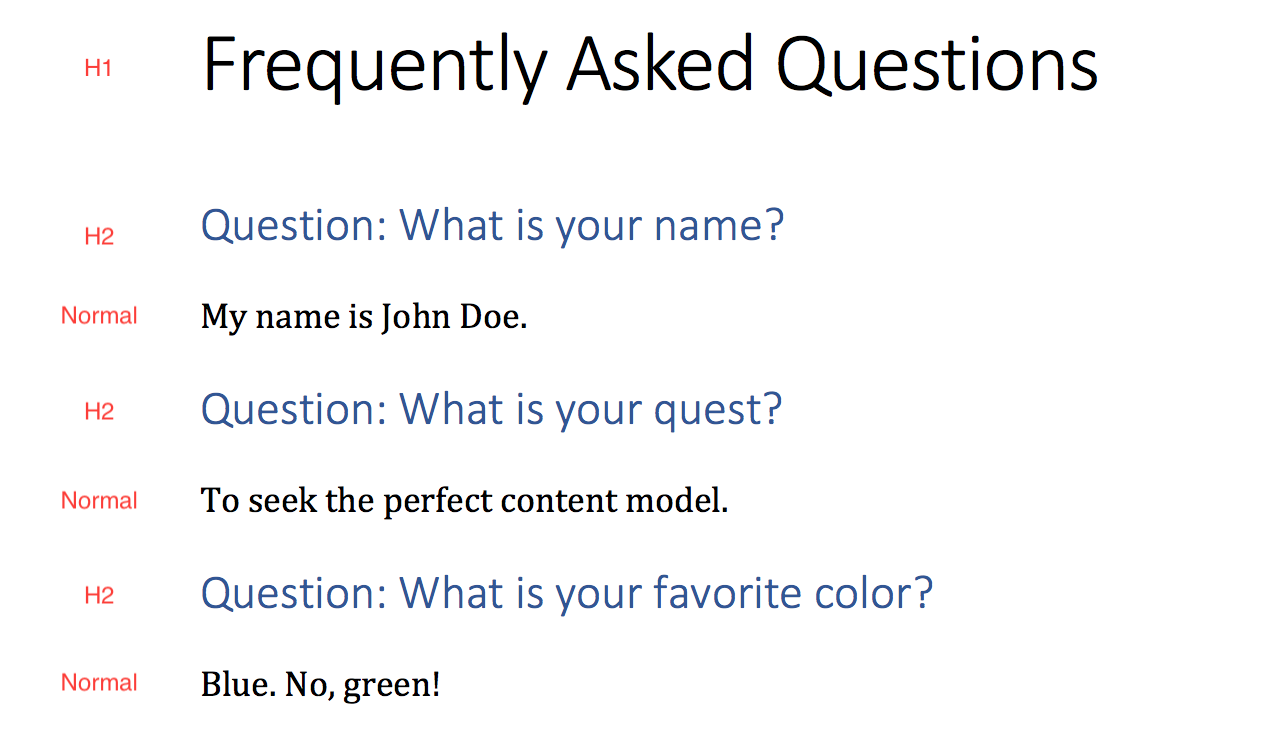
Most content has an implicit structure. For example, a white paper usually starts by stating a problem, then describes a possible solution, and then mentions a product that can help you with that approach.  A good marketing writer understands the implicit structure of a typical document, but the structure may not be clearly stated or outlined anywhere. With smart content, you take a document’s implicit structure and spell it out explicitly.

The tags in smart content capture the structure explicitly. Once you have your tagged document, you can process the information in lots of interesting ways (reuse, multichannel publishing, and much more). 

Smart content separates formatting and content.  In tools like InDesign or Word, you write and format  at the same time. In a smart content tool, you typically focus only on the content sequence and not on the formatting. As a marketing writer, I can tell you this is a big adjustment.  But there are huge benefits. Once you create smart content, the separation of content and formatting makes it much easier for you and others to reuse content. Reuse improves the consistency of your messaging across the company. Smart marcom content also allows you to spend more time creating the text, videos, and other promotional content rather than spending time focusing on the organizational structure.  

As you get started, there will be a learning curve. Having smart, structured marcom content can save your business time and money. Benefits such as simplifying rebranding, search engine optimization, time, and reuse make the switch worth it. 

 

Read More
Business case/ROI Structured content

ROI for content strategy: getting around roadblocks

When you want to put new content development processes in place, proving the return on investment (ROI) of your strategy is one of the most effective ways to get buy-in from managers or executives. 

You can calculate ROI by showing how much money you’re currently spending creating content, and comparing it to how much money you will save over time with a more efficient workflow. But what if there are roadblocks preventing you from gathering the metrics you need to get those numbers?

Read More
Change management Podcasts Structured content

Full transcript of Content strategy stakeholders podcast

Alan Pringle:      Welcome to the Content Strategy Experts Podcast, brought to you by Scriptorium. Since 1997, Scriptorium has helped companies manage, structure, organize, and distribute content in an efficient way. In episode 41 we discuss the stakeholders for content strategy projects. Who are the stakeholders? Why and how should you talk to them?

Read More
Structured content

Agile content strategy

In an agile environment, a company develops its products in continuous iterations with incremental deliveries called sprints. This approach allows the company to test the success of each small change to the product and adapt the development process accordingly. So what does that mean for content?

Read More
Podcasts Structured content

Full transcript of Potluck strategy podcast

Sarah O’Keefe: Welcome to the Content Strategy Experts podcast, brought to you by Scriptorium. Since 1997, Scriptorium has helped companies manage, structure, organize, and distribute content in an efficient way.

Sarah O’Keefe: Hi, everyone. I’m Sarah O’Keefe. For episode 40, we’re thinking about food. Although, I should clarify that we think about food a lot here at Scriptorium. It’s an important part of our daily life and our holiday potluck is an opportunity to show off our culinary skills in cooking and, I think, most especially eating. So it occurred to me that a great potluck has a lot in common with content strategy, and in this episode, we’re going to talk about our favorite topic, food, and how we can apply a potluck planning, which is hard to say, to content strategy.

Read More
Podcasts Structured content

Full transcript of Content strategy step one podcast

Kaitlyn Heath:   Welcome to the Content Strategy Experts podcast, brought to you by Scriptorium. Since 1997, Scriptorium has helped companies manage, structure, organize, and distribute content in an efficient way. In episode 38, we focus on the beginning stages of adapting your content strategy. What are the first steps in analyzing the current methods, what are the primary issues, and what improvements need to be made?

Read More
Change management Structured content

Full transcript of Content strategy pitfalls podcast: migration

Bill Swallow:       Welcome to the Content Strategy Experts podcast, brought to you by Scriptorium. Since 1997, Scriptorium has helped companies manage, structure, organize and distribute content in an efficient way. In episode 33, we continue our occasional series on content strategy pitfalls. Our focus today is content migration. What are some common pitfalls you may encounter during content migration and how might the intrepid content strategists avoid or handle them?

Read More
Change management Structured content

Full transcript of Content strategy pitfalls podcast: risk management

Gretyl Kinsey:    Welcome to the Content Strategy Experts podcast brought to you by Scriptorium. Since 1997 Scriptorium has helped companies manage, structure, organize, and distribute content in an efficient way. In episode 32 we discuss risk management as part of our occasional series on content strategy pitfalls. What are the risks involved when putting a new content strategy in place, and what can you do to minimize them?

Read More
Change management Content pitfalls Structured content

Full transcript of Content strategy pitfalls podcast: change management

Gretyl Kinsey: Welcome to the Content Strategy Experts podcast, brought to you by Scriptorium. Since 1997, Scriptorium has helped companies manage, structure, organize and distribute content in an efficient way. In Episode 29, we continue our occasional series on content strategy pitfalls. Our focus today is change management. What are some common change management pitfalls and how might the intrepid content strategist avoid or handle them?

Read More