
Competition against structured content
Companies want to hear that AI will automate all the things and therefore, it’s going to be So Easy. But unfortunately, we have the Iron Law of Life:
YOLO = GIGO

Companies want to hear that AI will automate all the things and therefore, it’s going to be So Easy. But unfortunately, we have the Iron Law of Life:
YOLO = GIGO

Communicating the value of content operations can be complicated. We created an ROI calculator to help.
In episode 162 of The Content Strategy Experts Podcast, Bill Swallow and Christine Cuellar discuss the benefits of single sourcing as part of your content strategy through the example of two things they love: coffee and beer.
“We know companies that have moved away from a do-it-yourself approach because they had maybe two or three different people putting in half to almost full-time work on the publishing system and not on other facets of the company’s core business or the writing. They were simply there to keep everything working. It just blows my mind that on a scale where you have hundreds of writers contributing content, you are saying, Okay, you three people are going to be solely responsible for keeping this thing up and running so that they can produce their content, rather than having a system that’s designed to keep itself up and running.”
— Bill Swallow
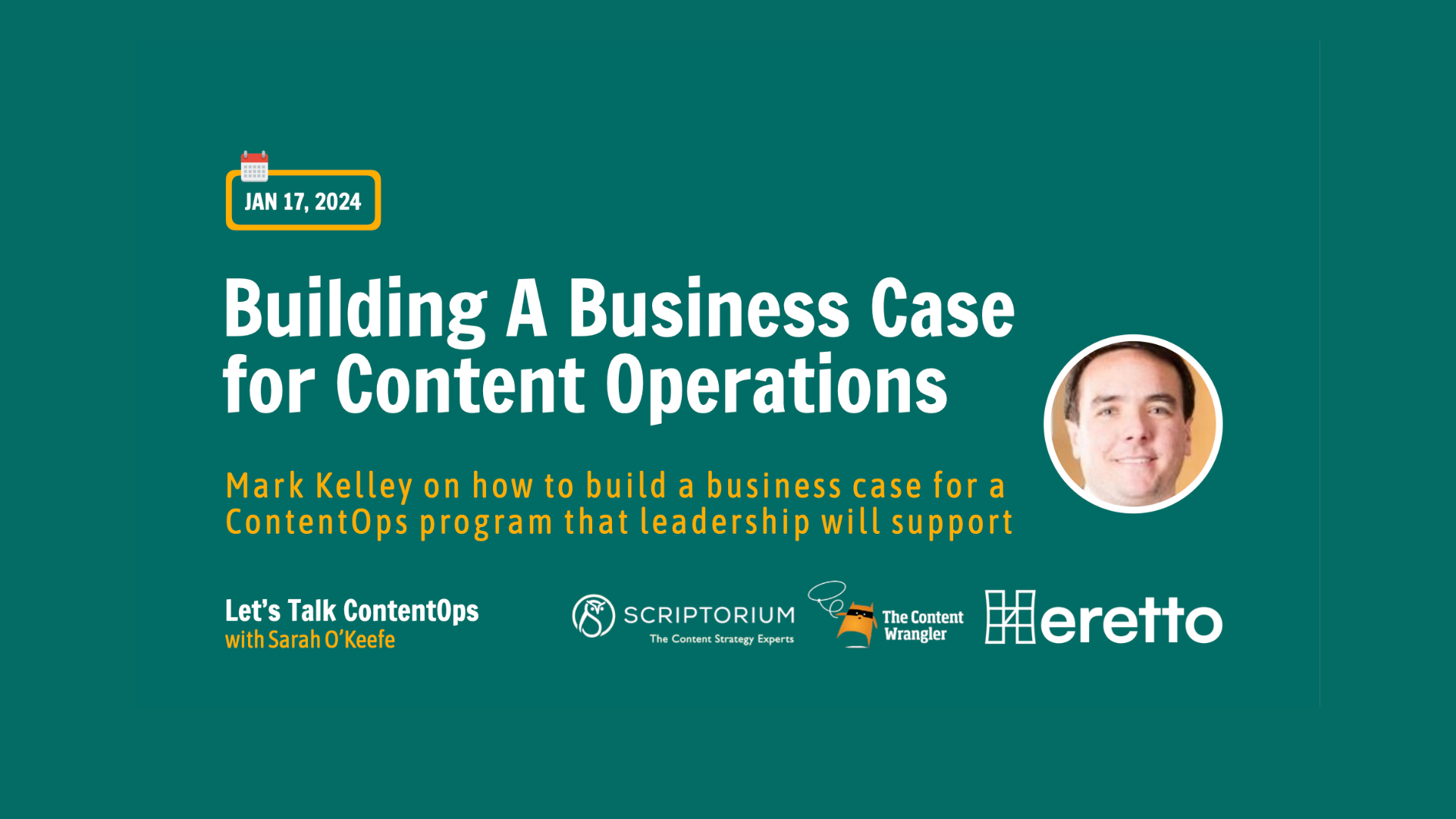
Organizations are recognizing the need for a strategic approach to content creation, management, and distribution, but content operations require upfront and continued investment. In this episode of our Let’s Talk ContentOps! webinar series, Sarah O’Keefe and special guest Mark Kelley discuss how to build the business case for content operations.
In this webinar, you’ll learn

What if your training content could be seamlessly tailored to a learner’s environment no matter where or how they interact with it?

This content was first published in Content Operations from Start to Scale: Perspectives from Industry Experts, Dr. Carlos Evia, editor; Virginia Tech Publishing.
We have an ingrained mental model of writers as introverted hermits, toiling away in solitude. Eventually, they produce manuscripts, which are fed into a publishing pipeline for editing and production. This model might hold for some fiction writers, but content production looks very different for marketing and technical efforts.
In episode 159 of The Content Strategy Experts Podcast, Bill Swallow and special guest Dipo Ajose-Coker share tips for moving from unstructured to structured content.
“I mentioned it before: invest in training. It’s very important that your team knows first of all not just the tool, but also the concepts behind the tool. The concept of structured content creation, leaving ownership behind, and all of those things that we’ve referred to earlier on. You’ve got to invest in that kind of training. It’s not just a one-off, you want to keep it going. Let them attend conferences or webinars, and things like that, because those are all instructive, and those are all things that will give good practice.”
— Dipo Ajose-Coker
In episode 158 of The Content Strategy Experts Podcast, Bill Swallow and special guest Dipo Ajose-Coker discuss the challenges of moving from unstructured to structured content.
“I think we could make broad categories of challenges as tools, technology, people, and methodologies, and I think we’ll just dive into these because they’re not necessarily independent—some of them flow one into the other. One of the most complex and challenging parts is implementation. Changing over to a new tool also involves changing processes and training the staff. Basically, some documentation teams struggle with that initial learning curve.”
— Dipo Ajose-Coker

Scriptorium principals Sarah O’Keefe, Alan Pringle, and Bill Swallow have decades of experience in the content industry. In this webinar, they share their analysis of key content operations trends.
After watching, you’ll learn
In episode 157 of The Content Strategy Experts Podcast, Sarah O’Keefe and special guest Dee Lanier discuss design thinking: what it is, what it isn’t, and obstacles and ideas for equity in design.
“Design thinking is not a model first. It is a mindset that incorporates a strong inquisitiveness. What’s happening here? Who are the people that are being affected by whatever problems that are happening here? And what don’t I know that I need to learn before proposing any solutions? That’s design thinking in a larger understanding.”
— Dee Lanier
In episode 156 of The Content Strategy Experts Podcast, Alan Pringle and Christine Cuellar are back discussing more pain points that Scriptorium has resolved. Discover the impact of office politics on content operations, what to do when your non-technical team is moving to structured content, and more.
“Here’s the thing. Skepticism is healthy. If people are trying to poke holes in this new process, sometimes they can actually uncover things that are not being addressed. That is real, that is useful. So don’t confuse that with people who were being a-holes and just being contrary for the sake of being contrary. Those are two different things, and you’ve got to be sure you understand those two things.”
— Alan Pringle
In episode 153 of The Content Strategy Experts Podcast, Sarah O’Keefe and special guest Dr. Carlos Evia of Virginia Tech discuss the upcoming book ContentOps Edited Collection: Content operations from start to scale. This is a free collection of insights from leading industry experts that will be available in October of 2023.
“This is going to be a free book. We are not going to become rich and famous with this book because we decided that we wanted to make the content in the book accessible for everybody who is interested in learning about content operations. It’s going to be published as an open-access book by Virginia Tech Publishing.”
— Dr. Carlos Evia
In episode 151 of The Content Strategy Experts Podcast, Bill Swallow and podcast guest, Jack Molisani discuss how content careers have changed through the pandemic, layoffs, quiet quitting, and AI, and what you should do to stay ahead of the curve.
“Rather than applying for a job […] you want companies to come to you and say, ‘Hey, will you come work for us?’ The only way they’re going to do that is if you write articles, if you’re speaking at conferences, and if you position yourself as an expert in your field.”
— Jack Molisani
In episode 150 of The Content Strategy Experts Podcast, Alan Pringle and special guest, Patrick Bosek of Heretto talk about choosing a content model, factors to consider, and when you should think about customization.
“There’s a valid use case for almost every approach that’s out there. There’s no way around that. I think what it really starts to come down to is making sure that you’re matching the 18+ months [ahead] to the decision you’re making now.”
— Patrick Bosek

Life during a merger or acquisition gets interesting. Reporting structures change, systems need to align, new technology must be implemented — and that’s just logistics.
How people cope with these big changes will vary, and reactions can be subtle, extreme, positive, or negative. In most cases, you’ll experience a hearty mix of everything.

When system maintenance is removed from your content experts’ workload, your team becomes a powerhouse for producing dynamic content.

In episode 147 of The Content Strategy Experts Podcast, Alan Pringle and Christine Cuellar continue talking about how teams adjust when content processes change, and tools you can use to navigate the question, “Why do I have to work differently?”
This is part two of a two-part podcast.
“We had a client a few years ago refer to us as content therapists, and that’s not far off. […] We provide a sounding board. We’re a sympathetic ear. We help give you the opportunity to bounce off concerns, problems, issues, and offer feedback. It’s a relationship where we are going to listen and give guidance, because again, we’ve been through this before with other people. Let’s apply that knowledge and make your life as easy as possible during, frankly, what can be a very tumultuous time.”
— Alan Pringle

In episode 146 of The Content Strategy Experts Podcast, Alan Pringle and Christine Cuellar talk about how teams adjust when content processes change, and how you can address the question, “Why do I have to work differently?”
This is part one of a two-part podcast.
“One of these kinds of business drivers can be a merger or an acquisition. When you end up combining two companies, you can have two separate workflows. Both of them are not going to win — they’re just not. […] But again, I mean, I have a lot of sympathy for these people. A lot of times they are asking this for legitimate reasons. ‘Why is this happening?’ ‘Why am I having to do this?’ That’s when you’ve got to help them step back and look at the bigger business situation.”
— Alan Pringle

In episode 136 of The Content Strategy Experts Podcast, Alan Pringle unveils horror stories of content ops gone horribly wrong.


In episode 134 of The Content Strategy Experts Podcast, Sarah O’Keefe and guest Jodi Shimp talk about the role of content strategy in UX teams.

We had an amazing lineup of guests and topics on our podcast in 2022. Here are some short highlights to help you figure out which episodes you might want to catch up on (the links take you to the individual episodes, where you will find the transcript and a link to the audio file).

How on earth is it already December?
My brain is unable to process how fast this year has gone by—yet we have a whole year’s worth of content on our blog for 2022. Here’s a roundup of posts and podcasts on content strategy and content operations.