AI, replatforming, and penguins?
The tcworld/tekom conference took place in Stuttgart, Germany, from November 5–7. The event is the largest technical communication conference in the world, typically with 2,500–3,500 attendees.
LavaCon 2024 delivered actionable insights, emphasizing that your business case for content operations requires strong alignment with business goals. Successful content modernization hinges on executive support, effective change management, and a wary eye on AI.
You’re probably tired of reading my articles about the business case for content ops. Here’s a more personal perspective as you consider a content ops initiative.
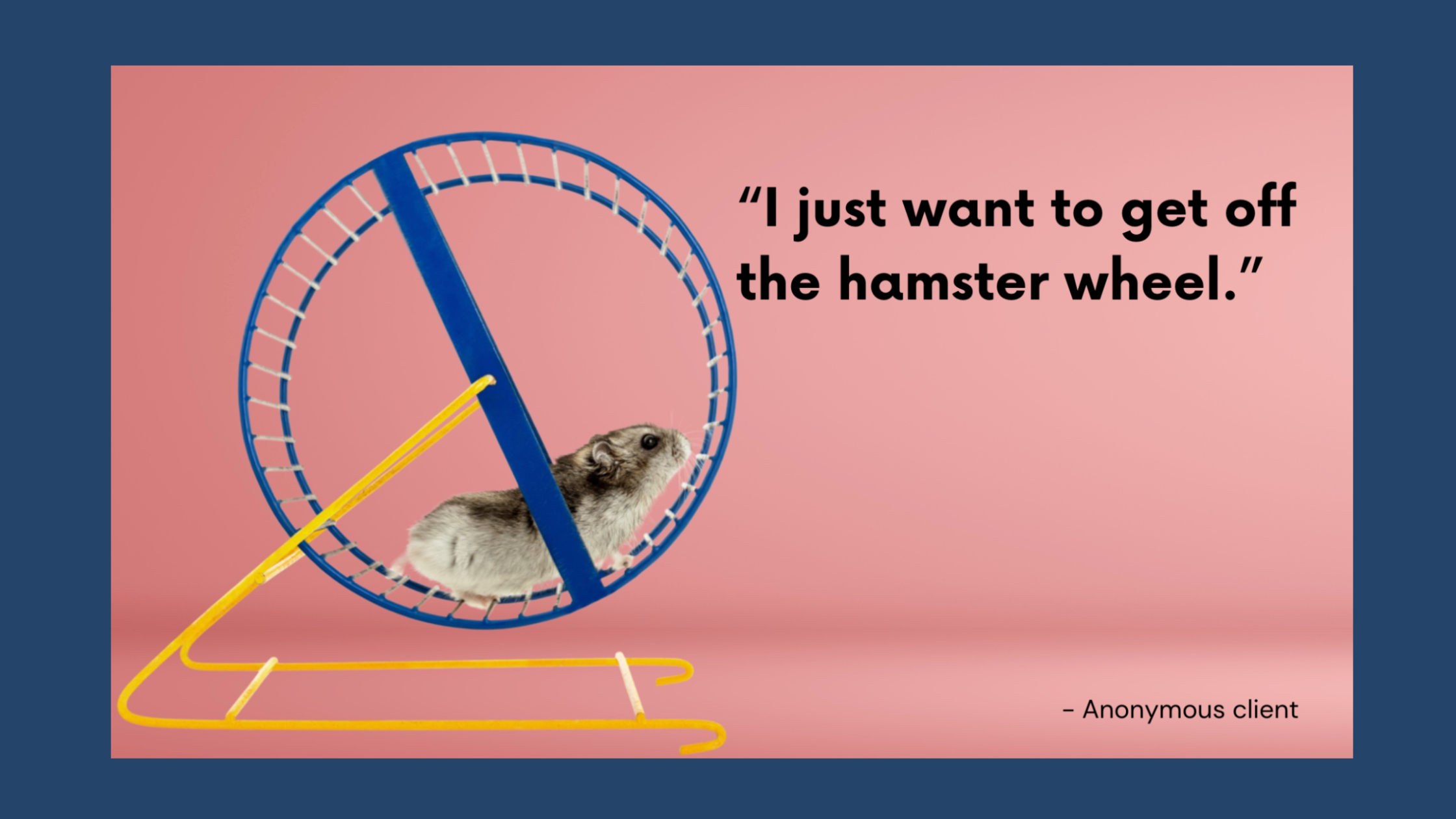
“I just want to get off the hamster wheel.”
— Anonymous client
One of our clients (you know who you are, hi!) said this in a meeting a few years ago.
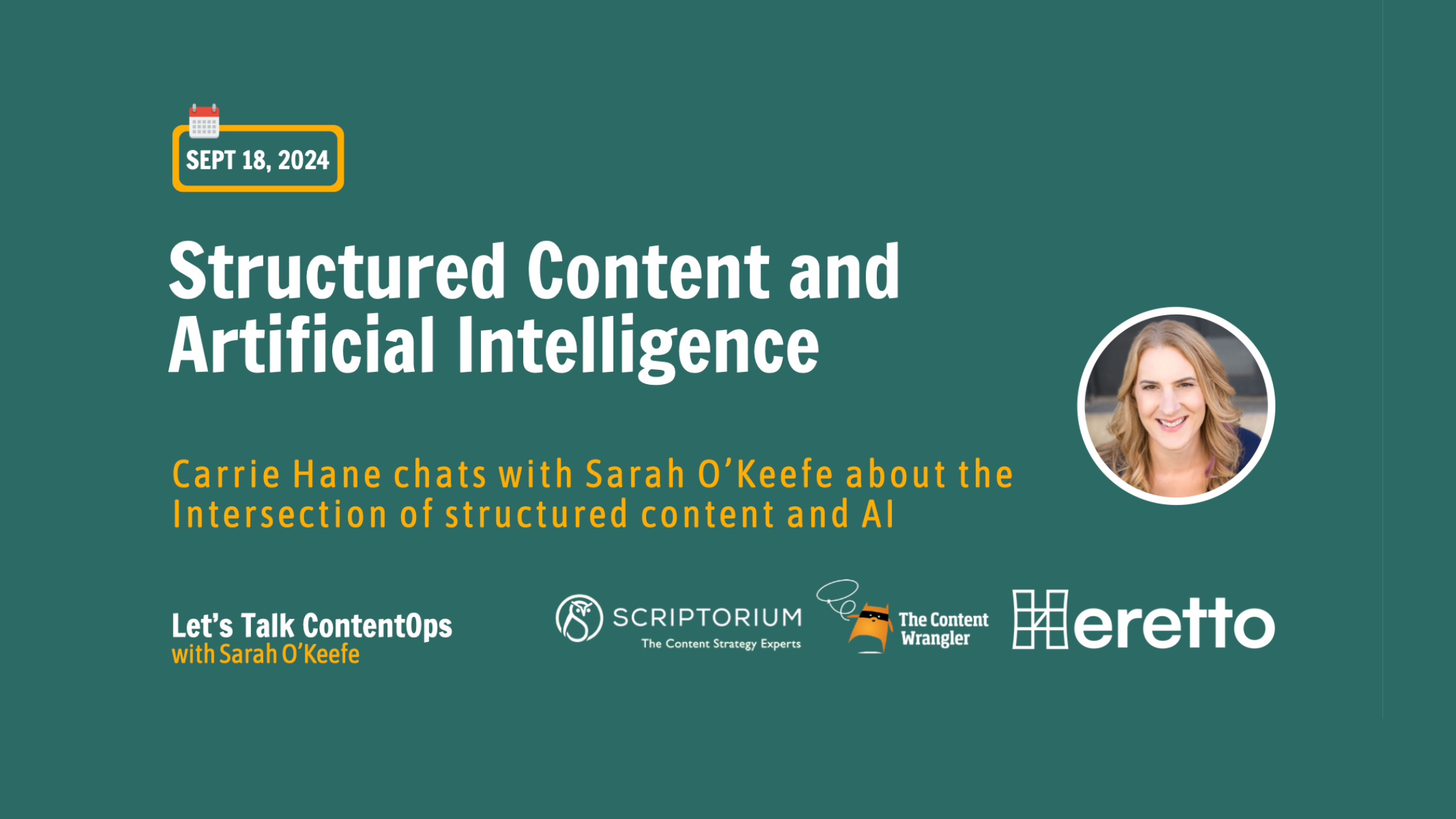
In this episode of our Let’s Talk ContentOps! webinar series, industry experts Sarah O’Keefe and Carrie Hane explore the intersection of structured content and artificial intelligence. Discover how structured content improves the reliability and performance of AI systems by increasing accuracy, reducing hallucinations, and supporting efficient content management.
In this webinar, attendees will learn:
Whether you’re surviving a content operations project or a journey through treacherous caverns, it’s crucial to plan your way out before you begin. In episode 176 of the Content Strategy Experts podcast, Alan Pringle and Christine Cuellar unpack the parallels between navigating horror-filled caves and building a content ops exit strategy.
Alan Pringle: When you’re choosing tools, if you end up something that is super proprietary, has its own file formats, and so on, that means it’s probably gonna be harder to extract your content from that system. A good example of this is those of you with Samsung Android phones. You have got this proprietary layer where it may even insert things into your source code that is very particular to that product line. So look at how proprietary your tool or toolchain is and how hard it’s going to be to export. That should be an early question you ask during even the RFP process. How do people get out of your system? I realize that sounds absolutely bat-you-know-what to be telling people to be thinking about something like that when you’re just getting rolling–
Christine Cuellar: Appropriate for a cave analogy, right?
Alan Pringle: Yes, true. But you should be, you absolutely should be.
Are you looking for real-world examples of enterprise content operations in action? Join Sarah O’Keefe and special guest Adam Newton, Senior Director of Globalization, Product Documentation, & Business Process Automation at NetApp for episode 175 of The Content Strategy Experts podcast. Hear insights from NetApp’s journey to enterprise-level publishing, lessons learned from leading-edge GenAI tool development, and more.
We have writers in our authoring environment who are not writers by nature or bias. They’re subject matter experts. And they’re in our system and generating content. That was about joining us in our environment, reap the benefits of multi-language output, reap the benefits of fast updates, reap the benefits of being able to deliver a web-like experience as opposed to a PDF. But what I think we’ve found now is that this is a data project. This generative AI assistant has changed my thinking about what my team does. Yes, on one level, we have a team of writers devoted to producing the docs. But in another way, you can look at it and say, well, we’re a data engine.
— Adam Newton
In episode 174 of The Content Strategy Experts podcast, Sarah O’Keefe and Alan Pringle explore the mindset shifts that are needed to elevate your organization’s content operations to the enterprise level.
If you’re in a desktop tool and everything’s working and you’re happy and you’re delivering what you’re supposed to deliver and basically it ain’t broken, then don’t fix it. You are done. What we’re talking about here is, okay, for those of you that are not in a good place, you need to level up. You need to move into structured content. You need to have a content ops organization that’s going to support that. What’s your next step to deliver at the enterprise level?
— Sarah O’Keefe
Translation troubles? This podcast is for you! In episode 173 of The Content Strategy Experts podcast, Bill Swallow and special guest Mike McDermott, Director of Language Services at MadTranslations, share strategies for overcoming common content localization challenges and unlocking new market opportunities.
Mike McDermott: It gets very cumbersome to continually do these manual steps to get to a translation update. Once the authoring is done, ideally you just send it right through translation and the process starts.
Bill Swallow: So from an agile point of view, I am assuming that you’re talking about not necessarily translating an entire publication from page one to page 300, but you’re saying as soon as a particular chunk of content is done and “blessed,” let’s say, by reviewers in the native language, then it can immediately go off to translation even if other portions are still in progress.
Mike McDermott: Exactly. That’s what working in this semantic content and these types of environments will do for a content creator. You don’t need to wait for the final piece of content to be finalized to get things into translation.
It’s hard to believe that the DITA standard needs additional tags. I tried counting them, but gave up at 150, when I had only reached the letter G. (Be my guest: https://www.oxygenxml.com/dita/1.3/specs/langRef/quick-reference/all-elements-a-to-z.html)
When organizations replatform from one content management system to another, unchecked technical debt can weigh down the new system. In contrast, strategic replatforming can be a tool for reducing technical debt. In episode 172 of The Content Strategy Experts podcast, Sarah O’Keefe and Bill Swallow share how to set your replatforming project up for success.
Here’s the real question I think you have to ask before replatforming—is the platform actually the problem? Is it legitimately broken? As Bill said, has it evolved away from the business requirements to a point where it no longer meet your needs? Or there are some other questions to ask, such as, what are your processes around that platform? Do you have weird, annoying, and inefficient processes?
— Sarah O’Keefe
Does any of this sound familiar?
It’s time for a new way of managing content. Here’s how a content strategist can help you create successful content operations.
Technical debt, hereafter called “content debt,” is “the implied cost of future reworking required when choosing an easy but limited solution instead of a better approach that could take more time,” Wikipedia, “Technical debt.”. Like financial debt, content debt isn’t always a bad thing. You can use a loan to buy a house right away (at least in the U.S.) and then pay off the debt over time while living in the house. Content debt allows you to create something quickly instead of doing it exactly right and taking much longer.
Too much content debt, though, will hamstring your work. The trick is to find the Goldilocks solution.
In episode 170 of The Content Strategy Experts podcast, Bill Swallow and Christine Cuellar dive into the world of content localization strategy. Learn about the obstacles organizations face from initial planning to implementation, when and how organizations should consider localization, localization trends, and more.
Localization is generally a key business driver. Are you positioning your products, services, what have you for one market, one language, and that’s all? Are you looking at diversifying that? Are you looking to expand into foreign markets? Are you looking to hit multilingual people in the same market? All of those factors. Ideally as a company, you’re looking at this from the beginning as part of your business strategy.
— Bill Swallow
Marketing professionals have opinions on what defines effective content strategy. But what if these definitions barely scratch the surface? The world of content strategy is much larger than marketing, and organizations can see amazing results when they incorporate an enterprise content strategy.
Is your team skilled in navigating your current CCMS, but unfamiliar with the system you plan to adopt? During a recent replatforming project, we worked with a team of in-house experts to build out a new CCMS. The combination of their domain expertise and our replatforming experience was a big success. The client is now self-sufficient and thriving in their new CCMS environment.
In the wide world of content, we’ve got a lot of terms. Some may be new to you, and others have contested definitions, which makes clear communication—typically our bread and butter—a challenge. If you’re exploring efficiency in your organization’s content processes, this post clarifies the foundational concepts of an enterprise content strategy.
In episode 167 of The Content Strategy Experts Podcast, Sarah O’Keefe, Alan Pringle, and Bill Swallow discuss the difficulties organizations encounter when they try to create a unified content experience for their end users.
AP: Technical content, your tech content or product content, wants to convey knowledge so the user or reader can do whatever thing that they need to do. Learning content is about improving performance. And with your knowledge base content, it’s when, “I need to solve this very specific problem.” So those are the distinctions that I see among those three types.
SO: Okay, and from a customer point of view, what does this mean?
AP: Well, in reality, I don’t think the customers care. They want the information available, and they want it in the formats they want it in. And also, they want the right information so they can either get that thing done, improve their performance, or solve a specific problem.
For your customers to effectively use your products and services, it’s critical that your enabling content is fully integrated across content types.
Bill Swallow, Director of Operations at Scriptorium, and Emilie Herman, Director of Publishing at the Financial Accounting Foundation (FAF), shared lessons learned from a DITA implementation project.
What did we want to accomplish with our project? One was to develop a single source of truth for our content, a single system to host all of it. Secondly, we wanted to modernize our information architecture and our content models and document all of it clearly. Lastly, we wanted to futureproof our content operations and go to a digital-first workflow.
— Emilie Herman
In episode 165 of The Content Strategy Experts Podcast, Sarah O’Keefe and guest Patrick Bosek of Heretto discuss how the role of customer self service is evolving in the age of AI.
I think that this comes back to the same thing that it came back to at every technological shift, which is more about being ready with your content than it is about having your content in the perfect format, system, set of technologies, or whatever it may be. The first thing that I think either of us will say, and a lot of people in the industry will tell you, is that you need to structure your content.
— Patrick Bosek
When a DITA-based workflow is the best choice to support business requirements for your content, you may face the daunting task of convincing leadership to move forward with this enterprise-wide change. Sarah O’Keefe shared practical tips for overcoming common objections to DITA during her session at the AEM Guides user conference.
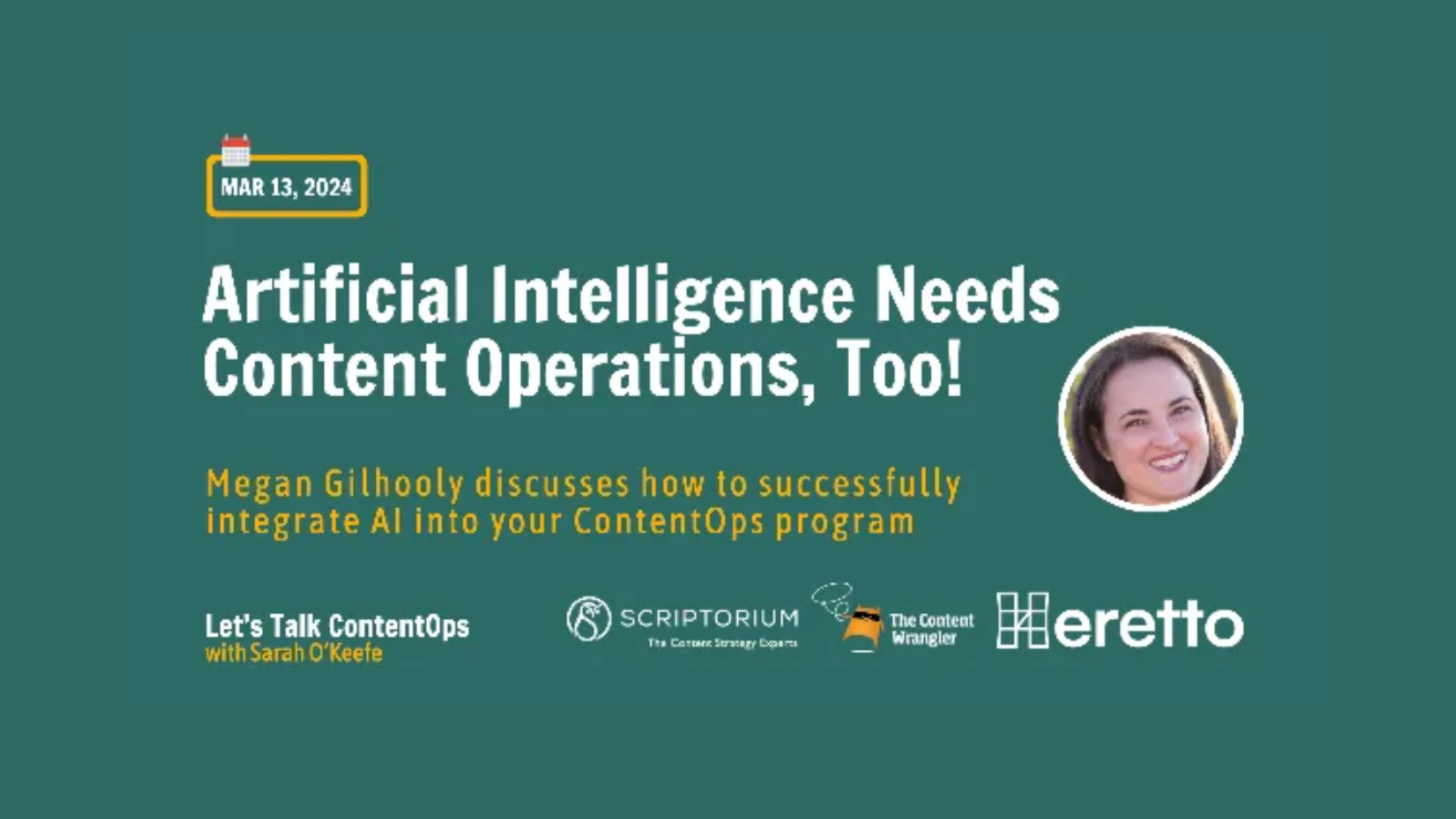
In this episode of our Let’s talk ContentOps! webinar series, Scriptorium CEO Sarah O’Keefe and special guest Megan Gilhooly, Sr. Director Self-Help and Content Strategy at Reltio, explore how to successfully integrate AI into your content operations. They discuss how to use AI as a tool, how to create content that an AI can successfully consume, and how the role of the writer will shift in a GenAI world.
In this webinar, you’ll learn
Companies want to hear that AI will automate all the things and therefore, it’s going to be So Easy. But unfortunately, we have the Iron Law of Life:
YOLO = GIGO
Communicating the value of content operations can be complicated. We created an ROI calculator to help.