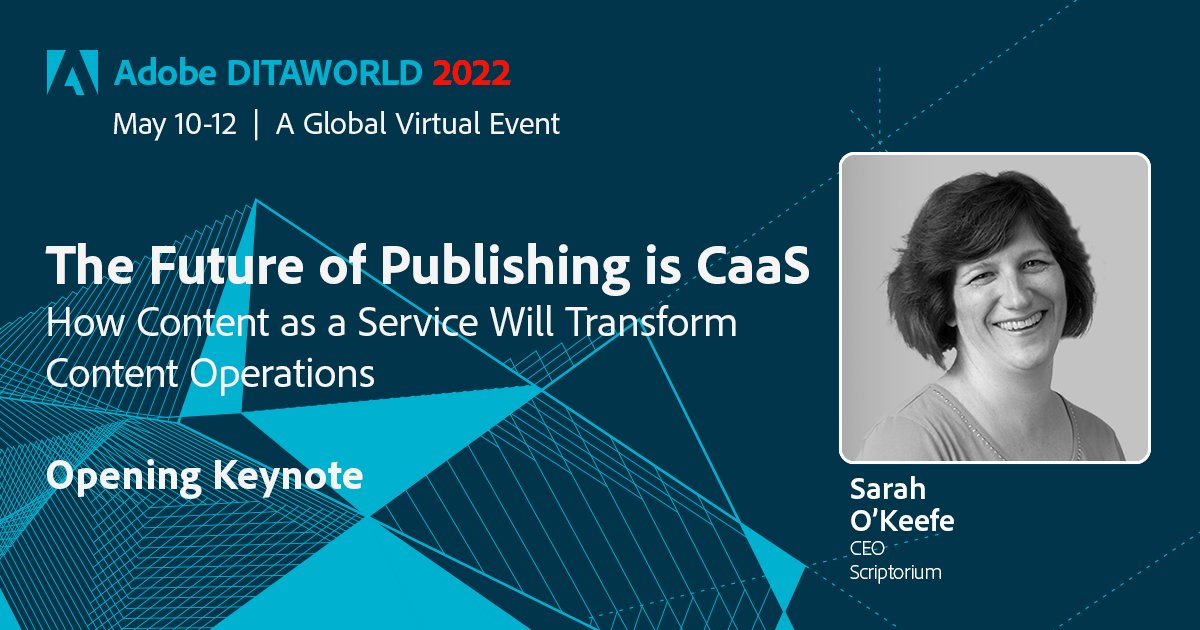
How can CaaS transform your content operations? Find out at DITAWORLD 2022.
A Content as a Service (CaaS) model lets you provide on-demand content that integrates information from various sources to enable richer, customized user experiences.
You’ve finished putting together your content strategy and have approval to move forward. It’s time to build out content operations. What does this mean? And how do you ensure success?
Content as a Service (CaaS) means that you make information available on request. The traditional publishing model is to package and format information into print, PDF, or websites, and make those collections available to the consumer. But with CaaS, consumers decide what information they want and in what format they want it.
Our internal Slack workspace has channels for projects, events, and other work-related items, but of course our most popular channel is #thefoodchannel, where we share recipes, restaurant recommendations, and general foodie discussions.
Content governance is a formal system of checks and balances that regulates your content development. Project success depends on clearly defined roles and responsibilities of everyone involved in the content development process. So how do you get buy-in? And what’s involved in putting a content governance plan together?
Getting started with a content strategy project can be intimidating. There are a lot of unknowns and changes that will take place. How do you ensure the changes you are making address your company’s needs and requirements?
Buyers are looking at your technical content and marketing content prior to the sale. To provide a unified customer experience, you need to integrate the two. Here are some resources to help you get started:
First published in Intercom (October 2020) by the Society for Technical Communication.
Scalable content requires you to assess your content lifecycle, identify points of friction, and remove them.
Company growth magnifies the challenges of information enablement. When you grow, you add products, product variants, markets, and languages—and each of those factors adds complexity. Process inefficiencies in your content lifecycle are multiplied for every new language or customer segment.
As a result, content scalability—increasing content throughput without increasing resources—becomes critical. Consider a simple localization example: when you translate, you have a few manual workarounds that require 1 hour of work per 100 pages of translated content. So if you translate 100 pages of content into 8 languages, you have 8 hours of workarounds. But as your content load grows, you are shipping 1,000 pages of content per month and translating into 20 languages. Suddenly, you are facing 200 hours of manual workarounds per month—the equivalent of one full-time person per year.
Content operations (content ops or ContentOps ) refers to the system your organization uses to develop, deploy, and deliver customer-facing information. Rahel Bailie refers to it as the way that your organization operationalizes your content strategy.
Over at easyDITA, there’s a more aspirational definition, which includes the purpose of good content ops:
Content Operations — ContentOps — is the infrastructure that maximizes your content creators’ efforts and guards against procedural errors by automating as much of the content development process as possible.
You’ve started developing a content strategy and are getting a better grasp on the content lifecycle. But what do you do about older content? It’s not as relevant as your most recent content, but there are still times when it proves useful. Your archiving approach is an important part of your content strategy and is often overlooked.
If you are moving from one content environment to another, you only want to convert what’s necessary. Archiving and organizing your content will help you decide what legacy content you want to convert. Here are some things to keep in mind when putting a plan in place for archiving content.
Good news: The technical problem of integrating marketing and technical content has been solved.
Bad news: The hard work is just starting.
The design-focused marcom perspective and the structure-focused techcomm perspective need to co-exist and co-create.
As 2020 comes to an interesting close, let’s take a look at some of our most popular posts and podcasts from the year.
Are your content development processes manual, inconsistent, or unable to scale up to meet larger demands? If so, you may be ready to look into a smart content solution. Smart content — or content that’s semantically structured, modular, and flexible — can help increase efficiency in content production.
Your digital transformation is underway! You have a plan for new content, new delivery, and new content experiences. But what do you do with all of that existing content? You may have a plan for actively maintained content, but you also have much older legacy content. What does your conversion strategy look like when you have very old documents and must continue to provide them, even if they are not changing?
You’ve deployed a successful content strategy for one department at your organization. How do you know you’re ready to take that strategy to the next level and expand it across the organization? Here are some common indicators that it’s time to develop an enterprise content strategy.
Employees are (and should be) hired for their knowledge and skill, not necessarily their multilingual skills. In a global organization with many offices worldwide, the result is a diverse team with content developers and contributors that speak many different languages. Collaborating on content development—especially on the same document—can be difficult if employees do not speak the same language fluently (or at all).
“When you share content across the company in ways you haven’t before, everyone has to shift to a culture of collaboration.”
Undertaking a project to improve your organization’s content creation process is overwhelming. It is not easy to move into structured content, create a new taxonomy, or develop a new content delivery platform, for example. Here is a list of things to do before you start any content project.
Looking for ways to save your company time and money? Content reuse allows you to write content once and use it again in multiple places. Do these use cases for reuse apply to your content?
Do your customers know the right words to search for? Does marketing refer to your product one way while the tech team refers to it another? Inconsistent word use causes confusion within your company and negatively affects customers’ perception of your brand. So what causes the inconsistencies, and how do you fix them?
Elizabeth Patterson: Welcome to the Content Strategy Experts podcast. Brought to you by Scriptorium. Since 1997 Scriptorium has helped companies manage, structure, organize, and distribute content in an efficient way.
E. Patterson: In episode 51, we talk with vendors at the CMS DITA North America Conference about how they have seen DITA evolve during their time in the industry. This is part two of a two-part podcast.
Elizabeth Patterson: Welcome to the Content Strategy Experts podcast, brought to you by Scriptorium. Since 1997, Scriptorium has helped companies manage, structure, organize, and distribute content in an efficient way. In Episode 50, we talk with attendees at the CMS/DITA North America Conference about how they have used DITA in their career and the challenges they have overcome. This is part one of a two-part podcast.
Bill Swallow: Welcome to the Content Strategy Experts podcast, brought to you by Scriptorium. Since 1997, Scriptorium has helped companies manage, structure, organize and distribute content in an efficient way. In episode 44, we take a look at several definitions of content strategy. Do they work, and are they accurate? Hey everyone, I’m Bill Swallow. I’m here with Sarah O’Keefe.
Gretyl Kinsey: Welcome to the Content Strategy Experts Podcast, brought to you by Scriptorium. Since 1997, Scriptorium has helped companies manage, structure, organize, and distribute content in an efficient way. In episode 43, we talk about how to make sure you’re selecting the right tools for developing and managing content. Hello, and welcome. I am Gretyl Kinsey.